

Educational discussion. Not FUD. DYOR.
Many people think hackers need super-advanced technology like quantum computers to break crypto. But in reality, as of today (November 2026), almost all major attacks still use much simpler methods.
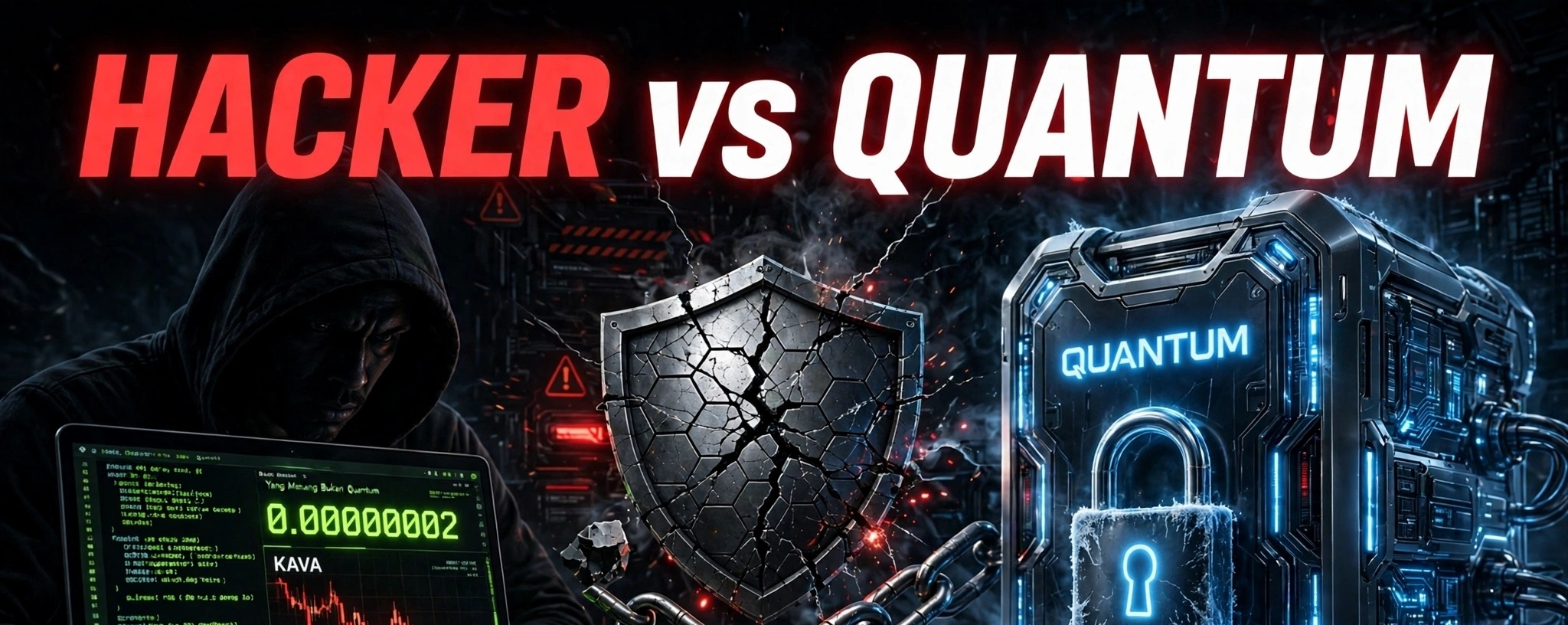
The recent incident on KAVA is proof.
1. Case Study: KAVA Lend, November 14, 2026
Kava Lend, a lending protocol on the Kava chain, lost 55.2 million KAVA (∼$3.76 million).
Not because a hacker stole a private key. Not because they hacked Kava’s server. Not because of quantum computing.
But because he found one line of faulty logic:
The protocol calculates interest by dividing by the BUSD market’s net supply. The code only checks, “if net supply is exactly 0, don’t divide.”
The attacker reduced the net supply to $0.00000002—almost zero, but not quite. The system still performed the division. As a result, the value of the collateral was calculated to be 243,000 times higher in 3 minutes, going from a small amount to what appeared to be 1.25 billion BUSD.
Using that fake collateral, the attacker borrowed KAVA 127 times, draining the pool from 55.33 million KAVA to 0.19 KAVA in 98 minutes, then selling it on BNB Chain.
This wasn’t a quantum attack. It was basic math: divide by a number that’s almost zero.
And this is what many people get wrong: DeFi hackers aren’t codebreakers; they’re code readers.
2. Why Does DeFi Always Have Vulnerabilities?
There are four reasons why DeFi vulnerabilities never go away:
a. Open-Source Code = An Open Book for Hackers
At banks, the code is closed. In DeFi, the code is public. Anyone can read it on GitHub.
That means hackers don’t have to guess. They can sit for days, reading thousands of lines of code and looking for a place where an unusual input produces a nonsensical result.
KAVA is one example. But there have been others:
- Euler Finance (2023, $197 million): A bug in the liquidation function.
- Mango Markets (2022, $110 million): Oracle price manipulation in an illiquid market.
- Cream Finance (multiple times): Flash loans + illiquid markets.
The pattern is always the same: Read the code, find logic that doesn’t account for extreme cases, exploit it.
b. Quiet / Dormant Markets Are Easy Targets
Hackers love markets that have been abandoned but are still active, like the BUSD market on Kava. BUSD stopped being minted in 2023, but its market wasn’t shut down.
Why are quiet markets dangerous? Because with a small amount of capital, a hacker can push the numbers to extreme levels.
Think of a swimming pool versus a bucket. In a large pool (the ETH/USDT market), throwing in a rock creates only a small ripple. In a bucket (the quiet BUSD market), throwing in a rock makes everything spill out.
As long as protocols keep dead markets running, vulnerabilities like KAVA’s will always exist.
c. Composability: One Bug Spreads to Everything
DeFi is like Lego. Protocol A uses prices from Protocol B, and Protocol B uses liquidity from Protocol C.
If one Lego brick cracks, the whole structure can collapse. KAVA Lend cracked, and the effects spread immediately to KAVA’s price on exchanges, the LayerZero bridge, and DEXs on BNB Chain.
That’s why DeFi attacks often cause losses far greater than the amount stolen. The $3.76 million loss at KAVA caused KAVA’s market cap to fall by hundreds of millions of dollars as trust collapsed.
d. No Fast Emergency Brake
In DeFi, smart contracts run automatically. As long as a transaction follows the written rules (even if those rules are wrong), the contract will comply.
KAVA made 127 loans in 98 minutes. To a human, that’s obviously strange. To a smart contract, it’s “valid.”
Kava only realized what was happening 7 hours after the attack began. In the DeFi world, 7 hours is already too late. The money has already been bridged and sold.
3. If DeFi Can Be Hacked, What About Exchanges?
Many people think big exchanges are safe because they’re centralized and have security teams. The fact is, exchanges have vulnerabilities too—they’re just different kinds.
Exchange attacks usually don’t target the blockchain itself, but the people and systems around it.
a. Hot Wallets & Private Key Management
Exchanges keep some of their funds in hot wallets (online) so withdrawals can be processed quickly. If a private key gets leaked because an employee’s laptop is infected with malware, or because multisig isn’t implemented properly, a hacker can move the funds in minutes.
That’s what happened in many major exchange hacks: the blockchain wasn’t breached—the key to the vault was stolen.
b. Social Engineering & Phishing
This is the cheapest and most effective method. Hackers don’t need to break the code; they just need to trick people.
They can impersonate support, send phishing links, get employees to click them, or ask users to enter their seed phrase on a fake website. In 2024–2026, losses from phishing still exceeded losses from smart contract bugs.
c. Bridges: The Most Vulnerable Link
Bridges are the most frequently hacked targets in crypto history. Ronin Bridge ($625 million), Wormhole ($320 million), Nomad ($190 million).
Why? Because a bridge has to lock assets on one chain and mint assets on another. If validation is weak on either side, hackers can mint fake assets without locking anything.
In the KAVA case, after stealing the funds, the hacker immediately used the LayerZero bridge to escape to BNB Chain. The bridge didn’t cause the attack, but it provided an escape route that sped up the sell-off.
d. Insiders & Operations
An exchange is a company. Companies have employees, vendors, and APIs. Every one of those is a potential vulnerability.
An API key accidentally uploaded to GitHub, an employee reusing the same password, or an unaudited internal system—any of these can be an entry point, without any quantum computing involved.
4. So, What Role Do Quantum Computers Play?
This is the part that’s most often misunderstood.
Here’s the most accurate way to put it:
> Quantum computers already exist and are being used for research, but none are powerful enough to break crypto cryptography. Hackers today don’t need to wait for quantum computers—they can already hack systems using logic bugs and market manipulation.
It’s not that they “aren’t being used yet,” but that they “aren’t being used at scale, and aren’t powerful enough to break encryption.”
Why aren’t they powerful enough yet?
We’re still in the NISQ era—Noisy Intermediate-Scale Quantum. Quantum computers exist, but they’re still noisy, prone to errors, and limited in number.
- Google Willow: 105 qubits
- IBM Condor: 1,121 qubits (physical)
- IBM Heron r2: 156 qubits, the one most often used for research
What are they used for now? Research into error correction, simulating small molecules for drug development, pilot-scale logistics optimization, and physics benchmarks. No business is operating purely because of quantum computers yet.
The qubits counted for breaking Bitcoin aren’t physical qubits, but logical qubits—qubits with errors corrected.
Breaking Bitcoin with Shor’s algorithm would require 1,200–1,450 logical qubits (Google, March 2026), or fewer than 500,000 physical qubits. IonQ’s version (September 2026) requires 1,457 logical qubits and 25.7 days per attempt.
Current hardware, meanwhile, has only dozens of logical qubits, with a maximum of 96 logical qubits (QuEra + Harvard, January 2026). The gap is still hundreds of times over.
Here’s the proof: in April 2026, the Project Eleven Q-Day Prize competition took place. The winner could only crack a 15-bit elliptic curve key using IBM hardware. Bitcoin uses 256-bit keys. That’s a huge difference.
So why are Google and governments panicking already?
For two reasons:
a. Qubit estimates keep dropping. From 20 million (2019) -> 500,000 (Google, March 2026) -> 26,000 (Oratomic, March 2026) -> 29,592 (Alice & Bob, October 2026). They’re dropping fast. That’s why Google moved up its internal migration deadline to 2029, NIST has established Post-Quantum Cryptography standards (FIPS 203, 204, 205), and the US, EU, UK, and Japanese governments have set migration deadlines of 2030–2035.
b. The “Harvest Now, Decrypt Later” threat. Hackers or nation-states can intercept encrypted data today, store it, and decrypt it 10 years from now when quantum computers are powerful enough. That’s why Bitcoin is currently debating BIP-360 (migration to quantum-safe addresses) and the proposed BIP-361 (freezing Satoshi’s 1.1 million BTC whose public keys have already been exposed).
Quantum computing is like nuclear weapons: frightening, but not yet used to break into systems. A logic bug, on the other hand, is like a kitchen knife: simple, but someone gets hurt by one every day.
5. Why Do These Vulnerabilities Never Go Away?
Because DeFi and exchanges keep evolving faster than they can be audited.
Every week there’s a new protocol, feature, chain, or bridge. Every new feature means thousands of new lines of code. And statistically, every 1,000 new lines of code are bound to contain a bug.
Then there’s business pressure: “We have to launch fast, or we’ll lose to the competition.” An audit that should take two months gets cut down to two weeks. Old markets that should be shut down are left running because “it’d be a shame—there are still a few users.”
KAVA is a perfect example of an “old market left running.”
6. What Can We Learn as Users?
We can’t stop hackers. But we can reduce our risk of becoming victims:
1. Don’t put all your funds in one protocol. Especially not a protocol with low TVL but lots of markets.
2. Check whether the protocol still has active, defunct markets. If a dead token (like BUSD) can still be used as collateral, that’s a red flag.
3. Distinguish between a “wallet hack” and a “protocol exploit.” In the KAVA case, your wallet wasn’t hacked; the pool where you had deposited your KAVA was drained. The risks are different.
4. Don’t click links in DMs. 90% of exchange attacks targeting users happen through phishing, not by breaking into systems.
5. For large sums, use a cold wallet. Don’t store funds long-term in an exchange’s hot wallet or in a lending protocol whose code you don’t understand.
Conclusion
Hackers aren’t waiting for quantum computers to arrive. They’re already busy today with simpler, cheaper methods: reading code, looking for quiet markets, manipulating numbers, and tricking people.
As long as DeFi remains open source, dead markets are left running, and people can still be tricked, vulnerabilities will always exist.
Quantum computing may become a major threat in 10–15 years. But the threat today isn’t quantum computing. Today’s threat is one line of code that forgot to check for a value close to zero.
What do you think, everyone? After the KAVA case, should DeFi protocols shut down all inactive markets, or leave them running in the name of decentralization?
Disclaimer: This article is an educational discussion about DeFi and exchange security. It is not financial advice. Always DYOR and manage your risk.
#KAVA #DeFi #Security #BitcoinSpotETFsPost$1.065BOutflowsForThirdStraightWeek #CryptoEducation