Saylor posted that familiar buying tracker chart again on Sunday, with the caption, “This dip is just right for adding a little orange.” Those who know him know what that means: he’s hinting that today’s weekly 8-K will probably show another new purchase. The question is what he’ll use to buy this time, and how much—nobody knows until the filing comes out, so don’t count his money for him just yet.
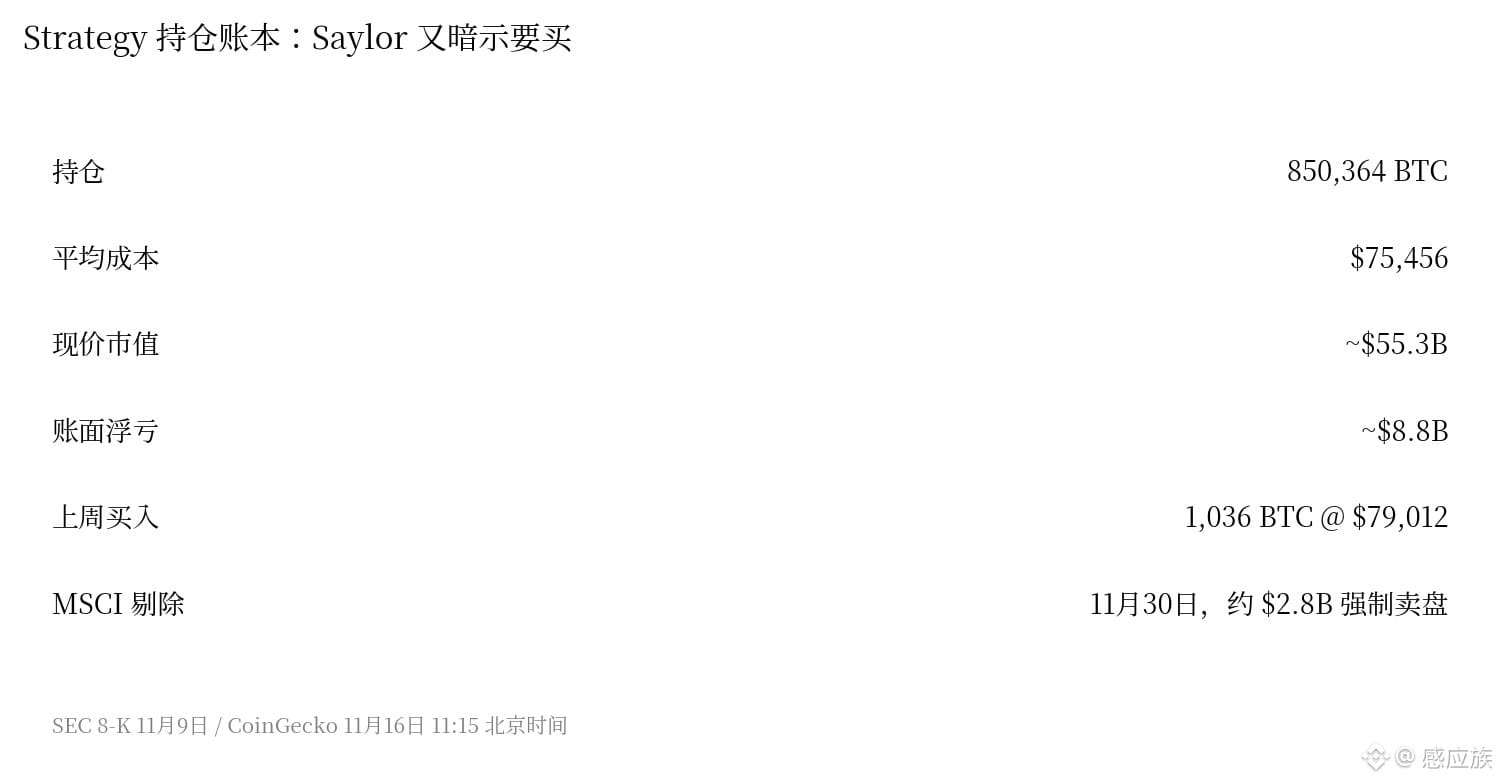
First, let’s do the math. Strategy holds 850,364 coins, at an average cost of $75,456, for a total cost of $64.16 billion. At $BTC 65,055 dollars as I write this, the whole position is worth just over $55.3 billion, leaving an unrealized loss of roughly $8.8 billion. Last week’s purchase of 1,036 coins at an average price of $79,012 is now down more than 17%. It’s not that he doesn’t feel the pain; he has to keep playing the part of the “committed buyer” through it—the share price and financing channels are both tied to this.
The tougher part is still ahead. MSCI will remove MSTR from its index on November 30, and JPMorgan estimates that this alone could trigger around $2.8 billion in passive selling. In other words, Saylor may be buying on one side, while index funds are certain to sell on the other. Before the end of November, it’s anyone’s guess which side will be bigger.
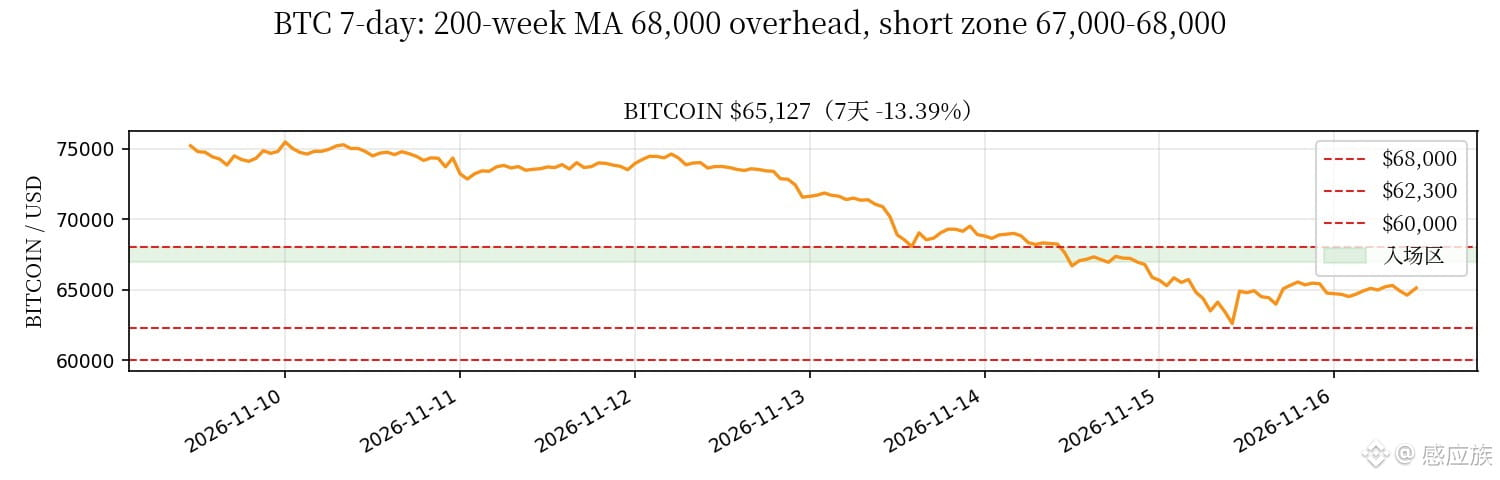
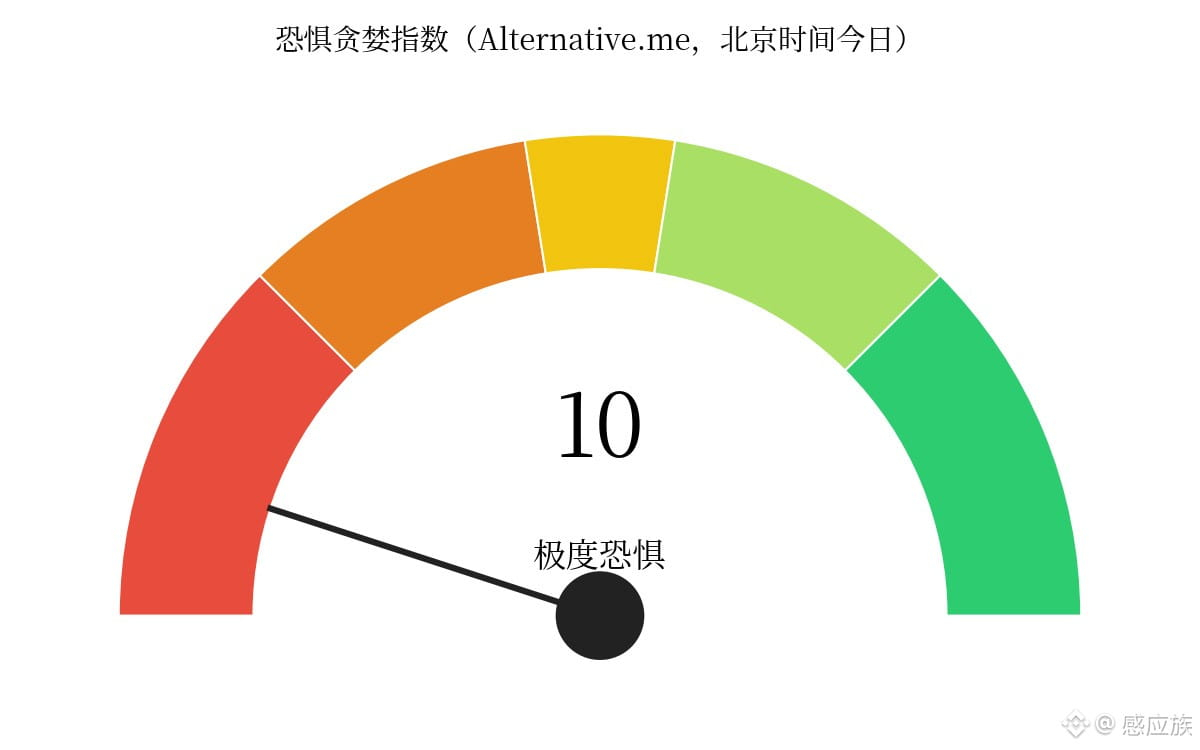
As for the market, it’s at $BTC 65,055 dollars, down around 0.3% over 24 hours, while $ETH 1,822 dollars is basically moving sideways. It just reclaimed 65,000, then lost it again a few times—enough to get on anyone’s nerves. If the 4-hour candle at 12 o’clock still closes below 68,000, that’ll be the 13th consecutive candle to close below the 200-week moving average. The Fear & Greed Index is at 10: extreme fear, stuck in single digits for a second straight day. There are also 5,110 Deribit options expiring at 16:00 this afternoon, with max pain at 68,500—well above the current price, so its pull is limited.
The #3 trade is still the same: wait for a rebound to 67,000–68,000 and scale into shorts, with a stop above 68,500 and targets at 62,300 and 60,000. Since noon on the 15th, the high has only reached 65,899, still nearly $2,000 short of the lower end of the entry zone. No entry, so there’s no profit or loss to report. Honestly, if Saylor really announces another purchase today, a price spike would actually be a good thing for me—it would push into my entry zone, making the short more comfortable. If it can’t break through 68,000 and fails to close back above it on the 4-hour chart, the bears are still in control. On the other hand, if a 4-hour candle closes above 68,000, I’ll admit I’m wrong; I’ll only consider flipping long if it gets back above 70,500. If 62,300 breaks first and the rebound never reaches the entry zone, I’ll skip the trade. I’m not chasing shorts at the lows.
The Plaza trending list is still the same three posts. The one about whale liquidations is nearing 240,000 views, with more than 2,000 comments. What do you think—if Saylor really bought this time, will the market trade it as good news for a while, or has nobody believed him anymore? Let’s talk in the comments. (Prices: actual figures from CoinGecko at 11:15 Beijing time on November 16; charts are original: 7-day price trend, Strategy holdings ledger, and Fear & Greed gauge.)