
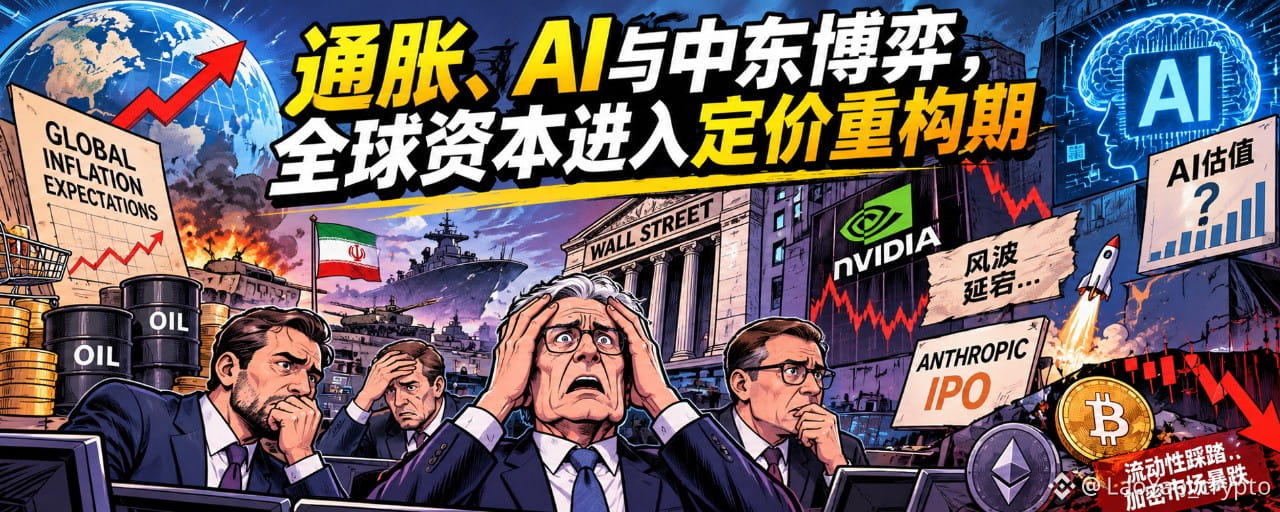

A new week begins, bringing a host of key developments for global capital markets.
The Fed’s rate path, turmoil among Nvidia’s management, AI industry valuations, geopolitical maneuvering in the Middle East, and energy supply risks are all intertwined.
This week, U.S. inflation data, earnings from tech giants, and global political and economic meetings will take center stage. Capital markets are not only reacting to economic data but also reassessing policy, industry, and geopolitical risks.
🔑 This Week’s Key Highlights
Inflation and interest rates: U.S. October CPI (Tuesday) and PPI (Friday) are important indicators ahead of the December FOMC meeting, directly influencing market expectations for the Fed’s future rate path.
Energy and monetary policy: Bessent said energy shocks should not be a reason for excessive rate hikes, reflecting the U.S. government’s policy trade-off between controlling inflation and sustaining economic growth.
AI tech: Jensen Huang will attend a U.S. congressional hearing, as controversy surrounding Nvidia’s leadership continues to unfold. The focus has broadened beyond a single company to encompass AI industry governance, business models, and valuation frameworks.
AI capital markets: Anthropic ( \u003cc-36/\u003e ) is set to list on Nasdaq this week, making its IPO an important gauge of investor appetite for tech.
Crypto markets: Crypto assets suffered a liquidity crunch over the weekend. Whether the rebound from lows can last depends on whether macro liquidity and market confidence recover.
\u003ct-47/\u003e \u003ct-49/\u003e
🧱 Geopolitics|The U.S. and Iran fight while negotiating
The Middle East situation has entered a new phase of strategic maneuvering.
1. Strait of Hormuz: Signs of easing in shipping risks
Kashkavi, spokesperson for the Iranian parliament’s National Security and Foreign Policy Committee, said a plan for passage through the Strait of Hormuz had completed its review and that arrangements for the relevant shipping lanes had been agreed with two littoral states.
Markets interpreted this as a possible easing of energy transportation risks. Risk appetite improved, and crypto assets rebounded in tandem.
2. Iran steps up military pressure in the region
Iran said drones had struck a U.S. military radar facility in Bahrain. Trump has not taken further military action for now and has kept his options open.
3. Red Sea situation shifts again
Yemeni government forces backed by Saudi Arabia announced a withdrawal from the Bab el-Mandeb Strait and the Red Sea coast, redirecting forces to defend the interim capital, Aden.
A six-week counteroffensive failed to achieve its expected results, further strengthening the Houthis’ control over the Red Sea chokepoint.
4. U.S. continues to deploy forces to the Middle East
A third U.S. aircraft carrier is heading to the Middle East. Trump has kept the option of striking Iranian nuclear facilities open while signaling a possible pause in military action.
Pakistan continues to play a go-between role in mediation efforts.
📌 Perspective:
The Middle East situation involves a complex interplay of energy transportation, regional security, U.S. strategic resources, and global inflation.
Security conditions in the Strait of Hormuz and the Bab el-Mandeb Strait will continue to affect the global energy risk premium.
💹 Capital markets|Key variables for global markets this week
This week, global capital markets enter a busy period packed with major events.
The APEC summit, earnings reports from Nvidia and Chinese tech giants, U.S. inflation and economic data, China’s October economic data, and LPR quotes will all shape market expectations.
us|U.S. markets
November 17: U.S. October retail sales; a gauge of consumer resilience.
November 18: Nvidia earnings and the minutes of the U.S. Federal Reserve’s October FOMC meeting; focus on AI demand and expectations for December interest rates.
November 18: Jensen Huang attends a U.S. congressional hearing; watch for signals from Nvidia’s leadership and on AI industry policy.
November 19: Anthropic plans to list on Nasdaq; watch how AI companies are valued by capital markets.
cn|China markets
November 16: China’s October economic data and property market performance.
November 18–19: APEC-related summit events in Shenzhen; watch for developments in Asia-Pacific trade and regional economic cooperation.
November 20: China’s November LPR quotes; watch the scope for monetary policy easing.
📌 Other major economies
Canada: inflation data.
United Kingdom: October CPI.
Japan: national October CPI.
Eurozone: final inflation reading.
📅 III. This Week’s Global Economic Calendar
November 16|Monday
🇨🇳 China’s October economic data
Focus on consumption, property sales, and fixed-asset investment to assess the strength of the domestic economic recovery.
November 17|Tuesday
🇺🇸 U.S. October CPI and retail sales data
Focus on persistent inflation and consumer trends to assess the Fed’s policy options going forward.
Earnings: Nvidia (NVDA)
Watch AI demand, data center business, and forward revenue guidance.
November 18|Wednesday ⭐ Key window of the week
🇺🇸 Fed minutes from the October FOMC meeting
🇬🇧 United Kingdom October CPI
🇨🇳 Shenzhen APEC Business Leaders Summit
Earnings: Tencent
Watch for U.S. monetary policy signals and changes in the valuations of global tech companies.
November 19|Thursday
Earnings: Alibaba, Pinduoduo, NetEase, Walmart, and others.
Anthropic IPO (ticker: ANT; offering price range: $70–78).
November 20|Friday
🇨🇳 China’s November LPR quotes: 1-year and 5-year-plus rates.
🇯🇵 Japan’s national October CPI.
🇺🇸 U.S. October PPI.
Focus on inflation trends and diverging monetary policies among the world’s major economies.
💸 Web3|Low-level recovery after a sharp weekend drop
Over the past 24 hours, crypto markets rebounded broadly as tensions in the Middle East eased. However, expectations of high interest rates, continued ETF outflows, and macro risk events are still weighing on the market’s medium-term performance.
📌 Major asset performance:
Total crypto market cap: about $2.26 trillion; market participants overall remain cautious.
\u003cc-242/\u003e: about $65,000, after hitting a weekend low near $62,000, a three-month low.
\u003cc-249/\u003e: about $1,800, after dipping to around $1,700; its decline was notably steeper than BTC’s.
Market sentiment: extremely bearish; ETF outflows continue, and risk appetite has yet to meaningfully recover.
📌 Market watch:
Pressure on the crypto market does not come entirely from within the industry.
Fed rate expectations, valuation adjustments in AI tech stocks, geopolitical risks in the Middle East, and shifts in global liquidity are all shaping capital allocation to crypto assets.
Any rebound in BTC and ETH still needs to be assessed against whether inflows, market depth, and derivatives leverage have genuinely recovered.
🧘 Crypto mindset: Capital is redefining risk and value
Global capital markets are currently being shaped by multiple major themes that interact and compete with one another.
1. Political shifts influence capital flows
Changes in the political landscape following the U.S. midterm elections will gradually feed through to the tech industry, financial markets, and crypto regulation. Policy expectations themselves are becoming an important factor influencing capital flows.
2. Geopolitics is redefining energy risks
U.S.-Iran tensions and risks around the Strait of Hormuz have once again made energy supply chain security a major factor in global inflation and industry costs. Energy prices affect not only inflation but also countries’ monetary policies and corporate earnings expectations.
3. Interest rate conditions determine asset valuations
Persistent inflation and hawkish Fed signals are prompting markets to reassess Treasury yields, the dollar’s trajectory, and valuation discount pressures on global risk assets.
4. The AI industry enters a value-validation phase
AI remains a major focus of global tech competition, but capital is shifting from simply chasing computing power, funding scale, and market share to scrutinizing commercialization, cash flow, and returns on capital.
5. Crypto assets and traditional finance become more integrated
The links between Treasuries, the dollar, tech stocks, and crypto assets continue to strengthen. The crypto market is no longer a standalone pool of capital, but an important part of the global capital allocation system.
📌 Outlook:
Global capital is shifting from simply chasing growth expectations to reassessing risk premiums, capital efficiency, and intrinsic value.
The key to future markets is not just identifying which sectors can grow, but determining who can continue to generate cash flow and returns on capital amid high interest rates, geopolitical conflict, and industrial transformation.
View capital through the lens of the mind; discern trends through cycles.
⚠️ The above reflects personal views and is intended only for market observation and discussion.
Geopolitical conditions can change rapidly. Please be mindful of position sizing and leverage risks. This is not investment advice.
📌 LaoYao(\u003cm-329/\u003e)
View capital through the lens of the mind; discern trends through cycles. Seek certainty amid uncertainty and anchor value amid volatility.