Monday Market Preview: Two major weekend developments—watch these two themes at the open tonight.
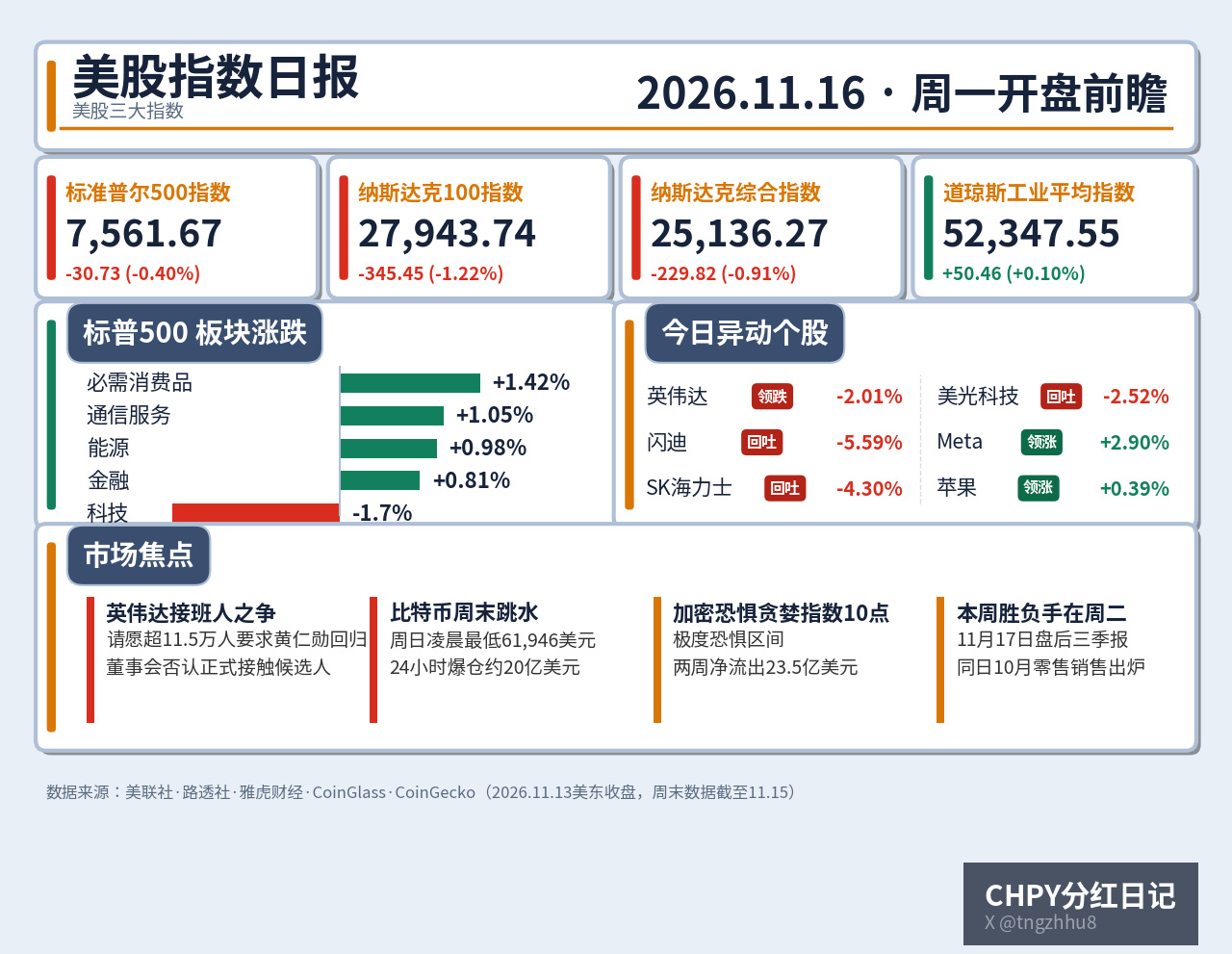
First, anchor on Friday’s close. The S&P 500 closed at 7,561.67, down 0.40%; the Nasdaq 100 closed at 27,943.74, down 1.22%; the Nasdaq Composite closed at 25,136.27, down 0.91%; and the Dow Jones Industrial Average closed at 52,347.55, up 0.10%. Friday was a down day, but all three indexes still rose for the week: the S&P 500 gained 2.51%, the Nasdaq Composite rose 2.27%, and the Dow gained 2.07%—their best week since early August. Technically, the S&P 500 closed below its 20-day and 50-day moving averages. Its 14-day relative strength index was 44.9—not yet oversold, but bulls have lost the short-term moving averages. Minutes before the close, the Federal Aviation Administration ordered a nationwide flight ground stop, adding to Friday’s turmoil.
The first weekend story: a tug-of-war over who could succeed Nvidia CEO Jensen Huang. The Financial Times reported that the board had approached Arm CEO Rene Haas as a potential successor. The board then told CNBC that it had not formally approached any candidates and was still selecting an executive search firm, adding that it was too early to discuss specific names. Meanwhile, a petition calling for Huang to return surpassed 115,000 signatures over the weekend. The petition website says about 5,965 current employees signed it; Tesla CEO Elon Musk was among them. Two major investors also wrote to the board, urging it to keep open the option of Huang’s return. Prediction markets currently favor internal engineer Ian Buck, at around 33%. Nvidia fell another 2.01% on Friday to close at $162.85, down 12.75% for the week. It has now fallen for six straight weeks, its longest losing streak since 2012, and its market capitalization has dropped below $4 trillion.
The second weekend story: Bitcoin plunged. Bitcoin was around $68,839 when U.S. stocks closed Friday, then slid through Saturday, hitting a low of $61,946 early Sunday—down about 10% from Friday’s close—before recovering to around $64,500 by Sunday evening. About $2 billion in crypto positions were liquidated across the market over 24 hours, including $1.68 billion in long positions. The Crypto Fear & Greed Index stood at just 10 on Sunday, in the Extreme Fear zone. Spot Bitcoin ETFs saw $2.35 billion in net outflows over two weeks, and Bitcoin has fallen below its 200-day moving average, around $73,000. ETF flows on Monday will be the first test of how solid this rebound is.
These two stories are really expressions of the same impulse: confidence in the AI narrative is wavering, rate-hike expectations are weighing on markets, and risk appetite is draining first from the most vulnerable areas. October’s Consumer Price Index rose 0.40% month over month, above expectations of 0.30%; October’s Producer Price Index rose 6.50% year over year. The CME FedWatch Tool puts the odds of a 25-basis-point rate hike in December at around 87%, and the 10-year Treasury yield has topped 5.10%. But one detail from last Friday is worth noting: although the indexes fell, more than 60% of S&P 500 constituents closed higher. Money is rotating, not retreating.
Four things to watch this week: Monday at noon, Fed Chair Warsh speaks; Tuesday, October retail sales are released, with the market expecting a 0.20% month-over-month gain, and Nvidia reports its third-quarter earnings after the close, with revenue expected at around $108 billion and options markets implying an 8% to 9% share-price move; Wednesday, minutes from the October Federal Open Market Committee meeting; Thursday, Walmart reports before the open, and Anthropic is expected to go public.
The two cold showers over the weekend won’t erase the foundations of last week’s rally, but they’ve pushed all the suspense to Tuesday. Can Nvidia’s earnings keep the AI narrative alive? Will retail sales add fuel to rate-hike expectations? The week’s direction won’t be clear until those two questions are answered.
#美股 #Bitcoin
$NVDA $QQQ $SPY
First, anchor on Friday’s close. The S&P 500 closed at 7,561.67, down 0.40%; the Nasdaq 100 closed at 27,943.74, down 1.22%; the Nasdaq Composite closed at 25,136.27, down 0.91%; and the Dow Jones Industrial Average closed at 52,347.55, up 0.10%. Friday was a down day, but all three indexes still rose for the week: the S&P 500 gained 2.51%, the Nasdaq Composite rose 2.27%, and the Dow gained 2.07%—their best week since early August. Technically, the S&P 500 closed below its 20-day and 50-day moving averages. Its 14-day relative strength index was 44.9—not yet oversold, but bulls have lost the short-term moving averages. Minutes before the close, the Federal Aviation Administration ordered a nationwide flight ground stop, adding to Friday’s turmoil.
The first weekend story: a tug-of-war over who could succeed Nvidia CEO Jensen Huang. The Financial Times reported that the board had approached Arm CEO Rene Haas as a potential successor. The board then told CNBC that it had not formally approached any candidates and was still selecting an executive search firm, adding that it was too early to discuss specific names. Meanwhile, a petition calling for Huang to return surpassed 115,000 signatures over the weekend. The petition website says about 5,965 current employees signed it; Tesla CEO Elon Musk was among them. Two major investors also wrote to the board, urging it to keep open the option of Huang’s return. Prediction markets currently favor internal engineer Ian Buck, at around 33%. Nvidia fell another 2.01% on Friday to close at $162.85, down 12.75% for the week. It has now fallen for six straight weeks, its longest losing streak since 2012, and its market capitalization has dropped below $4 trillion.
The second weekend story: Bitcoin plunged. Bitcoin was around $68,839 when U.S. stocks closed Friday, then slid through Saturday, hitting a low of $61,946 early Sunday—down about 10% from Friday’s close—before recovering to around $64,500 by Sunday evening. About $2 billion in crypto positions were liquidated across the market over 24 hours, including $1.68 billion in long positions. The Crypto Fear & Greed Index stood at just 10 on Sunday, in the Extreme Fear zone. Spot Bitcoin ETFs saw $2.35 billion in net outflows over two weeks, and Bitcoin has fallen below its 200-day moving average, around $73,000. ETF flows on Monday will be the first test of how solid this rebound is.
These two stories are really expressions of the same impulse: confidence in the AI narrative is wavering, rate-hike expectations are weighing on markets, and risk appetite is draining first from the most vulnerable areas. October’s Consumer Price Index rose 0.40% month over month, above expectations of 0.30%; October’s Producer Price Index rose 6.50% year over year. The CME FedWatch Tool puts the odds of a 25-basis-point rate hike in December at around 87%, and the 10-year Treasury yield has topped 5.10%. But one detail from last Friday is worth noting: although the indexes fell, more than 60% of S&P 500 constituents closed higher. Money is rotating, not retreating.
Four things to watch this week: Monday at noon, Fed Chair Warsh speaks; Tuesday, October retail sales are released, with the market expecting a 0.20% month-over-month gain, and Nvidia reports its third-quarter earnings after the close, with revenue expected at around $108 billion and options markets implying an 8% to 9% share-price move; Wednesday, minutes from the October Federal Open Market Committee meeting; Thursday, Walmart reports before the open, and Anthropic is expected to go public.
The two cold showers over the weekend won’t erase the foundations of last week’s rally, but they’ve pushed all the suspense to Tuesday. Can Nvidia’s earnings keep the AI narrative alive? Will retail sales add fuel to rate-hike expectations? The week’s direction won’t be clear until those two questions are answered.
#美股 #Bitcoin
$NVDA $QQQ $SPY