


a year ago the best AI agent could finish 2.5% of real freelance jobs.
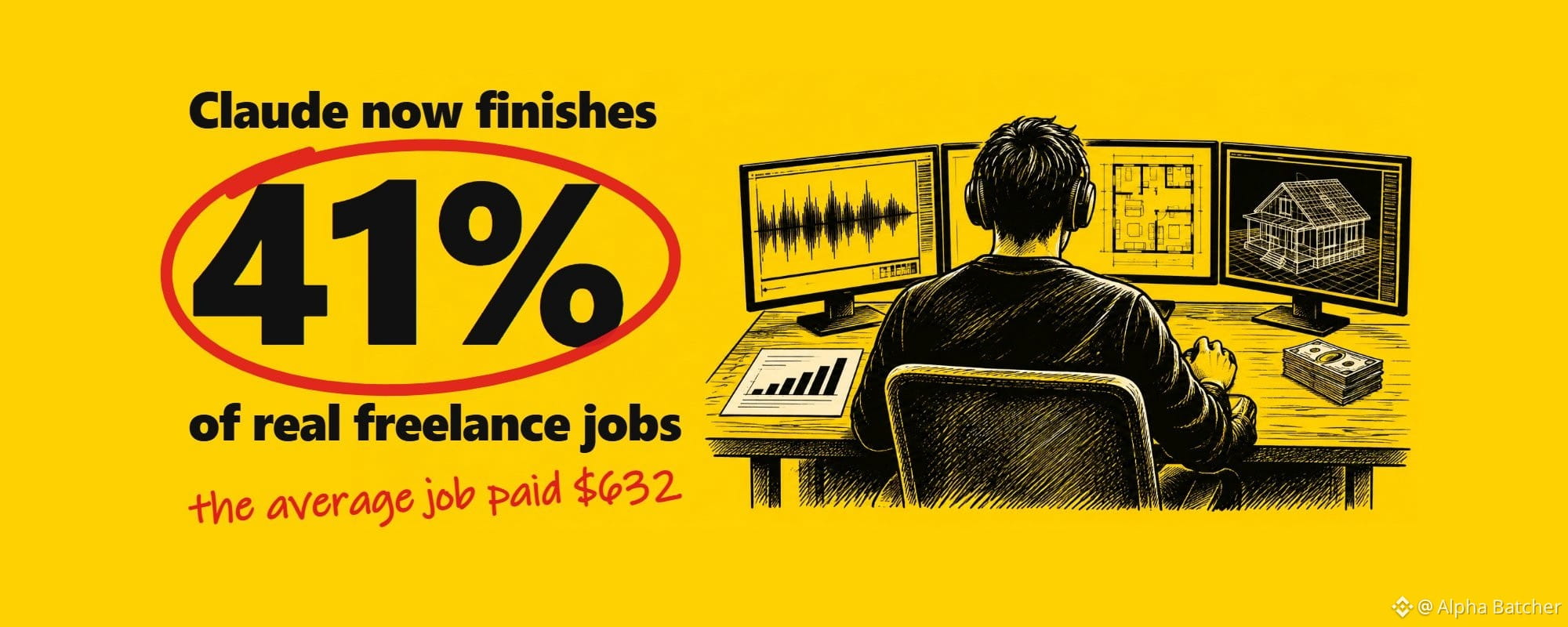
on november 9, Claude Fable 5.2 finished 41.3%.
the test is the Remote Labor Index from Scale Labs and the Center for AI Safety. it's 240 jobs that 358 verified freelancers already did on Upwork: sound design, floor plans, 3D models, data reports, game art. together the jobs are worth $143,991.
the AI gets the same brief and the same input files the freelancer got. then trained reviewers open its files next to the freelancer's and answer one question: would a reasonable client accept this?
for 41.3% of the jobs, Fable 5.2 got a yes. the next model, Opus 5.5, got 21.25%. GPT 6 Astra got 20.83%.
the jobs are real work. the average one paid $632.60 and took a person 28.9 hours. the median paid $200 and took 11.5 hours.
and the test let the AI spend up to $30 on a job.
clients still pay for every one of them. the fee goes to whoever sends the finished files, and Claude now does 4 of every 10 of those jobs well enough to get accepted.
Scale Labs said where Fable 5.2 jumped most: audio and music, architecture and interior design, and 3D modeling. it's still far off on industrial product design and animation.
this course turns that into income. you pick one of 4 jobs Claude is strongest at, price it from Upwork's own rate pages, run it through Claude Code, check it the way the reviewers did, and sell it. every chapter ends with something you paste.
• what 41% means, and what the other 59% looks like
• sound: edits, mixes and effects
• floor plans and interiors
• 3D models
• reports and charts
• the check before the client sees anything
• where to sell, and what to charge
• your first 30 days
tonight, open Upwork, search one of the 4 jobs, and save 5 briefs that match it. every chapter uses them.
what 41% means, and what the other 59% looks like
the score comes from 230 private jobs. 10 more are public, so anyone can see what a brief looks like.
every agent gets up to $30 per job for its tokens and tools, plus models for images, speech and video. the test's workspace has Blender, GIMP and Audacity on it.
three reviewers score every job, and the majority decides. they agree 94.4% of the time.
the other 59% is where your fee comes from. when an agent fails, the reviewers see the same 4 problems:
• poor quality, like child-like drawings: 45.6% of failures
• incomplete work, like an 8-second video for a brief that asked for 8 minutes: 35.7%
• broken or wrong files: 17.6%
• a house that changes shape between two 3D views: 14.8%
one failed job can have more than one of these. and every one of them shows the moment you open the file.
so the work you sell has two parts. Claude does the first pass. you open every file before the client does.
the pace is the other reason to start now. the RLI site puts the doubling time at about 3.3 months. in july the leader was Fable 5 at about 16%. four months later it's 41.3%.
set up a workspace in Claude Code before the first job, so every job runs the same way:
I'm starting a freelance delivery workspace. for each job, create a folder with: brief.md (the client's brief, word for word), inputs/ (their files), work/ (your drafts) and delivery/ (only files I approve). before you start any job, write work/plan.md: every deliverable, its file format, and the length, size or resolution the brief asks for. never put anything in delivery/ yourself.
sound: edits, mixes and effects
audio and music is where Fable 5.2 jumped most. even in the first round of the test, the jobs where AI matched people were mostly sound and images. the sound ones: effects for a retro video game, a vocal split from its backing track, voice-overs merged with intro and outro music.
on Upwork, audio editors in the US charge $36 to $60 an hour, according to Upwork's own rate page.
what to sell:
• podcast and interview cleanup: hiss, hum, levels and cuts
• intros and outros mixed under a voice-over
• vocal and instrument stems from one finished track
• sound effect packs for small games
leave AI voice-overs out. "robotic or unnatural voice-overs" are on the researchers' list of failures.
Claude Code runs the same tools an audio freelancer reaches for: ffmpeg for cuts, fades and loudness, and Demucs, an open-source model, for stems.
job: [paste the brief]. the client's files are in inputs/. use ffmpeg for cuts, fades and loudness. if the brief asks for stems, install Demucs and split the track. match the length, format and loudness the brief asks for; if it gives no loudness, master podcasts to -16 LUFS and music to -14 LUFS. log every change with its timestamp in work/changes.md, then render the deliverables to work/.
metric to watch: revision requests per job. one is normal. three means your intake questions are missing something.
mistake to avoid: sending a file you haven't listened to from start to finish.
floor plans and interiors
architecture and interior design was the second big jump. one example job in the test: a floor plan from the client's sketch, furnishing options and photorealistic renders of the bathroom.
it's also where agents used to fail in plain sight: floor plans that didn't match the sketch they were given.
on Upwork, interior designers list at $15 to $28 an hour, and at $41 to $91 in Los Angeles.
what to sell:
• a clean 2D floor plan from a hand sketch or a phone photo, with every dimension
• 2 or 3 furniture layouts for one room
• renders of one room for a listing or a renovation pitch
Claude Code can drive Blender from a Python script, so the renders run without you at the mouse.
job: [paste the brief]. the sketch is in inputs/. first copy every dimension from the sketch into work/dimensions.md and stop so I can check them. after I confirm, draw the plan as SVG and PDF with exactly those dimensions. then build the room in Blender with a Python script in background mode and render [number] views at 1920x1080. check every render against dimensions.md and list any mismatch before you finish.
metric to watch: every dimension on the plan matches the sketch.
mistake to avoid: rendering before the client approves the plan. one moved wall means every render again.
3D models
3D modeling was the third. on Upwork, 3D modelers list at $17 to $30 an hour, and 3D artists and rendering artists at $25 to $40.
what to sell:
• product models for online stores, with a turntable render
• low-poly assets for indie games
• printable STL files from a photo and measurements
the failure to look for shows up in 14.8% of failed jobs: a model that looks right from the front and changes from the side.
job: [paste the brief]. build the model in Blender with a Python script, in the real-world units from the brief. render front, side, top and three-quarter views with the same lights, then a 36-frame turntable. export [glTF / FBX / STL], reopen every exported file, and confirm it loads with the same dimensions. put a one-page sheet in work/: dimensions, polygon count and the file list.
metric to watch: every view agrees with the others.
mistake to avoid: taking a brief that needs animation. Scale Labs lists animation as far from solved.
reports and charts
this one already worked in the first round of the test: agents did well on report writing and on code for interactive data visualization.
on Upwork, data visualization specialists list at $25 to $45 an hour, and at $51 to $121 in the US.
what to sell:
• a monthly report from a client's spreadsheet export
• an interactive dashboard as one HTML file
• a market summary with every number linked to where it came from
job: [paste the brief]. the data is in inputs/. before any chart, write work/checks.md: row counts, empty cells, duplicates and the date range. then build the report as [PDF / one HTML file with interactive charts]. every number in the text must come from the data or a named source. list each number and where it came from at the end of checks.md.
metric to watch: every number in the report traces back to a row or a source.
mistake to avoid: charts before checks. one duplicated row changes every total.
the check before the client sees anything
the test still uses people as reviewers for a reason. CAIS tried AI reviewers, and they were fooled by work that looked polished and was broken inside.
so the check stays with you. Claude can do the first pass of it:
review work/ against brief.md before delivery. for every deliverable: open it with the tool it's made for and confirm it loads; check the format and the length, size, resolution or dimensions the brief asks for; compare it with the other deliverables for consistency: same object, same proportions, same names. for each file, answer one question: would the client who wrote this brief accept it? write yes or no with the reason to work/review.md. move nothing to delivery/.
then open every file yourself, in the software it was made for. the files you approve go to delivery/.
where to sell, and what to charge
start on Upwork. the test's 240 jobs came from freelancers there, and its fee is 0% to 15% of each contract.
price each job as a fixed deliverable. the median job in the test paid $200 for 11.5 hours of a person's time. start your first offers near that, and raise the price after your first 3 reviews.
your profile needs 3 samples per offer. make them from the 5 briefs you saved tonight.
before any proposal, filter the job posts. paste 10 of them at once:
I'm picking freelance jobs to deliver with Claude. here are 10 Upwork job posts: [paste]. for each one, list the deliverables and their file formats, and name its type: audio, floor plans and interiors, 3D models, reports and charts, or none. mark it skip if it needs animation, industrial product design, calls with the client, or results that take months, like SEO. rank the rest by budget per deliverable, best first.
say how you work in every proposal. one line is enough: "I make the first draft with Claude and check every file by hand before delivery." clients who mind will pass, and the ones who hire you won't be surprised later.
write a proposal for this job: [paste the job post]. 120 words max. first line: the deliverable and the deadline, in the client's own words. then one sample from my portfolio that matches, with its link: [link]. then the 3 questions I need answered to start. end with a fixed price of [$] and what it includes. no greetings and no "I'm excited".
your first 30 days
week 1: build 3 samples for one job type from the briefs you saved.
week 2: send 10 proposals a day, only to briefs your samples match.
week 3: deliver, and log every revision request. they show you which intake questions to add.
week 4: raise the price on the job type with the fewest revisions.
what it costs: Claude Pro now includes Fable for up to 50% of your weekly usage. on the API, Fable 5.2 is $8 per million input tokens and $40 per million output tokens. the test capped each job at $30.
what kills this:
• selling the other 59%. animation and industrial product design are still mostly failures.
• jobs the test left out: anything that needs calls with the client, physical work, or results you only see months later, like SEO. the 41% says nothing about them.
• AI voice-overs.
• skipping the check. poor quality is the most common failure, and a client sees it in the first minute.
the setup on one page
TEST Remote Labor Index: 240 real Upwork jobs worth $143,991, median $200
SCORE Fable 5.2 41.3%, Opus 5.5 21.25%, GPT 6 Astra 20.83%, a year ago 2.5%
STRONGEST audio and music, architecture and interior design, 3D modeling
WEAKEST industrial product design, animation
RATES US audio $36-60/hr, interiors $15-28/hr, 3D $17-40/hr, data viz $25-45/hr
FILTER 10 job posts at once; skip animation, product design, calls, SEO
CHECK open every file in its own software: would the client accept it?
SELL Upwork, fee 0-15%, fixed price per job, start near $200
WEEK 1 3 samples for one job type
save this block.
tonight, take one of the 5 briefs you saved and run it through the workspace prompt and the prompt for its job. open what comes back in the software it's made for. that's your first sample.
bookmark this before you open Upwork tonight. you'll want the prompts when the first brief comes in.