

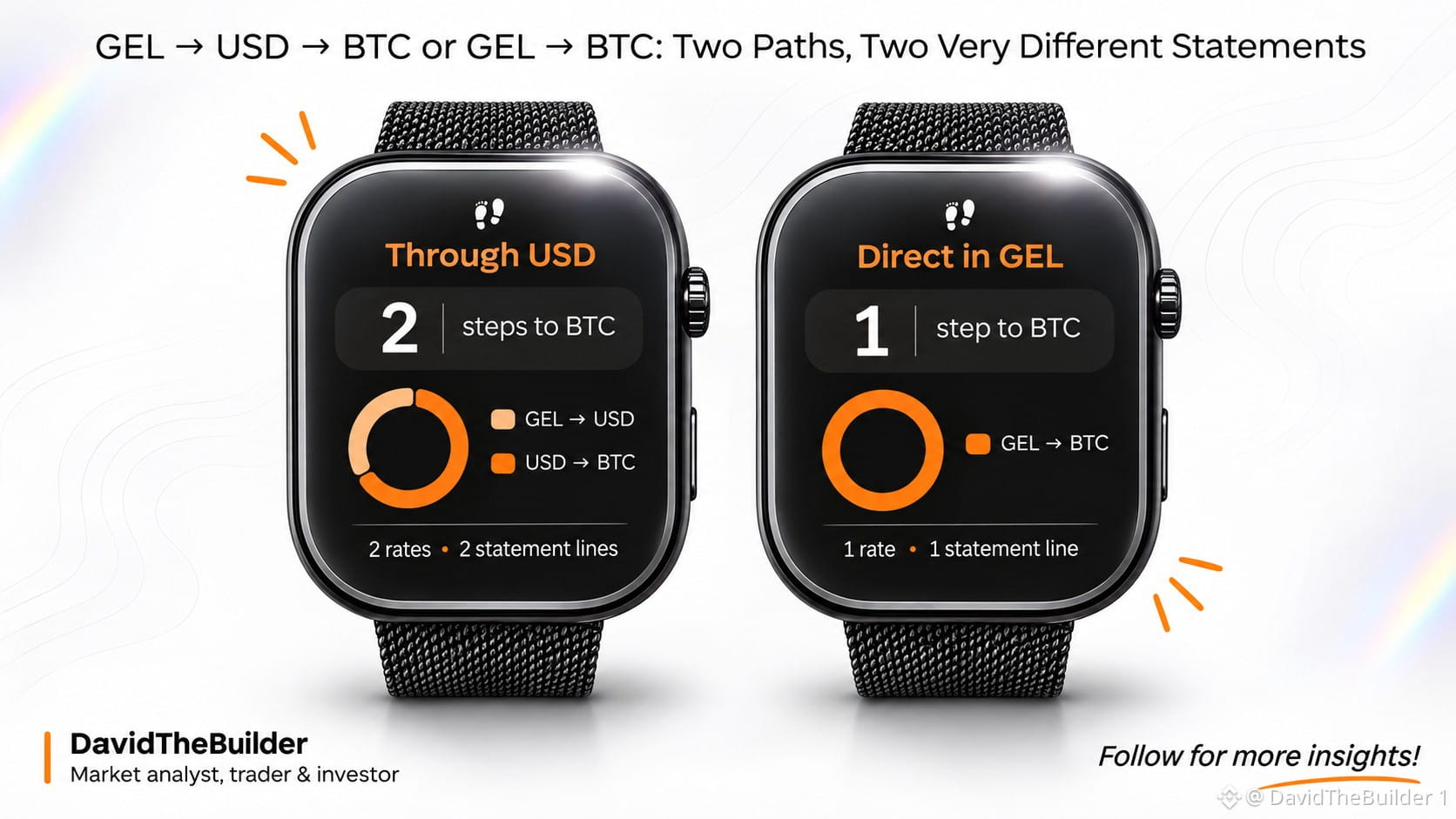
One Rate or Two? What Your Users See Before They Buy BTC A recent dLocal survey caught my eye: 71% of emerging-market shoppers would be unlikely to buy from a website that doesn’t support their local currency or payment method 📈 It made me wonder how many people open an app to buy $BTC , see dollar-only prices and leave. I saw this debate up close last spring, when a fintech I know was preparing its Georgia launch. The product lead wanted lari-to-crypto in one tap, while finance pointed out that building everything in-house would mean converting to USD first, since that’s where most crypto liquidity sits. To make it less abstract, someone walked an imaginary customer with lari through both setups 🧭 📍️️️️️️ Path A, in-house: GEL → USD → BTC ▫️ two rates and two confirmations ▫️ two lines in the statement ▫️ full control, but FX and liquidity stay on the team 📍️️️️️️ Path B, via a provider: GEL → BTC ▫️ one price shown in lari ▫️ one confirmation and one statement line ▫️ easier for a retail user to follow Seeing it laid out cooled everyone down. Then someone asked, "What do our customers actually hold?" For most of them it was lari, so every extra conversion meant one more step before their first BTC 💳 This is where a provider that already supports local fiat comes in. For example, through the WhiteBIT Crypto-as-a-Service API, crypto could be converted to and from fiat with 1,020+ trading pairs available. So a customer holding lari could get to BTC without a stop in dollars: https://institutional.whitebit.com/crypto-as-a-service?utm_source=coinmarketcap&utm_medium=david_caasS&utm_campaign=post If this debate ever starts in your team, open the customer balance report before the pricing slides 📌 Disclaimer: This is not financial or investment advice. DYOR before making any decisions. Use at your own risk. #BTC Price Analysis# #Bitcoin Price Prediction: What is Bitcoins next move?#
Join global crypto users on Binance Square
⚡️ Get latest and useful information about crypto.
💬 Trusted by the world’s largest crypto exchange.
👍 Discover real insights from verified creators.
Email / Phone number