

**Fear & Greed Index Hits 10: Lowest Since July—Everyone’s Scared, What Should You Do?**
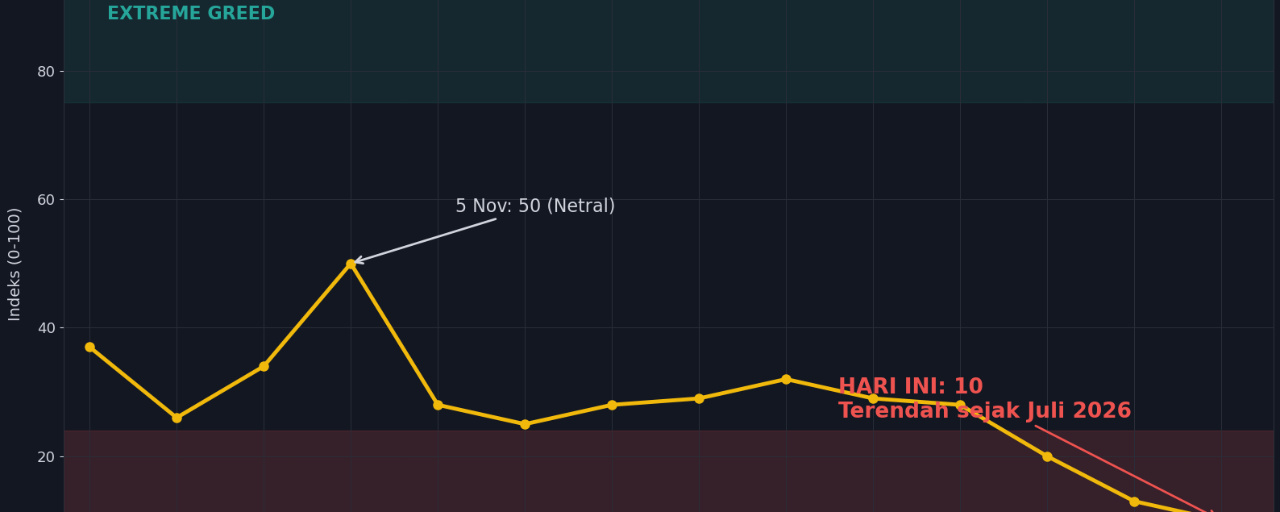
There’s one number today that tells a more dramatic story than the price chart: the crypto Fear & Greed Index is at 10. Extreme Fear. Ten days ago, it was still at 50—in other words, neutral. A month ago, it was at 63, in the Greed zone. In a short time, the market’s mood has shifted from relaxed to genuinely fearful. The question is, what does this number actually measure, and how should you respond to it?
**The Number Right Now**
Today the index is at 10. Yesterday it was 13. A week ago, it was 28. On November 5, it was still at 50. The last time the index was this low was July 1, 2026, when it stood at 11. So it’s not just falling—it’s falling fast and hard, alongside Bitcoin’s drop from $81,180 on November 4 to a low of $61,970 today, plus around $2 billion in leveraged liquidations over 24 hours.
**What Does This Index Measure?**
The Fear & Greed Index from alternative.me is a score from 0 to 100 that sums up the market’s mood. It combines several factors: price volatility, trading momentum and volume, social media sentiment, Bitcoin dominance, and search trends. A low score means the market is dominated by fear; a high score means it’s gripped by greed. It doesn’t measure prices directly—it measures the crowd’s emotions.
And the crowd’s emotions follow an interesting pattern: they’re almost always most fearful near the worst lows, and most greedy near the best highs. That’s why experienced investors often read this index contrarily rather than following it blindly.
**How to Read It Sensibly Without Getting Trapped**
First, Extreme Fear isn’t an automatic buy signal. It just says everyone is scared; it doesn’t mean prices can’t fall further. The index once hit 5 in February 2026, so even at 10, there’s still room to fall if panic continues. Trying to catch a falling knife with all your money just because the index is low isn’t a strategy—it’s gambling.
Second, what’s more useful about an extreme reading like this is what it tells you about the crowd’s positioning. When everyone is already scared and many have exited or been liquidated, there are fewer sellers left. That’s different from a guarantee that prices will rise right away, but it’s useful context for anyone thinking long term.
Third, if you’re the kind of person who invests gradually, conditions like this are usually best approached with a plan you wrote down while calm: a fixed amount, spread out over time, using money you can afford to set aside, and being mentally prepared for prices to fall further. Not going all-in because you see the number 10, and not panic-selling because you see that same number.
Fourth, don’t make one index your sole deciding factor. The Fear & Greed Index is a thermometer, not a compass. Combine it with your own big-picture view: price trends, your financial situation, and your time horizon.
The bottom line: a reading of 10 tells you the market is at its most fearful point in the past four months. For some, it’s a warning alarm; for others, it’s a reminder bell to start paying attention again with a clear head. One thing’s for sure: decisions made out of herd fear rarely turn out well.
What do you usually do when you see the index in Extreme Fear like this: step away for a while, sit tight and hold what you have, or start buying gradually?
This content is for educational purposes only, not investment advice. alternative.me index data as of November 15, 2026. Always do your own research and make decisions based on your own plan and circumstances.
#FearAndGreed #Bitcoin #MarketSentiment
$BTC$ETH