
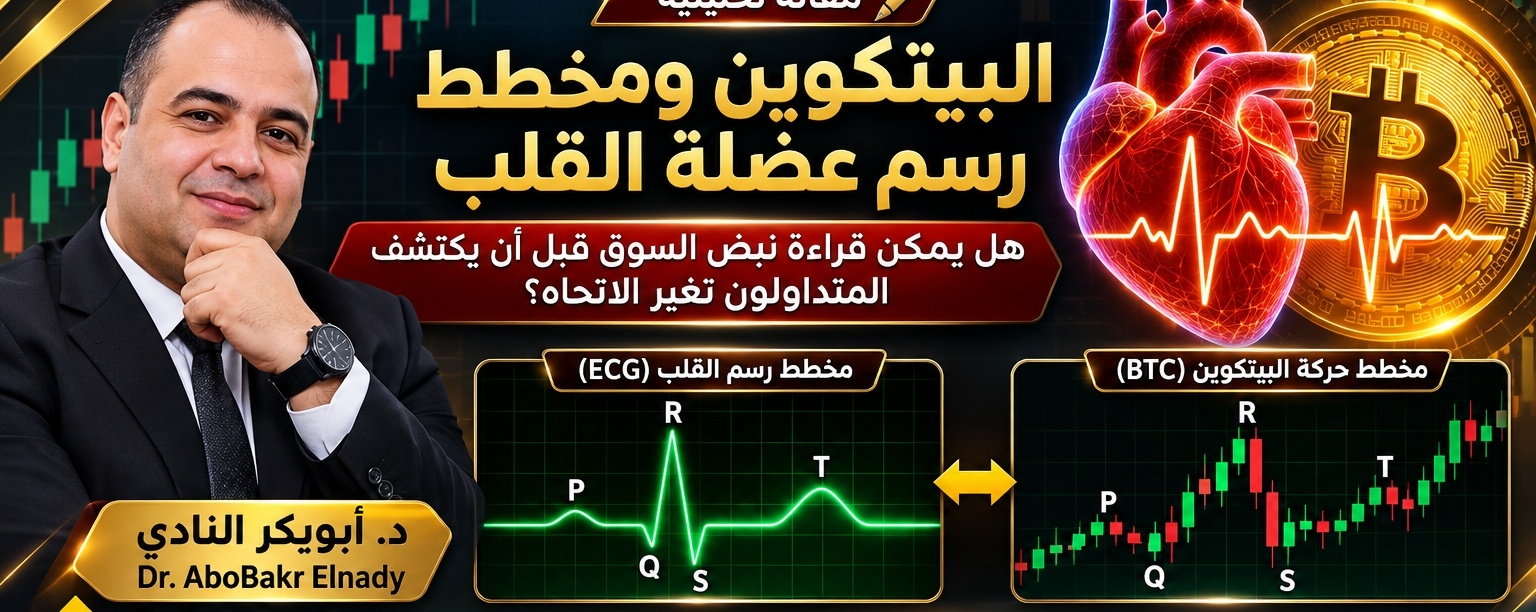


Can we read the market’s pulse before traders detect a change in direction?
By Dr. Abu Bakr Al-Nadi
Cryptocurrency Markets Analyst
When we look at an electrocardiogram (ECG), we are not merely looking at lines rising and falling; we are reading vital signals that reflect the condition of the heart muscle, the regularity of its beats, and the strength of its activity.
The question is: What if we approached Bitcoin’s movements in the same way?
Like any financial market, Bitcoin has its own rhythm. It moves between acceleration and deceleration, activity and inactivity, and periods of strength and weakness.
But can we read this rhythm before a major price move occurs?
First: The similarity between a heartbeat and Bitcoin’s pulse
In an electrocardiogram, we monitor:
The regularity of the heartbeat.
Changes in heart rate.
The strength of electrical signals.
Periods of calm and acceleration.
Unusual signs that may indicate a change in condition.
For Bitcoin, we can monitor:
The speed of price movement.
The strength of buying and selling momentum.
Trading volumes.
Liquidity flows.
Periods of accumulation and distribution.
Sudden changes in market behavior.
This is where the idea emerges: the most important change may not be a rise or fall in price, but a change in market behavior that occurs before it is clearly reflected in the price.
Second: How do we read a Bitcoin heartbeat chart?
We can build an analytical model inspired by the idea of an electrocardiogram and based on a set of signals:
1- Normal market pulse
Relatively steady price movement, with an acceptable balance between momentum, liquidity, and trading volume.
2- Accelerating pulse
Increasing speed of movement and rising momentum, while monitoring whether liquidity confirms this acceleration.
3- Weakening pulse
Momentum declines even as the price continues to rise, or trading volume falls—signals worth watching for a possible weakening of the trend.
4- Irregular pulse
Contradictions emerge between price, trading volume, and liquidity, potentially indicating a shift in the balance of power between buyers and sellers.
5- Transition phase
When several signals come together to confirm a change in market behavior, we begin assessing the possibility that the market is shifting from an uptrend to a downtrend, or vice versa.
Third: The idea we want to explore
We are not trying to invent another indicator that chases price after it moves. Instead, we want to develop a method that helps us detect changes in the market’s pulse early.
This is where the project idea comes in:
Bitcoin Heartbeat – Bitcoin’s Pulse
A proposed analytical model that links:
Price movement.
Momentum.
Liquidity.
Trading volumes.
Acceleration and deceleration.
The goal is to test whether combining these elements can detect early shifts in Bitcoin’s behavior.
Fourth: Can the pulse anticipate price movement?
This is the most important research question.
If we can detect weakening momentum or a change in liquidity flows before a clear reversal appears on the chart, we may have a tool that helps us better understand what is happening inside the market.
However, the model must be tested against historical data, its accuracy measured, and its signals compared with actual outcomes before it is used to make trading decisions.
Conclusion
In medicine, we do not always wait for severe symptoms to appear before monitoring vital signs.
Likewise, in financial markets, we should not wait for a major price move before looking for its causes.
The key may not be simply watching Bitcoin’s price movements, but understanding their rhythm.
We are not chasing the price; we are trying to read its pulse.
Dr. Abu Bakr Al-Nadi
Bitcoin Heartbeat – A New Approach to Market Behavior Analysis
😀
Scientific note: The comparison between an electrocardiogram and Bitcoin’s price movements is a research analogy intended to develop an analytical model. It does not imply medical equivalence or claim that the market has actual cardiac activity.