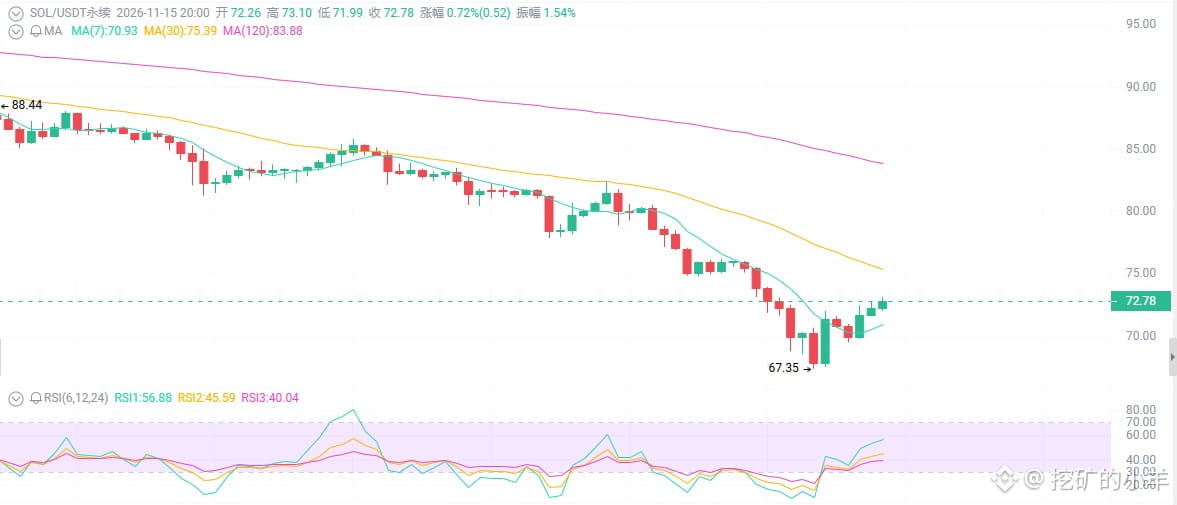
SOL at $73—did you cut your losses?
Breakpoint is underway in London, and DTCC is set to bring trillions of dollars in assets onto Solana. Yet the market hit you with a massive red candle: down 19% for the week and 30% for the month, $69 million in long positions wiped out, and ETFs seeing consecutive outflows. Is this institutions quietly selling during the conference, or one last panic-driven shakeout?
First, the surface-level picture: good news at the conference, bad news in the market.
Breakpoint 2026 opened in London today—the ecosystem’s biggest annual event, where institutions, infrastructure, and the builder economy are all in focus. DTCC announced that it will bring tokenized Russell 1000 stocks, ETFs, and Treasuries onto Solana in 2027—a gateway to a trillion-dollar RWA market.
This isn’t a coincidence. Market manipulators are exploiting the gap between conference expectations and reality to liquidate leveraged positions.
First: ETFs are flowing out, but DTCC is on its way in.
U.S. spot SOL ETFs have seen net outflows for several consecutive days, totaling tens of millions of dollars—a sign that institutional demand has weakened in the short term.
Sounds alarming? But look at the other side: DTCC plans to connect its tokenization services to Solana in the second half of 2027, covering eligible Russell 1000 stocks, ETFs, and Treasuries.
ETF outflows are a short-term capital flow; DTCC’s integration is long-term infrastructure.
Second: macro conditions point to rate hikes, but SOL is oversold.
The Fed’s policy rate is 3.75–4.00%, core PCE remains sticky, and markets are pricing in a very high probability of a 25-basis-point hike in December. The 10-year Treasury yield is at 5.1%, and the dollar is strengthening. Risk assets are under pressure across the board, and the Fear & Greed Index is in extreme fear territory.
This is the main cause of the current downturn—there’s no sugarcoating it. But macro conditions are hurting valuations, not the ecosystem.
Solana’s TVL is still around $4.6–4.7 billion, stablecoins total $14 billion, daily DEX volume is $1.6 billion, and the network processes tens of millions of transactions a day. Jupiter, Kamino, Raydium, and Jito are all still running. The network hasn’t collapsed, the ecosystem isn’t dead, and developers haven’t left.
Third: the technicals are oversold, but a reversal isn’t confirmed yet.
The daily and 4-hour charts show a clear downtrend, with lower highs and lower lows. Price is well below the major moving averages, the EMA death cross is strengthening, and the bearish structure remains intact.
The RSI has entered oversold territory, open interest is falling, leverage is being flushed out, and $69 million in long positions have been liquidated—this is a classic deleveraging phase.
Support: $67–68 (intraday low + demand zone) → $65 → $60–62 (strong historical support)
Resistance: $75 (short-term rebound target) → $78–80 (former support turned resistance) → $85–90
Around $67–68, if price stabilizes and a bullish candle forms on strong volume, an oversold bounce toward $75 is possible. If it breaks below $67, the decline could accelerate toward $65 or even $60–62.