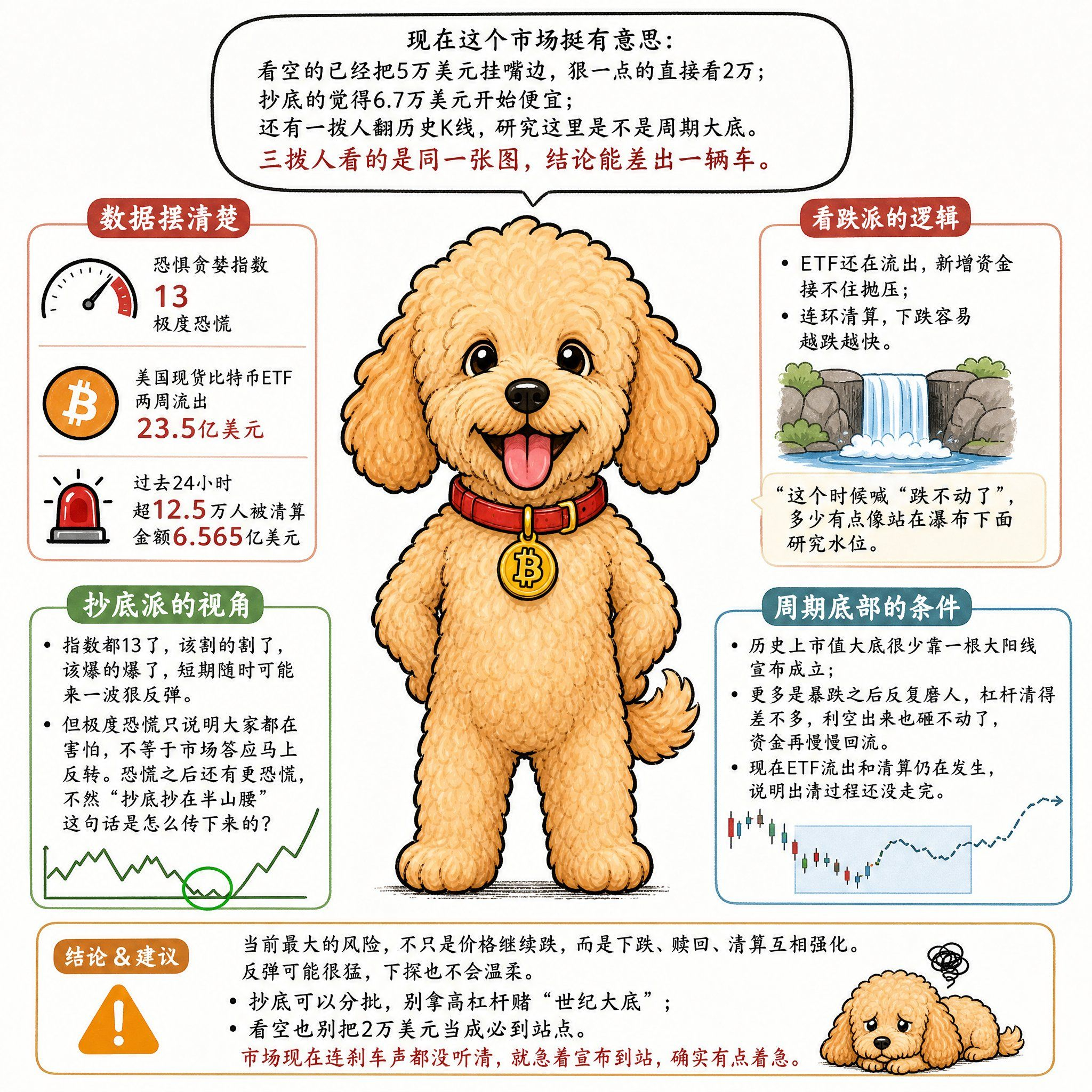
The market is pretty fascinating right now: bears are throwing around $50,000, and the more hard-line ones are looking straight at $20,000; dip buyers think $67,000 is starting to look cheap; and another group is poring over historical candlestick charts, trying to figure out whether this is the cycle bottom. They’re all looking at the same chart, yet their conclusions differ by the price of a car.
First, let’s lay out a few figures. The Fear and Greed Index has fallen to 13, signaling extreme fear; U.S. spot Bitcoin ETFs have seen $2.35 billion in outflows over two weeks; and in the past 24 hours, more than 125,000 traders were liquidated, totaling $656.5 million. Fear, money flowing out, and leveraged positions getting wiped out—all at once.|
The bearish case is simple: ETFs are still seeing outflows, new money can’t absorb the selling pressure, and cascading liquidations can make a drop accelerate. At a time like this, saying “it can’t fall any further” is a bit like standing beneath a waterfall and studying the water level.
Dip buyers are looking at the other side. The index is down to 13; those who were going to sell have sold, and those who were going to get blown up have been blown up. A sharp rebound could happen at any time in the short term. But extreme fear only means everyone is scared—it doesn’t mean the market has promised to reverse right away. Things can get even scarier after a bout of extreme fear. Otherwise, how did the saying “buying the dip halfway down the mountain” catch on?
As for a cycle bottom, the bar is usually higher. Historically, major market-cap bottoms are rarely confirmed by a single big green candle. More often, after a crash, the market grinds people down with repeated swings; leverage is mostly flushed out, bad news stops pushing prices lower, and money gradually flows back in. ETF outflows and liquidations are still happening, which suggests the cleanup isn’t over yet.
So the biggest risk right now isn’t just that prices keep falling—it’s that falling prices, redemptions, and liquidations reinforce one another. The rebound could be fierce, but the next leg down won’t be gentle either.
If you’re buying the dip, scale in and don’t bet on a “once-in-a-century bottom” with heavy leverage. If you’re bearish, don’t treat $20,000 as a guaranteed stop. The market hasn’t even clearly hit the brakes yet, so rushing to announce that we’ve arrived is a little premature.