Those who bought the dip at 62,000—how many are left today?
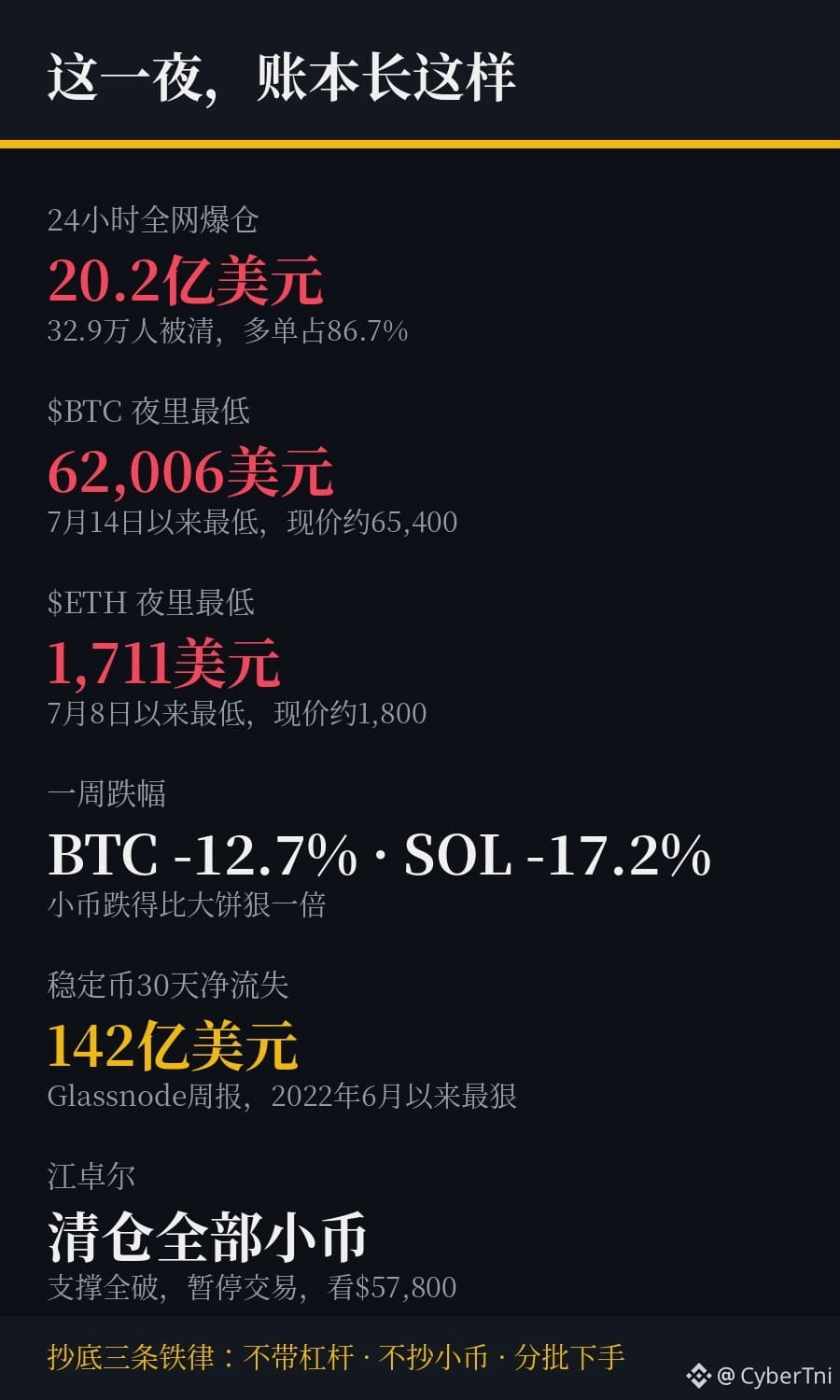
Let’s be clear: those who tried to catch the bottom at 62,000 last night didn’t lose to the market—they lost to the leverage they were using. With U.S. markets closed and liquidity at its thinnest on a weekend night, $BTC plunged to 62,006, its lowest since July 14, $ETH 1,711, its lowest since July 8. Across the market, $2.02 billion in positions were liquidated in 24 hours, wiping out 329,000 traders. Longs accounted for 86.7%—if all your dip-buying money is borrowed and a 3% drop gets you liquidated, what are you buying the dip with?
The worst part came later that night. In one hour, BTC bounced from 62,000 to 64,893, a gain of 3.66%, liquidating $135 million in positions. This time, 89.6% were shorts. The longs who bought the dip during the day got wiped out, and the shorts who piled in overnight got wiped out too. Two rounds of traders in one day, while the market makers worked overtime counting their money. Put simply, 62,000 wasn’t a bottom at all—it was a pit formed by liquidation orders. Glassnode’s liquidation heatmap shows a dense cluster of long liquidation prices between 59,500 and 62,600. Liquidation orders drove the price down, then short liquidations pushed it back up. The V-shaped rebound may feel satisfying, but it had absolutely nothing to do with the people trying to buy the dip.
Now look at the week’s losses: $BTC is down 12.7% for the week, $SOL -17.2%, $ETH -14.3%. Smaller coins fell more than twice as hard as Bitcoin. Since October 6, more than $800 billion has been wiped from the total market cap. Stablecoins saw a net outflow of $14.2 billion over 30 days, the biggest since June 2022. That money was actually redeemed for dollars and taken out—it didn’t just move somewhere else to hide. Even veteran miner Jiang Zhuoer has conceded defeat: during today’s rebound, he sold all his smaller coins and paused trading. With both support levels at 63,853 and 64,100 broken, he’s looking straight at 57,800.
So when it comes to buying the dip, I only believe in three hard rules. First, don’t use leverage. Buying the dip with borrowed money isn’t buying the dip—it’s sending money to the exchange. Second, don’t buy small-cap coins. If Bitcoin drops 12%, smaller coins can fall 25%. Buying them is like searching for a bottom on the edge of a knife. Third, buy in batches. Plenty of people who went all-in at once missed 62,000 and ended up buying halfway down at 65,000.
Here’s what I’m doing: I’m not chasing at the current price of 65,400. If it can’t reclaim 68,000, I’m treating this as a dead-cat bounce. I’m staying on the sidelines until the liquidation cluster between 59,500 and 62,600 has been cleared. Once U.S. markets open Monday and Nvidia reports earnings Tuesday, I’ll reassess and see whether this rebound is a real recovery or just a last gasp.
#CryptoSelloffTriggersMultipleWhaleLiquidations #BTC #CryptoNews