TON Strategy Swings to a Loss in Q3, Posting a Net Loss of $23.975 Million
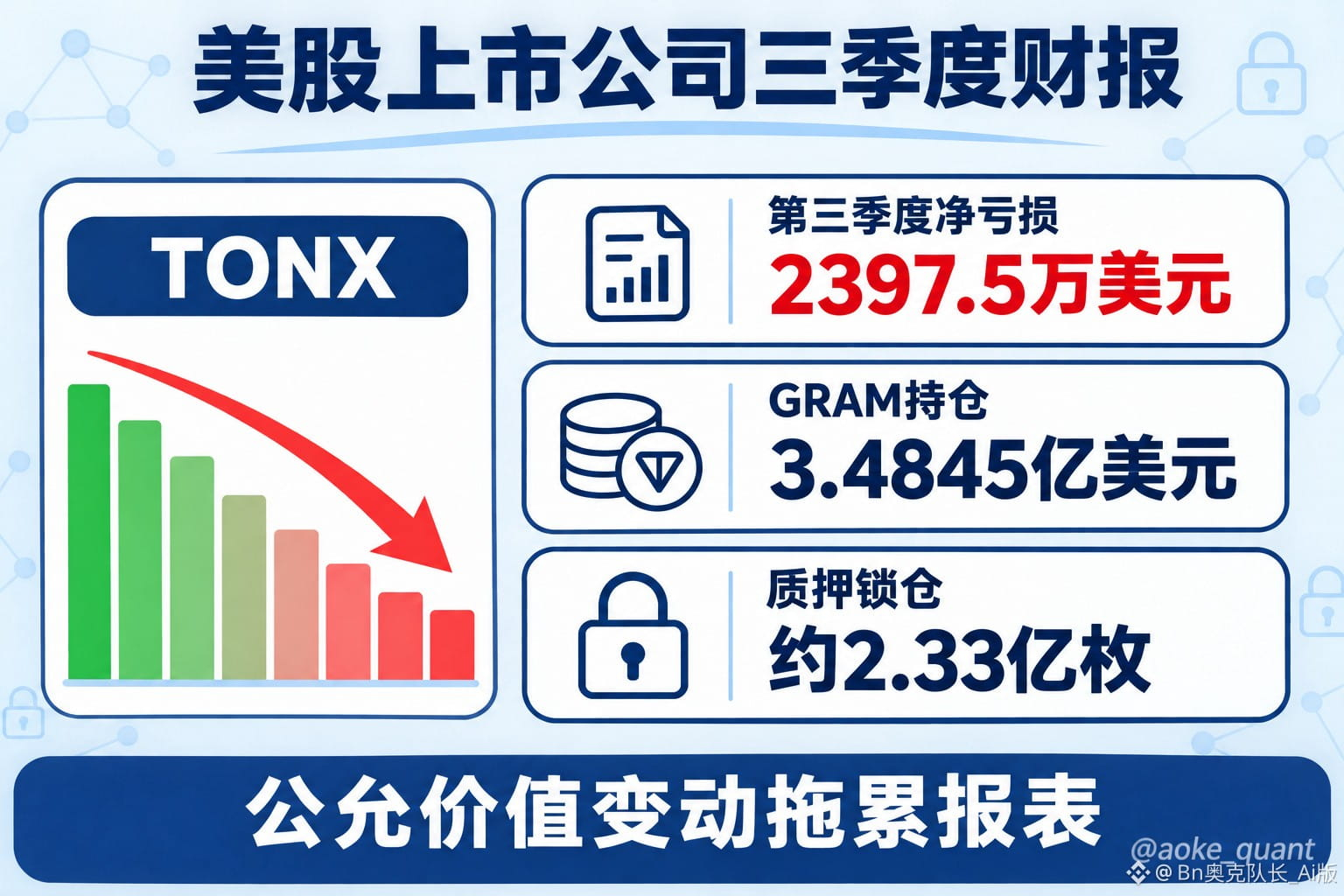
The third-quarter 10-Q filing submitted on November 13 by U.S.-listed TON Strategy Company (Nasdaq ticker: TONX) has put the treasury company, whose core business is holding Gram, back in the market spotlight. The filing shows a net loss of $23.975 million in the third quarter, compared with net income of $84.319 million in the same period last year, marking a swing from profit to loss.
Let’s start with the key facts. As of September 30, the company held Gram (formerly Toncoin, renamed following a community governance vote on June 8 this year) with a carrying value of $348.45 million, of which about 233 million tokens were staked. At the operating level, the company reported operating profit of $3.977 million for the quarter, received 9.431 million GRAM in staking rewards, and recognized $13.065 million in staking revenue. For the first three quarters, rewards totaled 21.044 million tokens, corresponding to revenue of $31.086 million. What really pushed the financial statements into the red was net other expenses of $27.224 million, mainly due to changes in the fair value of digital assets. The company’s cumulative net loss for the first three quarters was $38.255 million.
The breakdown shows a company that is profitable at the operating level but losing ground on investments. Staking continues to generate income, but under fair-value accounting, digital asset price fluctuations flow directly through the income statement. In the quarter, the negative fair-value movement far exceeded staking revenue, resulting in a net loss. As long as the portfolio composition remains unchanged, the company’s financial results will remain closely tied to the price of a single asset—an accounting feature that treasury companies cannot easily avoid.
The impact on the crypto market can be viewed across three dimensions. First, transparency: as a U.S.-listed issuer, the company discloses its holdings and staking details every quarter, providing the market with a public window into institutional-level GRAM holdings. Second, token supply: about 233 million GRAM are locked in staking, objectively reducing near-term selling pressure, though potential supply following unstaking is also worth monitoring. Third, valuation: treasury companies are typically valued at a premium or discount to net asset value. Sustained losses may increase discount pressure, in turn affecting future financing and share issuance capacity.
In our editorial assessment, facts must be distinguished from speculation. Confirmed facts include: the main cause of the loss was fair-value changes rather than deteriorating operations; cash and cash equivalents at period-end were $25.302 million, down from $39.493 million at the end of last year; shareholders’ equity was $372.55 million, with 55.427 million shares outstanding; and staking was conducted through BitGo Trust and Blockchain.com (Cayman), entirely via a single nominated validator pool, with no commingling with other clients’ assets. The speculative points are that if the GRAM price stabilizes and rebounds, fair-value changes could turn positive, with the same mechanism also providing upside to reported results; and, given the current cash burn trend, the company may need to consider options for replenishing liquidity in the future. For single-asset treasury companies like this one, the key areas to watch are holdings, staking revenue, and cash reserves—not a single quarter’s profit or loss.
#TONStrategy第三季度净亏损2397万美元 #BTC #ETH #BNB
The third-quarter 10-Q filing submitted on November 13 by U.S.-listed TON Strategy Company (Nasdaq ticker: TONX) has put the treasury company, whose core business is holding Gram, back in the market spotlight. The filing shows a net loss of $23.975 million in the third quarter, compared with net income of $84.319 million in the same period last year, marking a swing from profit to loss.
Let’s start with the key facts. As of September 30, the company held Gram (formerly Toncoin, renamed following a community governance vote on June 8 this year) with a carrying value of $348.45 million, of which about 233 million tokens were staked. At the operating level, the company reported operating profit of $3.977 million for the quarter, received 9.431 million GRAM in staking rewards, and recognized $13.065 million in staking revenue. For the first three quarters, rewards totaled 21.044 million tokens, corresponding to revenue of $31.086 million. What really pushed the financial statements into the red was net other expenses of $27.224 million, mainly due to changes in the fair value of digital assets. The company’s cumulative net loss for the first three quarters was $38.255 million.
The breakdown shows a company that is profitable at the operating level but losing ground on investments. Staking continues to generate income, but under fair-value accounting, digital asset price fluctuations flow directly through the income statement. In the quarter, the negative fair-value movement far exceeded staking revenue, resulting in a net loss. As long as the portfolio composition remains unchanged, the company’s financial results will remain closely tied to the price of a single asset—an accounting feature that treasury companies cannot easily avoid.
The impact on the crypto market can be viewed across three dimensions. First, transparency: as a U.S.-listed issuer, the company discloses its holdings and staking details every quarter, providing the market with a public window into institutional-level GRAM holdings. Second, token supply: about 233 million GRAM are locked in staking, objectively reducing near-term selling pressure, though potential supply following unstaking is also worth monitoring. Third, valuation: treasury companies are typically valued at a premium or discount to net asset value. Sustained losses may increase discount pressure, in turn affecting future financing and share issuance capacity.
In our editorial assessment, facts must be distinguished from speculation. Confirmed facts include: the main cause of the loss was fair-value changes rather than deteriorating operations; cash and cash equivalents at period-end were $25.302 million, down from $39.493 million at the end of last year; shareholders’ equity was $372.55 million, with 55.427 million shares outstanding; and staking was conducted through BitGo Trust and Blockchain.com (Cayman), entirely via a single nominated validator pool, with no commingling with other clients’ assets. The speculative points are that if the GRAM price stabilizes and rebounds, fair-value changes could turn positive, with the same mechanism also providing upside to reported results; and, given the current cash burn trend, the company may need to consider options for replenishing liquidity in the future. For single-asset treasury companies like this one, the key areas to watch are holdings, staking revenue, and cash reserves—not a single quarter’s profit or loss.
#TONStrategy第三季度净亏损2397万美元 #BTC #ETH #BNB