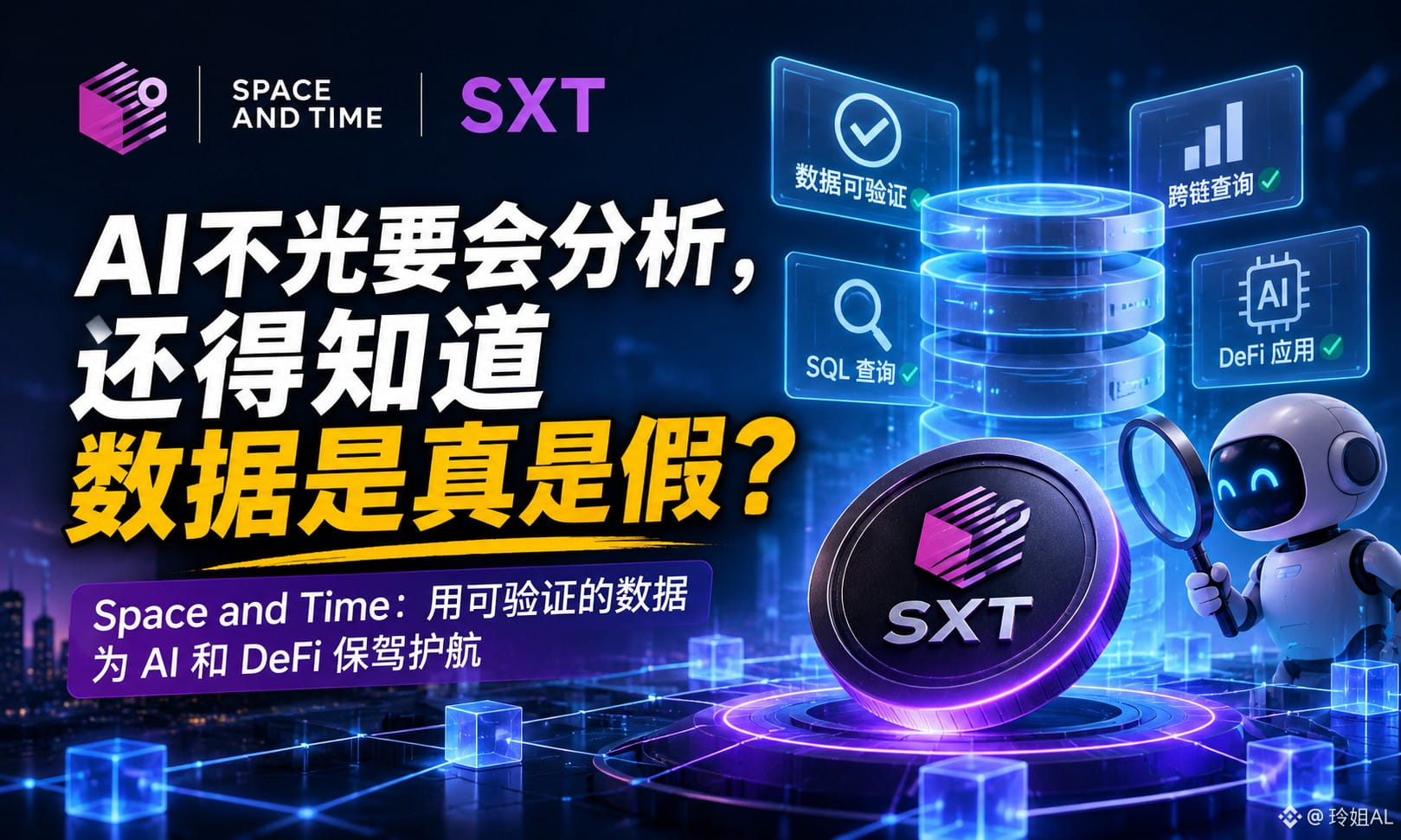
Recently, I’ve been looking into @SpaceandTime and found what the project is doing pretty interesting.
AI can now help us check market prices, analyze wallets, and track the flow of funds, but one issue is often overlooked: Is the data AI gets actually accurate? If the underlying data is faulty, even the best AI analysis won’t help.
That’s the problem Space and Time aims to solve.
Here are a few of its features worth paying attention to.
1. Cross-chain data queries
It can bring together data from different blockchains. The networks listed in the official documentation as currently supported include Ethereum, Bitcoin, Polygon, ZKsync, Sui, Avalanche, and others. For example, if you want to look up a wallet’s transaction history and changes in funds across different chains, you don’t have to research each chain separately—you can query them using SQL.
2. Proof of SQL data verification
I think this is its core feature. A traditional database gives you a query result, and usually you just have to trust it. SXT uses zero-knowledge proofs so that query results come with a verification proof.
Put simply, it doesn’t just tell you how many assets a wallet has; it can also prove that the calculation and underlying data haven’t been arbitrarily altered.
According to the official technical documentation, its verification results can be submitted to EVM smart contracts, with on-chain verification costing around 150,000 Gas.
3. Support for AI and DeFi data
For example, if an AI Agent wants to analyze the flow of funds for a project, or a DeFi protocol needs to verify collateral, user balances, and transaction records, it needs a lot of reliable data.
SXT can provide query results to AI applications and financial protocols through SQL, APIs, and smart contract interfaces. This means AI doesn’t just get a pile of data—it can also verify that the data is reliable.
4. What is the SXT token used for?
This is also worth paying attention to. SXT isn’t just a token named after the project. The official tokenomics link network workloads—such as data indexing, data writing, and zero-knowledge proof queries—to payments and settlements made with SXT.
In other words, if more developers use the network in the future, creating ongoing demand for data queries and verification, the token could have real-world utility.
#sxt $SXT @SpaceandTime