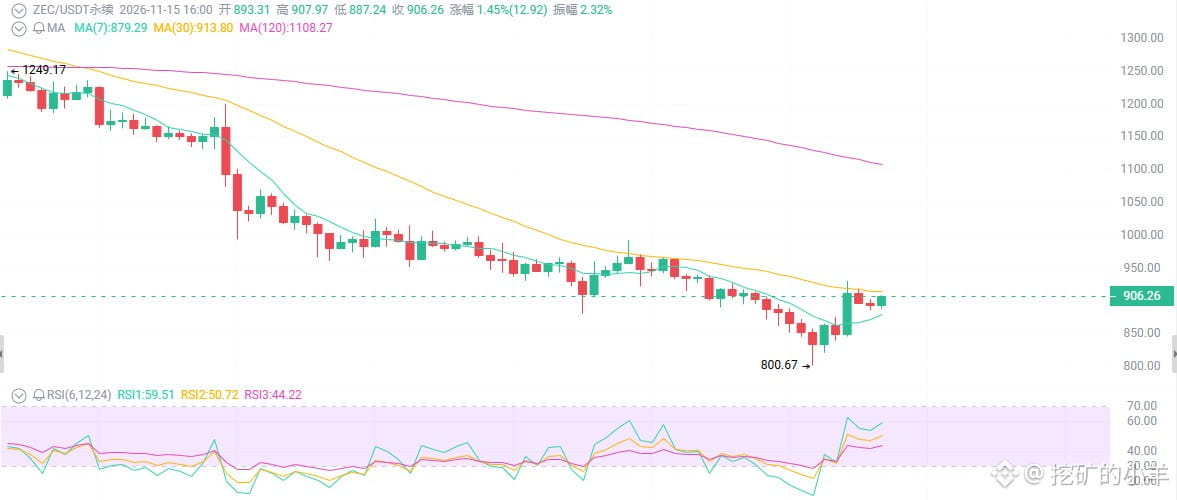
ZEC at $907—are you panicking?
It’s only been 10 days since the NU7 upgrade went live. Block times were cut from 75 seconds to 25, yet the price plunged from 1,300 to 907, dropping 30% in 7 days. What stings even more is that governance voting starts on November 16, and 50,000 ZEC are set to be redirected. Is this a classic case of “buy the rumor, sell the news,” or are whale manipulators using the privacy narrative for one last cash grab?
First, the surface picture: the upgrade is live, and the price has crashed.
Down 1–2% in 24 hours and 28–30% in 7 days, the price has been hammered from above 1,300 all the way down to 907. Market cap is down to $15 billion, ranking it in the top 11, with 24-hour trading volume exceeding $1 billion. The price is below the major moving averages, the chart structure has broken down, and volume has risen during the decline—sellers are in control.
First up: the NU7 upgrade is technically bullish, but the market is treating it as a signal to sell.
NU7 activated on November 6, cutting block times from 75 seconds to 25, adjusting fee distribution, and handling $16 million in frozen funds in the old Sprout privacy pool. Developers are also working on quantum resistance.
Sounds pretty impressive, right? But instead of rising, the price fell 30%.
What does “buy the rumor, sell the news” look like? This is a textbook example. No one cares how good the technology is right now. Retail traders are still dreaming of an “upgrade-driven rally,” while institutions had already gotten out ahead of the upgrade.
Second: governance voting starts November 16, and 50,000 ZEC are set to be redirected.
The proposal would remove or redirect around 50,000 ZEC from the treasury, while adjusting the 8% Grants allocation of block rewards and directing it toward development and a legal defense fund.
The vote will directly affect the supply narrative and how funds are used, so short-term volatility is inevitable.
Uncertainty itself is bearish. The broader market is already in risk-off mode: BTC has fallen to $62,000–$65,000, leveraged longs have faced billions in liquidations, and ETFs have seen consecutive outflows.
Third: the privacy narrative has staying power in the long term, but no one is buying it in the short term.
Zcash is a PoW privacy coin with optional private transactions using zk-SNARKs, a maximum supply of 21 million, around 81% in circulation, and a halving mechanism that curbs inflation. Grayscale has ZCSH-related products, and developer activity has picked up in recent years.
But look at the reality: DeFi TVL is in the millions of dollars, on-chain fee revenue is limited, and privacy coins as a whole face regulatory scrutiny from exchanges. The narrative is sexy, but the revenue is anything but.
Privacy is a real need, but that doesn’t mean the price has to rise right now.
When the broader market is risk-off, high-volatility altcoins are ATMs for everyone else. As a mid-to-large-cap privacy coin, ZEC tends to fall even harder. Don’t expect it to be immune.