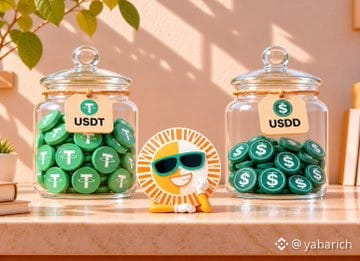
💧 100 USDT In, Less Than 100 USDD Out. Why?
Two stablecoins can both trade near $1 without exchanging at exactly 1:1 inside a liquidity pool.
The difference comes from how decentralized exchanges determine swap prices.
Consider a USDT/USDD pool.
When traders repeatedly swap USDT for USDD, the pool accumulates USDT while its USDD reserves decline.
As USDD becomes scarcer relative to USDT, the pool's pricing mechanism makes additional USDD purchases progressively more expensive.
SunCurve's StableSwap model is designed to address this challenge.
🔹 When liquidity is relatively balanced, the curve supports exchanges close to 1:1 with lower price impact.
🔹 When reserves become significantly imbalanced, the curve becomes steeper, discouraging further depletion of the scarce asset.
🔹 Trading fees can also reduce the final amount received.
My perspective: Stablecoin stability and swap execution are two different concepts.
A token trading near $1 does not guarantee a 1:1 swap. Understanding pool conditions is essential for evaluating the actual cost of stablecoin transactions.
@TRON DAO @Justin Sun孙宇晨
#TRONEcoStar #SunCurve #TRON #StableSwap #DeFi