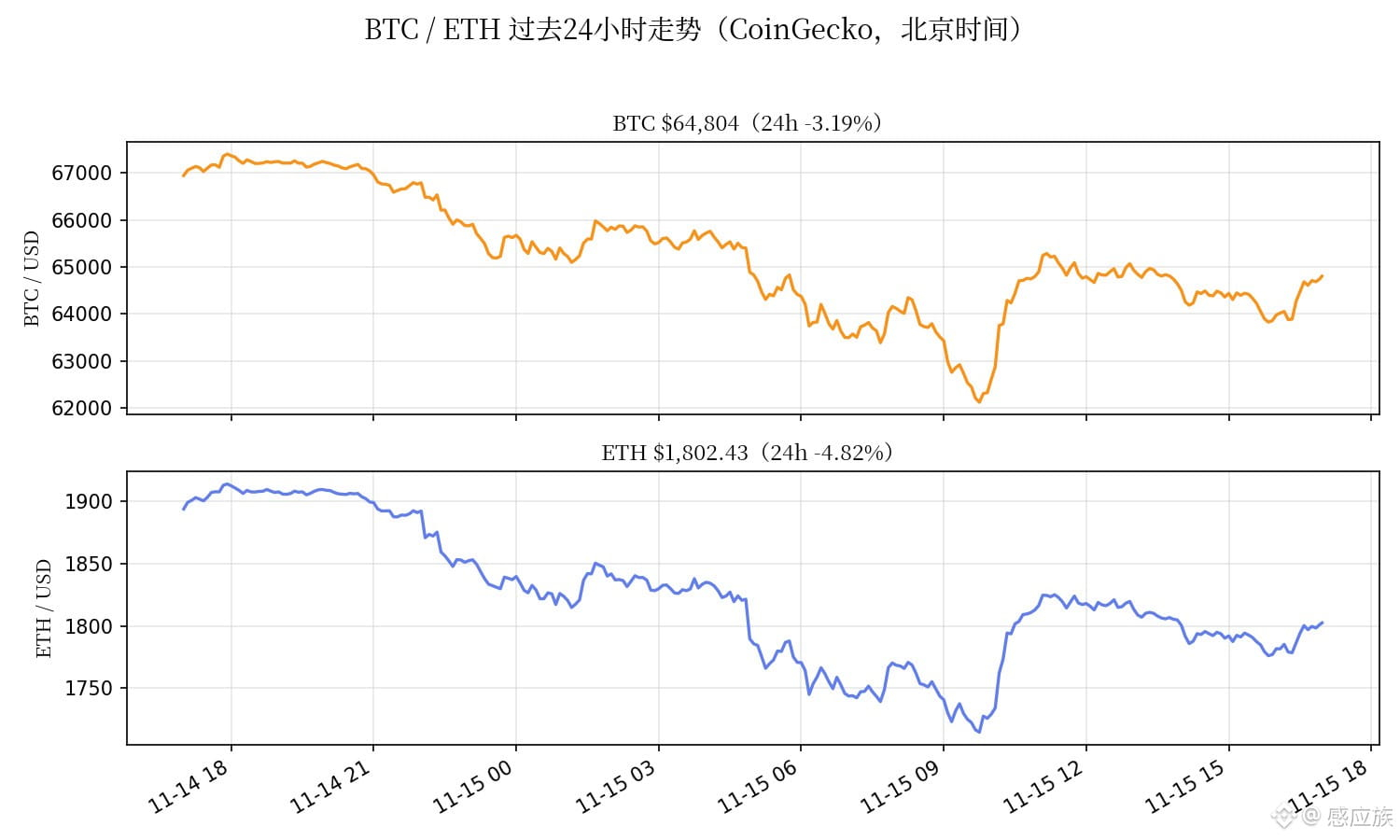
The 16:00 4-hour candle has closed, confirming another candle in the bearish structure. At 17:00, $BTC was about $64,797, down 3.2% in 24 hours; $ETH was about $1,802, down 4.8% (CoinGecko, actual reading at 17:00 Beijing time).
First, the candle: the 16:00 4-hour candle closed at $63,980, marking the eighth consecutive close below the 200-week moving average (around $68,000). At 12:00, it was the seventh, at $64,794. At the same time, 5,324 BTC in Deribit options expired, with a max pain price of $68,000. Yet around expiry, the price first plunged to about $63,880 before bouncing back to $64,800—the so-called “expiry magnet” didn’t materialize this time, and the bearish structure stayed intact.
On-chain data also looks bearish: Glassnode flagged a cluster of long liquidation orders around $59,500–$62,600. According to CryptoQuant, less than 45% of the active supply is still in profit. Short-term holders’ cost basis is about $75,068, nearly $10,000 above the current price—all these holders are underwater. About $2 billion in positions were liquidated across the market in 24 hours, nearly 90% of them longs (CoinGlass, as reported by multiple media outlets). BTC alone accounted for about $750 million in liquidations, 80% of them longs.
Trade #3 update: The short on a rebound, posted at 13:00 (scale in short between $67,000 and $68,000, stop above $68,500, targets at $62,300/$60,000), hasn’t been triggered yet. Since 13:00, the high has only reached about $65,026, still roughly $2,200 below the lower end of the entry zone. No entry, no profit or loss. My decision is unchanged: I won’t chase a short at $64,800 in the middle of the range. I’ll wait for a rebound to $67,000–$68,000 and scale in. If the price breaks below $62,300 before a rebound comes, the trade won’t trigger; I’ll reassess then, and won’t chase a short below $62,300. The invalidation level is unchanged: exit if a 4-hour candle closes above $68,000; I’ll only consider flipping long if the price gets back above $70,500. With 100x leverage, I’ll put only a very small portion of my total funds toward margin.
Overhead resistance: $65,600 is the first hurdle, followed by $68,000–$70,000 (according to crypto.news). Support below is first at $62,000, then $60,000—which is also my second target. Monday’s 08:00 weekly close will be the final test: a close below $68,000 would mark a sixth consecutive weekly decline.
Kava is still crashing, down 44% in a day (Upbit and Bithumb have suspended deposits and withdrawals while they investigate the cause). VVV is up 6.9% against the trend. Both are small-cap coins—just sentiment thermometers, not something I’d touch.
Do you think the rebound can reach $67,000 before Monday’s open? Let’s talk in the comments. (Prices: actual CoinGecko readings at 17:00 Beijing time on November 15; chart shows the past 24 hours.)