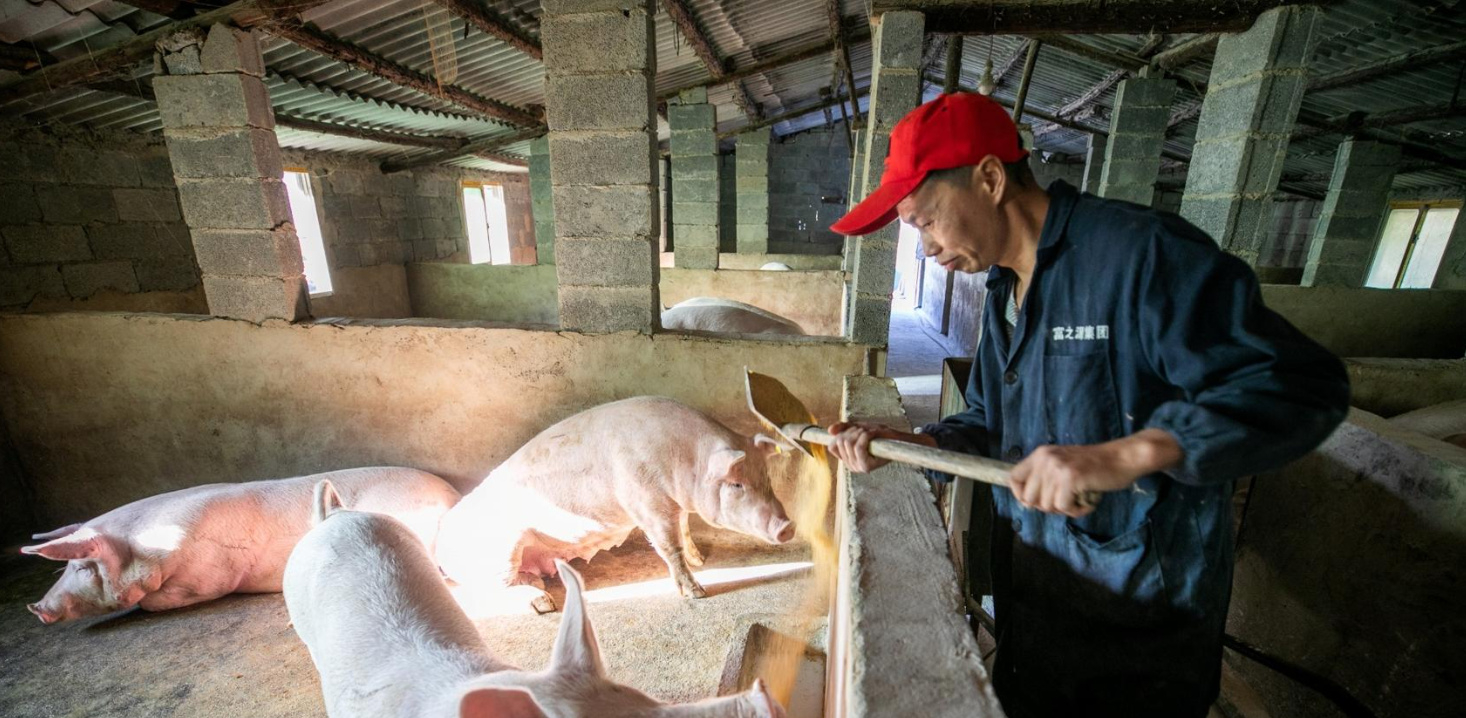

Many people think that as long as you're willing to work hard, you can make money running a brick-and-mortar business. But anyone who's actually been through it knows that when the market is bad, even working harder may not help. This fan's story is a true reflection of an ordinary man from the countryside.
He's 38, grew up in the countryside, and has little formal education. When he was young, he learned pig farming from his relatives. Later, he leased a plot of land and started raising pigs on his own. When the market was good, he could make quite a bit of money in a year. Although he had to feed the pigs, clean their pens, and keep an eye on their feed and disease prevention every day—sometimes getting so busy he didn't even have time to eat—watching the pigs grow day by day and eventually sell for real money made him feel that all the hard work was worth it.
In 2020, a fellow villager who ran a business out of town returned to the village. While we were eating and chatting, he brought up Bitcoin. He'd never heard of it before and initially thought it seemed a bit dubious. Later, he bought himself a phone and started checking BTC prices online and learning about blockchain and exchanges. He didn't rush to invest a lot of money at first. Instead, he used a small portion of the profits from his livestock business to buy BTC and ETH. Unexpectedly, the market later took off, and his account did earn him a decent extra return. He was overjoyed. He thought that since he could make money raising pigs and make money investing, his life finally had a brighter future.
But who could have known that the real test was still to come.
Later, conditions in the livestock industry began to change. Feed prices kept rising, while hog prices fluctuated repeatedly. The profit from each pig kept shrinking. Sometimes, after months of hard work, there was barely anything left after selling them. Rent, labor, disease prevention, feed—every item was an expense, and cash flow grew tighter and tighter.
As if that weren't enough, he also started making mistakes in crypto.
The more pressure he faced in his real-world business, the more he wanted to make his money back quickly in crypto.
He used to be able to patiently hold spot assets, but later he started trading short-term constantly. When he saw BTC going up, he chased long positions; when it fell, he hurried to open shorts. Sometimes the price rose just after he sold, or dropped just after he bought. He was being pulled along by the market. He kept thinking that if he could just catch one big move, he could solve the problems at the farm.
Once, BTC suddenly became highly volatile. Watching the price fall continuously, he thought it had hit bottom and opened a long position. But the price kept dropping, and his unrealized losses grew larger and larger. He didn't want to cut his losses, thinking he'd get out after a small rebound. He even considered adding to his position. In the end, the market didn't go the way he expected, and his account suffered huge losses.
During that period, the first thing he did each morning wasn't go to the pig farm—it was check the account on his phone. He needed to keep money in the bank for feed, and the farm still had labor and other expenses to cover, while his investments had taken a loss. At his lowest point, he even considered shutting down the entire farm.
He said something that really struck me: “When I lose money raising pigs, at least I know the pigs are still in the pen. When I lose money in crypto, the numbers disappear from the screen, and there's nothing I can hold on to.”
Eventually, he realized he couldn't keep mixing his real-world business with investing, and he certainly couldn't rely on futures trading to make up for losses at the farm.
He started learning about trading again and set a few rules for himself. First, he had to control his position size and strictly separate living expenses, feed money, and trading funds. He wouldn't gamble with money needed to keep the business running. Second, he would set a stop-loss before every trade and exit once the loss reached the preset level, rather than averaging down by adding to his position. Third, he would learn to wait. If BTC had no clear trend, or the price hadn't reached a key support or resistance level, he wouldn't open a position on a whim. Fourth, he would control his emotions. After a string of losses, he would pause trading—and never rush into the market at night to win back money he'd lost raising pigs during the day.
Later, he started checking the market at a set time each day and recording BTC's trend, key levels, and the profit or loss on every trade. For example, when the price broke through resistance, he wouldn't rush in and chase it. Instead, he'd wait for a retest to confirm the breakout, then see if there was a suitable entry opportunity. If the price action didn't match his expectations, he'd follow his plan and exit at his stop-loss. At first, he traded very slowly. Sometimes he wouldn't make a single trade all day. But at last, he had stopped trading just for the sake of trading.
After some time adjusting his approach, his account gradually began to grow again. A few trend trades that followed his plan also produced good results. But unlike before, he didn't recklessly increase his position size. He set aside some of his profits as savings and used the rest to keep learning and practicing.
His farm isn't as large as it used to be, but the business is gradually becoming more stable, and he's managed to build up some savings again. He plans to improve the farm's equipment first to reduce labor costs, then slowly set aside money for his children's education. He still trades crypto, but it is no longer his whole life.
I asked him, “After going through all that, what changed the most?” He said, “I used to think making money meant working yourself to the bone. Then I thought it meant seizing opportunities. Now I know what really matters is whether you can hold on to the money you've earned.”
I think there's a lot of truth in that.
In livestock farming, you have to pay attention to hog prices, feed costs, and market cycles. In trading, you have to pay attention to trends, position size, and risk. The two may seem completely different, but the principles are much the same: just because you made money before doesn't mean you'll keep making money; and just because you're losing money now doesn't mean you should hastily bet everything on one move.
I often tell the guys in my trading group that the most important thing in trading isn't how many market moves you can catch each day, but whether you can keep your hands off the keyboard when things are uncertain. Position size determines risk, stop-losses protect your capital, patience determines the quality of your entries, and your emotions determine whether you can stick to your plan.
If you're also dealing with losses, or you've just entered the crypto market and don't yet have your own trading approach, you're welcome to join our group and share ideas. We regularly discuss BTC and ETH market analysis, trading logic, and reviews of real trades, so we can learn and improve together. We can't guarantee that everyone will make money; we just hope to help people avoid unnecessary detours and keep them from handing over their hard-earned savings to the market.
I'll leave you with this: people in the countryside can build a better life little by little with their own hands, and ordinary people can change the way they think through learning. But whatever you do, never forget to hold on to your principles. If you can't make money, take your time. When your capital is gone, that's when life really gets hard.$EVAA $INIT $BLESS