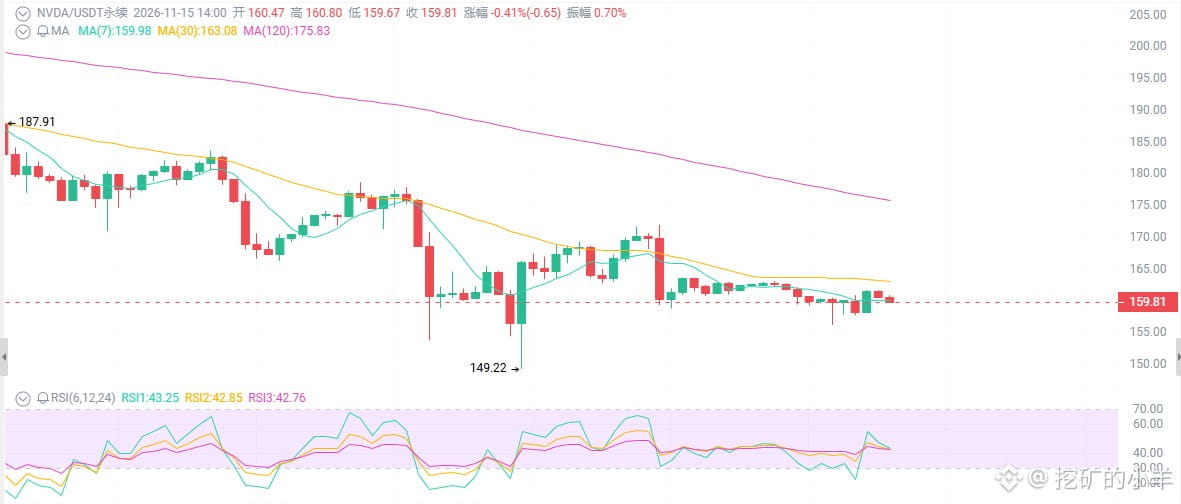
Nvidia at $160—would you dare catch a falling knife?
A scandal involving Jensen Huang has blown up, the board is discussing his future, and the stock has plunged 30% from $243 to $160. But the RSI is only 25, deep in oversold territory, and Tuesday’s earnings report will be a life-or-death verdict—is this a once-in-a-decade golden opportunity, or a bottomless pit?
First, the surface picture: a waterfall-like plunge, but the indicators are already crying “uncle.”
From its early October high of $243, the stock has been hammered down to $160, a drop of over 30%. It has fallen below the 200-day moving average at $204 and below the annual trend line. The moving averages are bearishly aligned, and the MACD death cross is deepening. The daily RSI is around 25, deep in oversold territory. Trading volume has risen during the decline, with long liquidations dominating. The stock has fallen too far in the short term, but the trend has not turned bullish yet.
First key point: Jensen Huang’s scandal is the real protagonist behind this selloff.
The biggest negative catalyst over the past two weeks wasn’t collapsing AI demand or a disastrous earnings report—it was leadership uncertainty. Reports involve an extramarital affair and alleged ties to people connected to China. The board has discussed whether he should stay, followed by reports that he might resign or be ousted. Analysts at Cantor, Bernstein, Evercore, and others have cut their price targets, with some slashing them from extremely high levels to $200–$250.
The stock’s fall from $243 to $160 isn’t about valuation—it’s about whether “Jensen Huang will still be sitting in that chair.”
Second key point: the fundamentals are monstrous, but the market isn’t paying attention to them right now.
Q2 revenue was $9.62 billion, up 106% year over year; data center revenue was $8.9 billion, up 117%. Q3 guidance is $10.8 billion, plus or minus 2%, and FY2028 growth is expected to hold at around 70%. Gross margin is about 75%, free cash flow is strong, and the buyback authorization is large.
There’s nothing wrong with the company’s ability to make money. The problem is the “person.”
The market is worried that rising HBM costs will squeeze margins, custom-chip competition will intensify, export-compliance risks will grow, and the AI capital-spending cycle will slow—amid interest rates, power constraints, political headwinds, and policy uncertainty after the midterm elections.
Third key point: Tuesday’s earnings report will be the real life-or-death verdict.
After the U.S. market closes on November 17, the company will report FY2027 Q3 results. The market is focused on three things:
Will the guidance be reaffirmed—can Q3 guidance of around $10.8 billion, plus or minus 2%, and FY2028 growth of around 70% hold up?
How is Vera Rubin’s ramp progressing—can the next-generation product take over?
Strong guidance reaffirmed + smooth leadership transition → a rapid rebound to test $170+, or even $180.
Weaker-than-expected guidance + leadership chaos → another test of $150, or even the 52-week low of $148–$149.
Vague, neutral results → continued grinding between $150 and $170 until you lose your patience.
A scandal involving Jensen Huang has blown up, the board is discussing his future, and the stock has plunged 30% from $243 to $160. But the RSI is only 25, deep in oversold territory, and Tuesday’s earnings report will be a life-or-death verdict—is this a once-in-a-decade golden opportunity, or a bottomless pit?
First, the surface picture: a waterfall-like plunge, but the indicators are already crying “uncle.”
From its early October high of $243, the stock has been hammered down to $160, a drop of over 30%. It has fallen below the 200-day moving average at $204 and below the annual trend line. The moving averages are bearishly aligned, and the MACD death cross is deepening. The daily RSI is around 25, deep in oversold territory. Trading volume has risen during the decline, with long liquidations dominating. The stock has fallen too far in the short term, but the trend has not turned bullish yet.
First key point: Jensen Huang’s scandal is the real protagonist behind this selloff.
The biggest negative catalyst over the past two weeks wasn’t collapsing AI demand or a disastrous earnings report—it was leadership uncertainty. Reports involve an extramarital affair and alleged ties to people connected to China. The board has discussed whether he should stay, followed by reports that he might resign or be ousted. Analysts at Cantor, Bernstein, Evercore, and others have cut their price targets, with some slashing them from extremely high levels to $200–$250.
The stock’s fall from $243 to $160 isn’t about valuation—it’s about whether “Jensen Huang will still be sitting in that chair.”
Second key point: the fundamentals are monstrous, but the market isn’t paying attention to them right now.
Q2 revenue was $9.62 billion, up 106% year over year; data center revenue was $8.9 billion, up 117%. Q3 guidance is $10.8 billion, plus or minus 2%, and FY2028 growth is expected to hold at around 70%. Gross margin is about 75%, free cash flow is strong, and the buyback authorization is large.
There’s nothing wrong with the company’s ability to make money. The problem is the “person.”
The market is worried that rising HBM costs will squeeze margins, custom-chip competition will intensify, export-compliance risks will grow, and the AI capital-spending cycle will slow—amid interest rates, power constraints, political headwinds, and policy uncertainty after the midterm elections.
Third key point: Tuesday’s earnings report will be the real life-or-death verdict.
After the U.S. market closes on November 17, the company will report FY2027 Q3 results. The market is focused on three things:
Will the guidance be reaffirmed—can Q3 guidance of around $10.8 billion, plus or minus 2%, and FY2028 growth of around 70% hold up?
How is Vera Rubin’s ramp progressing—can the next-generation product take over?
Strong guidance reaffirmed + smooth leadership transition → a rapid rebound to test $170+, or even $180.
Weaker-than-expected guidance + leadership chaos → another test of $150, or even the 52-week low of $148–$149.
Vague, neutral results → continued grinding between $150 and $170 until you lose your patience.