
A secondary-school teacher in Hong Kong switched careers to trading and grew $1 million into $16 million in two years.
In 2024, he won the U.S. Investing Championship’s $1 million-plus stock division, breaking Minervini’s record in that category. The following year, he defended his title, while his wife took second place using the same strategy 👍👍
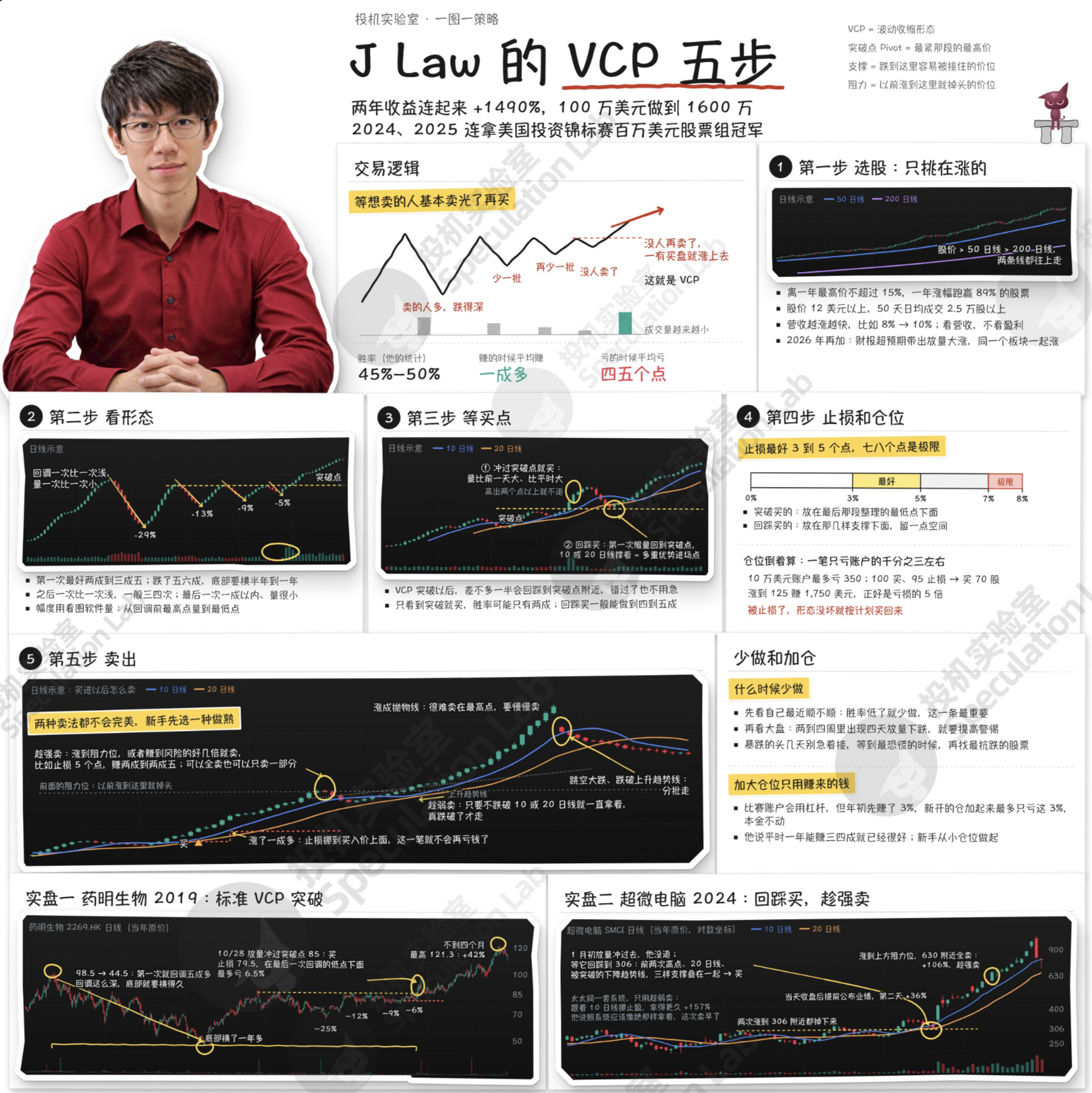
His name is J Law, and he uses Minervini’s VCP strategy. I’ve turned his entire approach into this one graphic.
His idea is to wait until most of the people who want to sell have already sold, then buy. With each pullback, fewer sellers remain, so the pullbacks get shallower and volume gets lighter. Once there are no sellers left, any buying pressure can send the price higher.
First, choose stocks: only consider stocks that are rising, with prices above the 50-day moving average, the 50-day above the 200-day, and both averages trending up. Revenue should also be growing at an accelerating rate.
Next, look at the chart pattern: each pullback should be shallower than the last, with the final one no deeper than 10%. Volume should be very light on down days. The high of the tightest area is the breakout point.
There are two ways to buy: buy when the price surges above the breakout point on heavy volume, or wait for its first low-volume pullback to the breakout point and buy if the 10-day or 20-day moving average provides support. Ideally, set your stop 3–5% below your entry; 7–8% is the absolute maximum. Work out your position size in reverse, so each trade risks only about 0.3% of your account.
Once the stock is up more than 10%, move your stop above your entry price. There are also two ways to sell: sell when it reaches resistance—this is called selling into strength—or hold it by following the 10-day or 20-day moving average—this is called selling into weakness. Beginners should pick one approach and get comfortable with it first.
The graphic shows how to draw each step, when to trade less, and two real trades: WuXi Biologics and Super Micro Computer.