Beginner Lesson 42: Do your stop-losses keep getting triggered? First check how volatile this coin is, then use ATR to set the distance
Many beginners like to use a fixed percentage for stop-losses, such as 2% across the board. But $BTC and other coins don’t all have the same volatility, so the same percentage can fall right within normal price fluctuations and get triggered repeatedly. ATR (Average True Range) measures how much an asset typically moves: it looks at how far a candle in this coin has moved over a recent period, including gaps. It is not a buy or sell signal and won’t tell you whether the price will go up or down.
1. How to read it
1) Search for ATR in your trading app. A common setting is 14, meaning it smooths the true range over the most recent 14 candles;
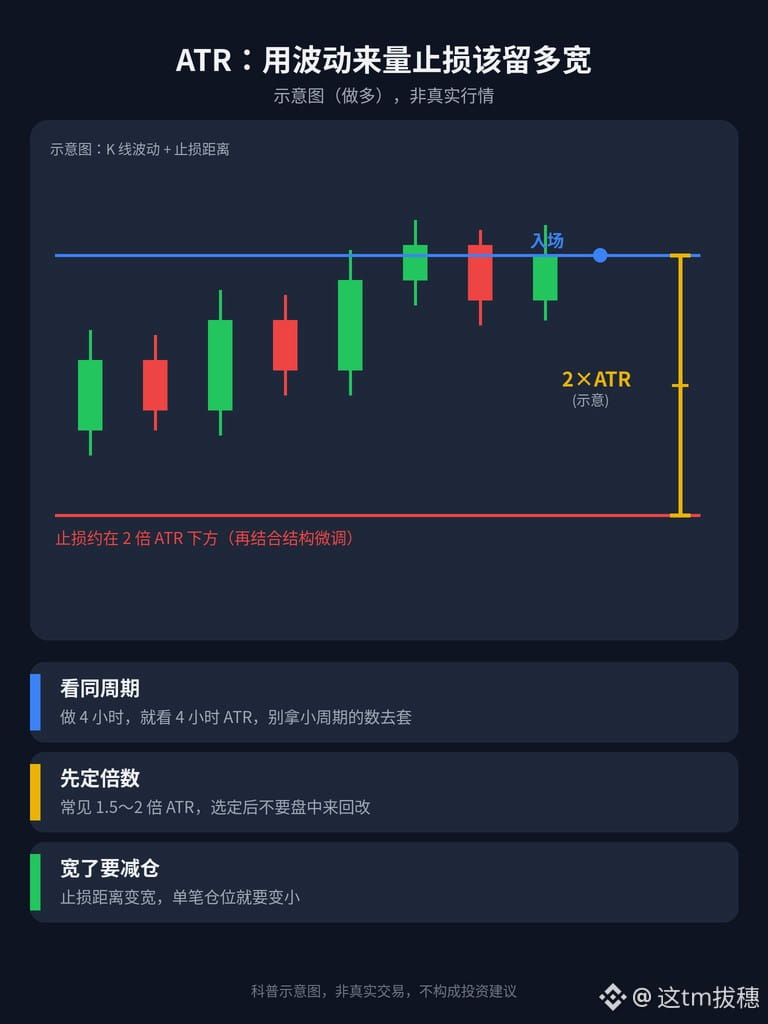
2) Check the timeframe you’re trading: if you’re trading the 4-hour chart, use the 4-hour ATR. Don’t apply a 5-minute figure to a daily trade;
3) A rising ATR means recent price action is more volatile. If that means you need a wider stop-loss, you should also reduce your position size—not move the stop-loss on an existing position further into loss.
2. How to use it to set a stop-loss
You can use 1.5 to 2 times the ATR as a guide for the distance, but this isn’t a universally optimal setting. Choose your rules before entering a trade. When going long, consider support and market structure, and check whether your stop-loss is outside the range of normal fluctuations instead of just picking a round-number percentage.
For popular coins with especially high short-term volatility on November 14, such as $SHELL , using a very tight stop-loss like you might when trading $ETH or Bitcoin can easily get you stopped out by normal price swings. If your planned stop-loss needs to be wider, reduce your position size; if the risk doesn’t suit you, you can also skip the trade. Never combine a wide stop-loss with a large position.
Before you read on, take a moment to choose: when setting a stop-loss, do you mostly use a fixed percentage, or do you check volatility first?
3. Common beginner mistakes
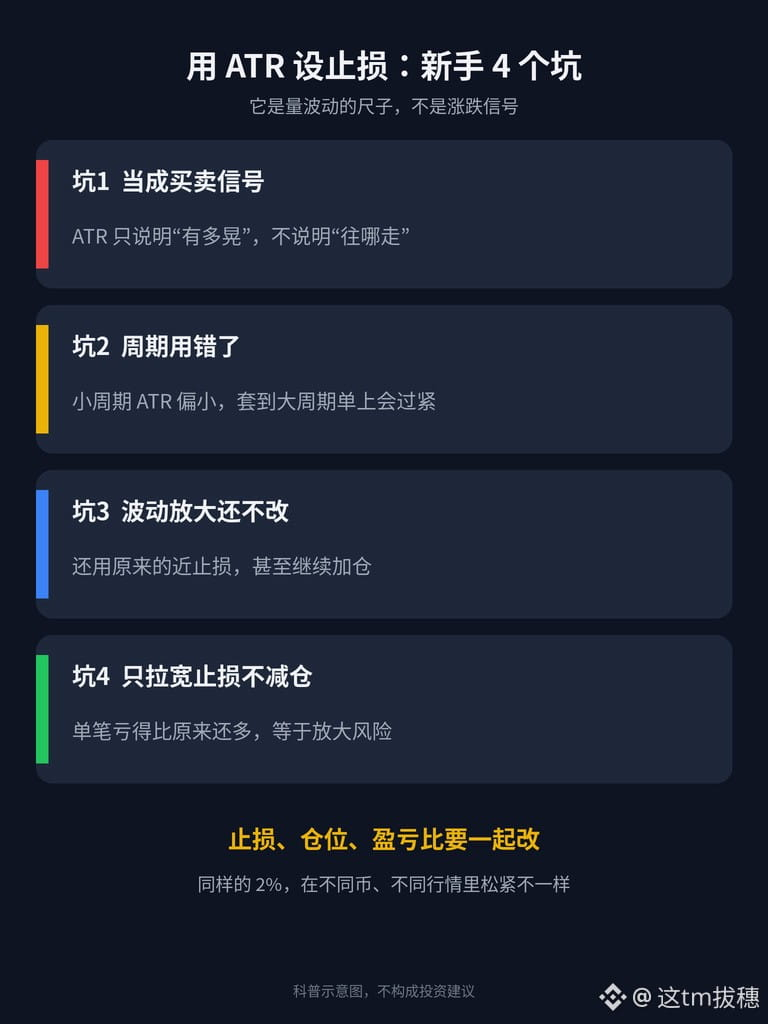
1) Treating ATR as a price-direction signal: it only tells you “how much it moves,” not “which way it’s going”;
2) Using the wrong timeframe: ATR on a shorter timeframe tends to be smaller, so applying it to a longer-timeframe trade can make your stop-loss too tight;
3) Ignoring ATR’s lag: when unexpected news breaks, actual volatility can far exceed past levels;
4) Widening your stop-loss without reducing your position size, which can make your loss per trade even larger than before.
This ties in with position sizing from Lesson 9 and risk-reward ratio from Lesson 40: before entering a trade, if the stop-loss distance gets wider, your position size should get smaller. Reassess your target, too—don’t push it farther away just to force a particular risk-reward ratio.
In short: first measure how much a coin moves, then decide how wide to set your stop-loss and how large your position should be. The same 2% can be loose or tight depending on the coin and market conditions.
Here’s a specific question: when setting a stop-loss, would you choose A, a fixed percentage, or B, a distance based on ATR or recent volatility? Just reply with a letter in the comments.
The content above is for educational purposes only and does not constitute investment advice. Crypto assets are highly volatile, and futures trading carries even greater risks. Only trade with money you can afford to lose.
#新手入门 #技术分析 #BinanceSquare