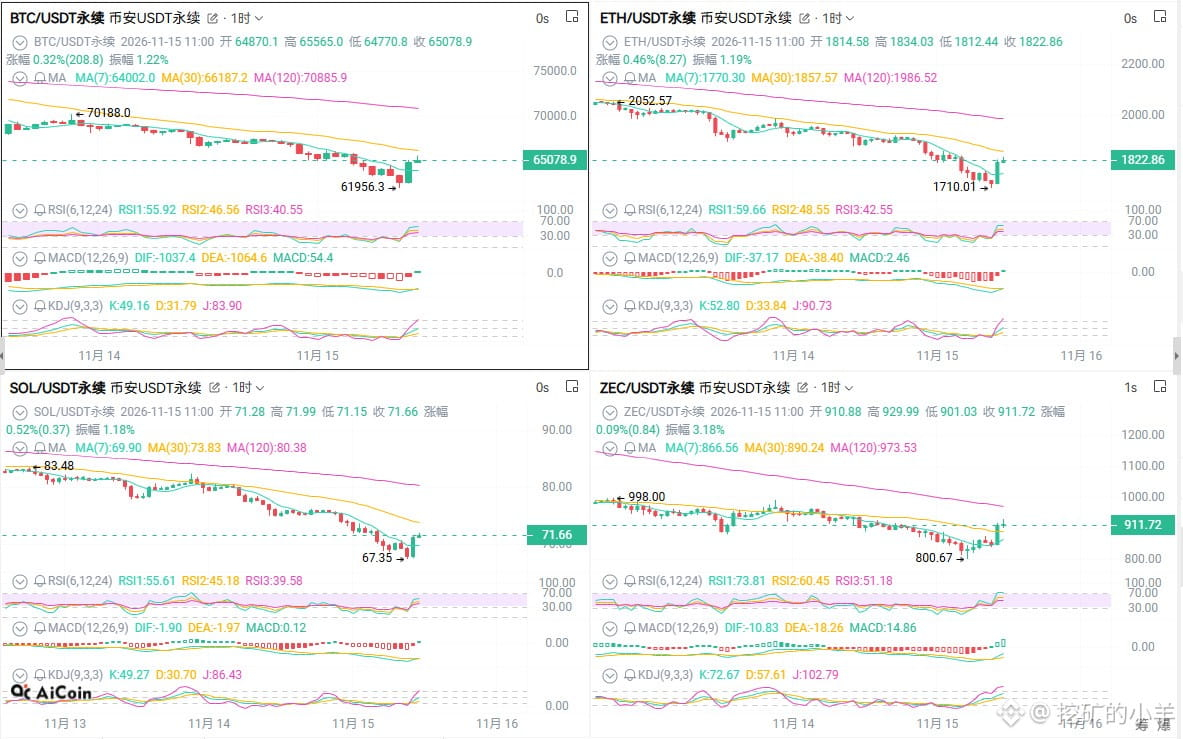
At 8 o’clock, people were still panicking, thinking the $60,000 level wouldn’t hold. Then BTC bounced from $62,006 to $64,820, ETH climbed back above $1,800, and SOL also began to recover.
Some started calling it a buying opportunity, others thought the worst was over, and some couldn’t wait to buy back the positions they had previously sold.
But a big drop doesn’t mean the decline is over, and a quick rebound doesn’t mean the trend has reversed.
BTC rebounded 4.54%, but was still down 4.25% over 24 hours.
ETH rebounded 6.05%, but was still down 5.15% over 24 hours.
SOL rebounded 5.55%, but was still down 6.69% over 24 hours.
What we’re seeing right now is only a partial recovery of the losses—not a market that has returned to an upward trend.
U.S. spot BTC ETFs saw net outflows of about $1.07 billion last week, marking seven consecutive trading days of outflows. ETH ETFs have also faced outflows for several weeks.
The stablecoin supply has fallen by about $14.2 billion over the past 30 days.
Put simply:
Some people in the market are buying the dip, but money from outside the market hasn’t clearly returned yet.
A true bottom isn’t a sudden 4% rise on a particular day. It’s when, during a decline, sellers finally run out, and buyers begin to step in consistently.