In the Federal Reserve’s financial stability report last Friday, 87% of respondents listed AI as their top risk.
That 87% is twenty out of twenty-three people.
The sample consisted of just twenty-three contacts, and the survey was conducted in September and October.
Convert the percentage back into a headcount, and the warning carries a different weight. But there’s another set of figures in the report that’s just as striking when converted into people-sized numbers.
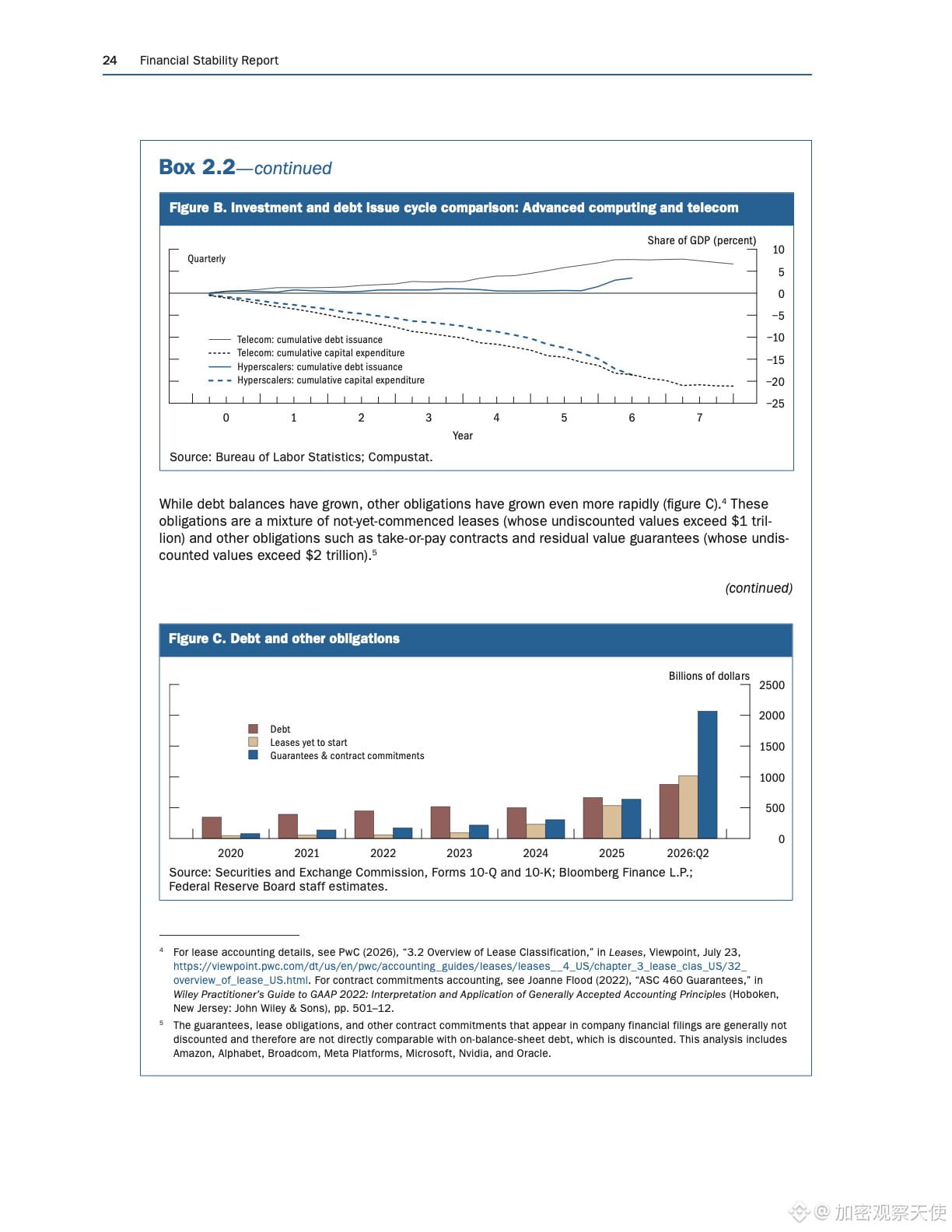
As of October, bond issuance related to advanced computing had exceeded $680 billion, five times the total for all of 2023.
This type of borrowing rose from less than 6% to about 31% of issuance of nonfinancial investment-grade corporate bonds.
Outstanding publicly traded debt is estimated at more than $1.1 trillion.
The heavier burden is off the balance sheet.
Leases that haven’t started yet have an undiscounted value of more than $1 trillion. Add take-or-pay contracts and residual value guarantees, and the total exceeds another $2 trillion.
The report’s footnote is clear: these figures are undiscounted and can’t be added directly to balance-sheet debt.
So $1.1 trillion and $3 trillion belong in two separate drawers. Adding them together would lump “how much was borrowed” in with “what was promised.”
$NVDAB and $MSFTB are both on that list of seven, and both trade on Binance around the clock.
The timing matters too. The data are as of October 28, and the report was published on November 13.
In those three days, November 10–13, the 10-year yield rose from 4.98% to 5.15%, while Bitcoin fell from 73,796 to 68,314.
So the claim that “the Fed warned about this drop” gets the timing backwards. It warned about a valuation situation that already existed.
What I’m unsure about is whether these leases will really turn into liabilities. Signing for fifteen years and installing equipment over three years, then seeing demand forecasts change while commitments remain unchanged—that makes sense, but it can’t be verified.
The real thing worth remembering is this mismatch.
Any company that builds its expansion into leases rather than capital expenditures will eventually leave its heaviest burden in the footnotes of its financial statements.
The balance sheet records money already spent; the footnotes record money that hasn’t been spent yet but must be.
At 9:30 a.m., the 10-year yield was still at 5.15%, the Nvidia token was at 157.80, 3.1 points below Friday’s close.
Do you think this $3 trillion should be included in valuation, or in the risk premium?
Methodology: The report is the Fed’s official PDF. The figures are taken from the original text of Box 2.2 and are undiscounted; data are as of October 28.
The above is a compilation of public information and personal analysis, and does not constitute investment advice.
That 87% is twenty out of twenty-three people.
The sample consisted of just twenty-three contacts, and the survey was conducted in September and October.
Convert the percentage back into a headcount, and the warning carries a different weight. But there’s another set of figures in the report that’s just as striking when converted into people-sized numbers.
As of October, bond issuance related to advanced computing had exceeded $680 billion, five times the total for all of 2023.
This type of borrowing rose from less than 6% to about 31% of issuance of nonfinancial investment-grade corporate bonds.
Outstanding publicly traded debt is estimated at more than $1.1 trillion.
The heavier burden is off the balance sheet.
Leases that haven’t started yet have an undiscounted value of more than $1 trillion. Add take-or-pay contracts and residual value guarantees, and the total exceeds another $2 trillion.
The report’s footnote is clear: these figures are undiscounted and can’t be added directly to balance-sheet debt.
So $1.1 trillion and $3 trillion belong in two separate drawers. Adding them together would lump “how much was borrowed” in with “what was promised.”
$NVDAB and $MSFTB are both on that list of seven, and both trade on Binance around the clock.
The timing matters too. The data are as of October 28, and the report was published on November 13.
In those three days, November 10–13, the 10-year yield rose from 4.98% to 5.15%, while Bitcoin fell from 73,796 to 68,314.
So the claim that “the Fed warned about this drop” gets the timing backwards. It warned about a valuation situation that already existed.
What I’m unsure about is whether these leases will really turn into liabilities. Signing for fifteen years and installing equipment over three years, then seeing demand forecasts change while commitments remain unchanged—that makes sense, but it can’t be verified.
The real thing worth remembering is this mismatch.
Any company that builds its expansion into leases rather than capital expenditures will eventually leave its heaviest burden in the footnotes of its financial statements.
The balance sheet records money already spent; the footnotes record money that hasn’t been spent yet but must be.
At 9:30 a.m., the 10-year yield was still at 5.15%, the Nvidia token was at 157.80, 3.1 points below Friday’s close.
Do you think this $3 trillion should be included in valuation, or in the risk premium?
Methodology: The report is the Fed’s official PDF. The figures are taken from the original text of Box 2.2 and are undiscounted; data are as of October 28.
The above is a compilation of public information and personal analysis, and does not constitute investment advice.