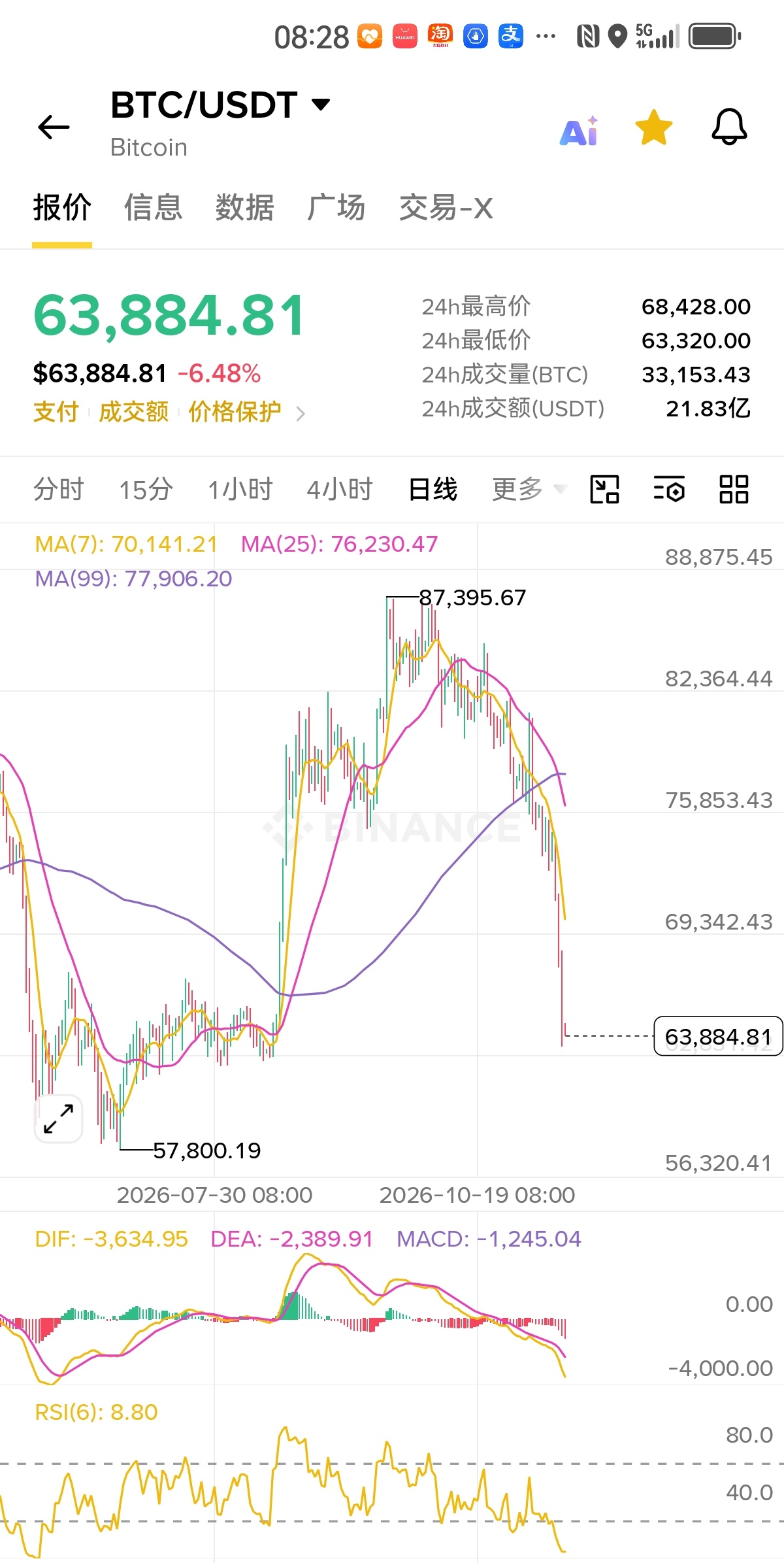
150,000 people got liquidated overnight, $BTC and the price was driven straight down to $63,000. This drop really wasn’t undeserved—the bad news just kept piling up.
The most immediate trigger was another hotter-than-expected inflation report. U.S. CPI rose 0.4% month over month in October, while core CPI rose 0.3%—both above expectations. The market had thought the Fed could take a breather, but Waller came right out and said a 50-basis-point cut in December could be considered, while a 25-basis-point cut would “jeopardize the central bank’s credibility.” Hopes for rate cuts were dashed, risk assets took a beating across the board, and crypto was hit first.


But macro factors alone weren’t enough to make things this bad—institutions are bailing too. From November 2 to 13, U.S. spot Bitcoin ETFs saw net outflows of $2.347 billion over two trading weeks, with redemptions exceeding $1 billion in each week. BlackRock’s IBIT was even worse: it posted net outflows for 11 consecutive trading days starting October 30, totaling about $2.35 billion. ETFs were among the biggest buyers in this bull market; now they’ve become the biggest sellers.
Sentiment took another two hits. The fallout from the $6 billion Binance theft is still unfolding, dealing another blow to trust in centralized platforms. On top of that, news of Jensen Huang’s resignation rattled U.S. stocks, sending risk appetite crashing—and crypto naturally wasn’t spared.$ETH

There’s also a painful twist in the logic: people used to think that when AI stocks cooled off, money would flow back into crypto. But in this AI pullback, people looking to buy the dip went for Nvidia instead, and Bitcoin lost out as it competed with AI stocks for capital. Stablecoin supply shrank by $14.2 billion over 30 days, its biggest contraction since the 2022 bear market, meaning there’s less and less capital on the sidelines ready to buy the dip.
So this isn’t a single bearish factor—it’s four things colliding at once: rate-hike fears, ETF outflows, a crisis of confidence, and shrinking liquidity. After Bitcoin fell below its 200-day moving average at $73,000, leveraged longs were liquidated in a cascade. Liquidations briefly surged to $1.9 billion in 24 hours, almost all of them long positions.
Don’t rush to call a bottom in the short term. First, let’s see how much the Fed actually raises rates in December. The market is currently pricing in an 88% probability of a 25-basis-point hike, but if it really goes for 50, there could be more downside. Staying alive matters more than anything.$SOPH #英伟达正物色新CEO,谁会接替黄仁勋? #美国PPI年率6.5%,低于预期或缓解BTC压力 #比特币活跃供应盈利占比跌破45%