Last night, UniHexa published the first article in a series of long-form posts. The title says it all: Why can limit orders only be filled in full?
It opens by mentioning a semi-automated token listing plan, but the article is really about a limitation of traditional Bitcoin limit orders. The team announced a total of three articles; this is the first, and the other two haven't been released yet.
Here are the key points:
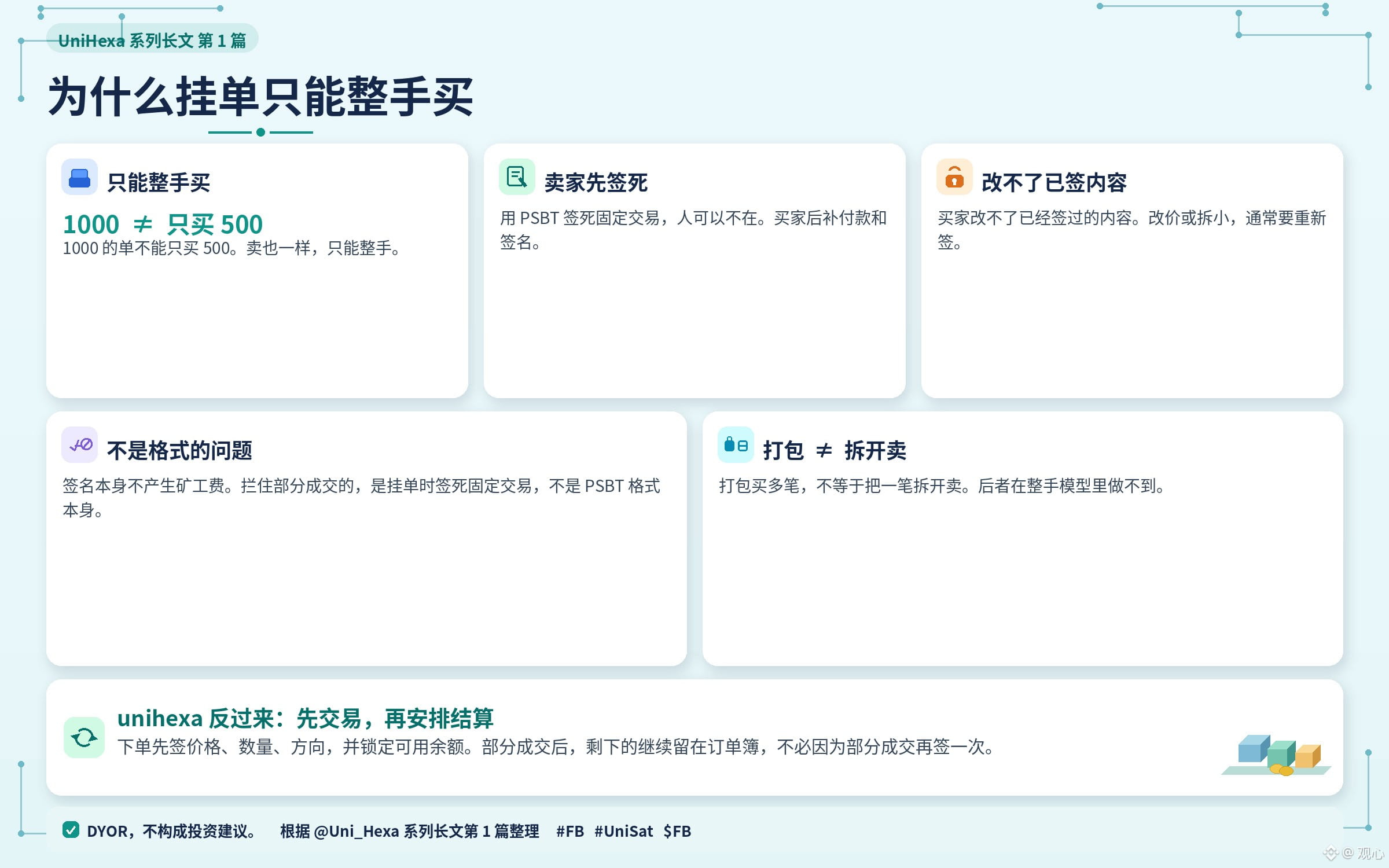
▪️Traditional limit orders can only be filled in full. If an order is for 1,000, you can't buy just 500. The same goes for selling: only the full amount is allowed.
▪️The seller first signs a fixed transaction using PSBT. They don't need to be present; the buyer adds the payment and signature later.
▪️The buyer can't change the signed transaction. Changing the price or splitting the order into smaller amounts usually requires signing again.
▪️A signature itself doesn't incur miner fees. What prevents partial fills is that the fixed transaction is signed when the order is placed—not the PSBT format itself.
▪️Bundling multiple buys ≠ splitting one order into smaller sales. The latter isn't possible under the full-lot model.
▪️UniHexa does the opposite: trade first, then arrange settlement. When placing an order, you sign the price, quantity, and direction, and lock the available balance. After a partial fill, the remainder stays in the order book, with no need to sign again just because the order was partially filled.
#FB #UniSat $FB