
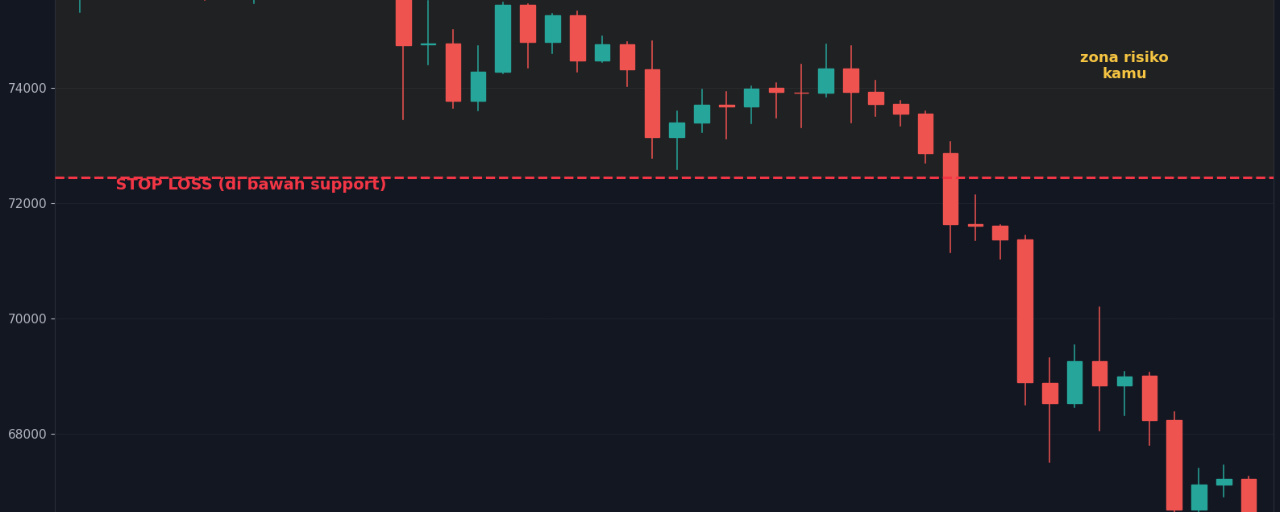

Have you ever bought a coin, watched the price dip a little, and thought, "It’ll go back up," only for it to keep falling until you’re stressed out? That usually happens because you got in without setting a clear loss limit. A stop loss is your brake, so decide in advance where you’ll get out before emotions take over.
**How to Set One Sensibly**
First, decide your entry price and why you’re buying. For example, if you buy because the price is holding at a support area, your reasoning no longer applies if that support breaks. Without a clear reason, you’ll just end up confused about where to set your limit.
Second, determine the stop-loss distance from your entry price. Place it slightly below support or below the point that would prove your analysis wrong. Don’t put it too close to the current price, because prices often make small fluctuations before moving. If it’s too close, a little noise can easily trigger it.
Third, calculate your position size based on that distance. For example, if your capital is Rp1,000,000 and you only want to risk 1% per position, your maximum risk is Rp10,000. Use that to adjust how much you buy, rather than putting in all your capital and getting caught off guard.
Fourth, place the order directly in the order menu when you buy. Select the stop-loss type and enter the trigger price. Don’t just keep it in your head, because when prices move quickly, panic usually takes over.
Fifth, don’t move your stop loss further away just because you’re afraid of taking a loss. Moving the limit while you’re losing is like moving the finish line when you’re losing a race—it’ll never end.
The point is, a stop loss isn’t a sign that you’re pessimistic; it’s a sign that you have a plan. Do you usually set your stop loss based on support, or use a fixed percentage?
This content is for educational purposes only and is not investment advice. Always DYOR and adjust your risk to suit your circumstances.
#StopLoss #LearnCrypto #RiskManagement