
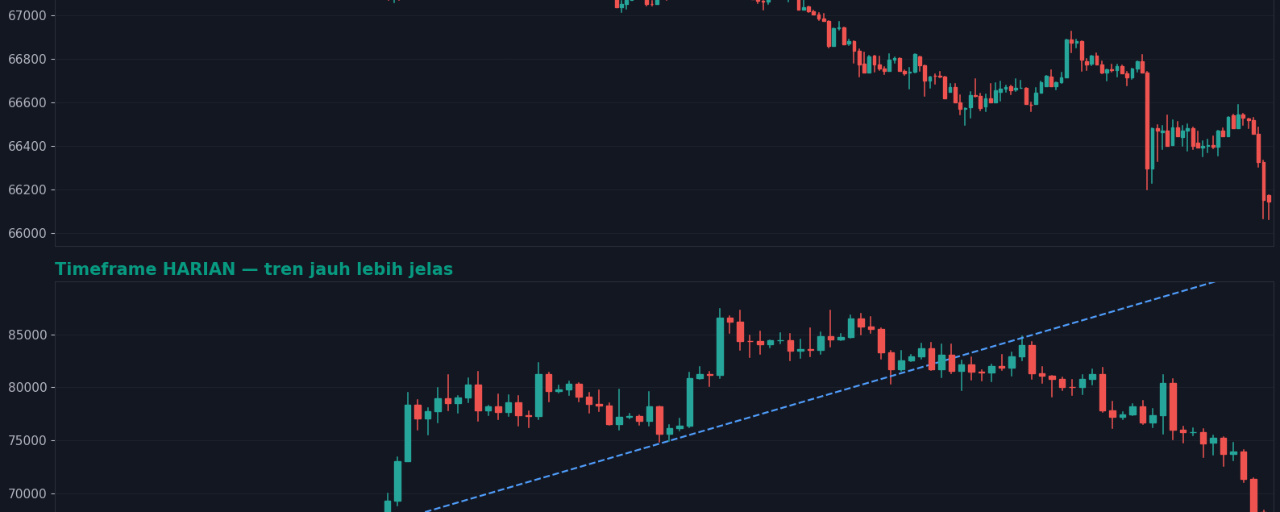

You open a 1-minute chart and your heart starts racing with every candle movement. It ticks up a little and you’re happy; it dips a little and you panic; five minutes later, it’s up again. If your day is spent on a mini roller coaster like this, the problem might not be the coin—it might be the timeframe you’re watching.
A timeframe is the period represented by a single candlestick. On a 1-minute timeframe, each candle tells the story of one minute. On a daily timeframe, each candle tells the story of an entire day. They feel and mean very different things.
**Why Small Timeframes Are So Noisy**
The smaller the timeframe, the more random movements—or noise—it contains. Tiny little jumps that don’t really mean anything can look like big signals. As a result, beginners can get swept up in their emotions: buy, sell, buy again, sell again—they’re constantly busy and totally exhausted, but may not be getting anywhere. It’s like running on a treadmill: you’re drenched in sweat, but you haven’t moved an inch.
On larger timeframes, the picture is much clearer:
- The main trend is easy to see, whether it’s going up or down, without noise getting in the way
- Important support and resistance areas are easier to mark
- You don’t have to stare at the screen every minute; just check in periodically
- Your decisions are calmer because there are fewer signals, but they’re more meaningful
**A Simple Example of How to Use It**
For example, if you want to get a sense of the bigger picture first, open a daily chart on TradingView. You’ll be able to see the general direction of the trend. Then, if you want to look at the details, drop down to the 4-hour timeframe as needed. The 1-minute timeframe? Sure, you can check it now and then just out of curiosity, but don’t make it your life’s main compass.
Think of it like looking at a map. A larger timeframe is like a map of the city—you know where you are and where you’re going. The 1-minute timeframe is like looking at every single pebble on the road as you walk. You’ll get dizzy before you even arrive.
**The Takeaway for You**
For beginners, a larger timeframe isn’t slow—it’s sensible. Fewer false signals, less panic, and an easier way to learn how to read real trends.
Which timeframe do you usually watch? Are you on Team 1-Minute, biting your nails, or Team Daily, taking it easy?
This is for educational purposes only, not investment advice. Always DYOR before making a decision.
#Timeframe #TechnicalAnalysis #BeginnerTrading
Sign up for Binance