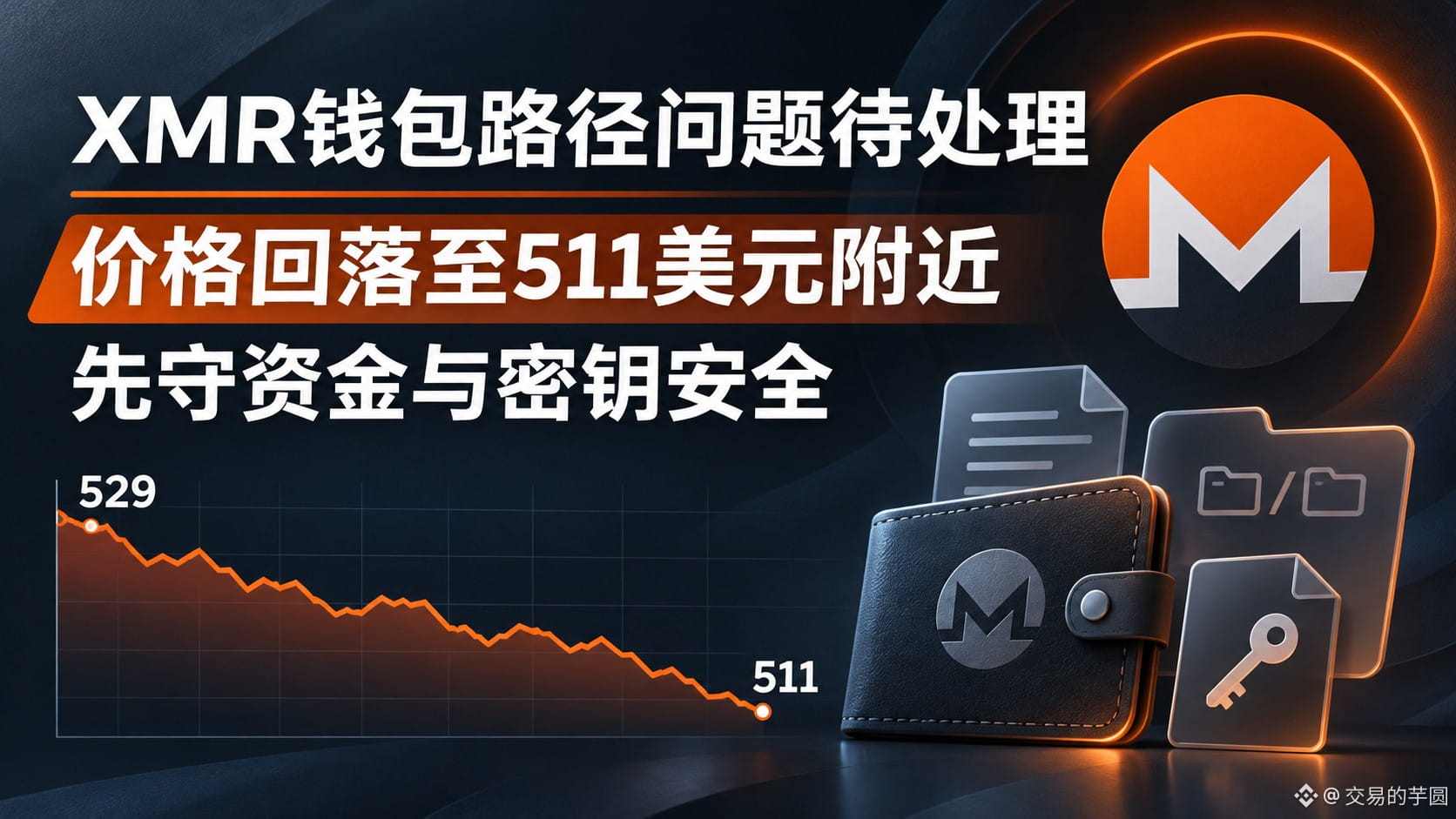
XMR wallet path issue remains unresolved | Price retreats to around $511 | I’m prioritizing the safety of funds and keys
My stance is cautious: when looking at XMR this time, I’m separating wallet-operation risks from price volatility. On November 10, an issue report numbered 11727 appeared in Monero’s official code repository. The reporter reproduced it on Linux using a disposable wallet: when the path for the destination key file overlaps with the existing cache path, the wallet2 store_to operation may return success without leaving behind the destination key file, making the migrated wallet impossible to reopen from those files. The issue page still shows Open, and I have not seen a merged fix or formal security notice addressing it. It describes a collision involving specific file paths; it does not mean ordinary transfers will lose funds, nor does it justify claiming that the entire network or all wallets are affected. The related code review PR 11726 discusses avoiding overwriting key files, but the issue report explicitly states that this PR has not resolved this collision scenario.
Why should traders pay attention to this? XMR’s value proposition depends on self-custody and privacy. If holders panic and migrate wallets without independently verifying their seed phrases and backups, the risks of the operation could outweigh market risks. However, there is currently no evidence that this development issue directly caused today’s selling pressure. Looking at the market’s actual moves: I checked Kraken’s live XMR/USD quote, which was around $511, with a 24-hour opening reference of about $528.95, an intraday low of $509.43, and a high of $538.26. The price is near the day’s low, indicating weak short-term support. This is just one exchange’s quote; it does not represent trading on all platforms, and the decline cannot be attributed to the wallet report above. XMR is also absent from Binance Square’s current Most Searched list, so there’s no basis for labeling it a trending topic.
My initial levels to watch are the $509–$510 intraday low zone, $520 as a rebound confirmation level, and around $529 as the opening reference. If $509 breaks and the price fails to reclaim it on a rebound, the bearish assessment remains valid. If the price recovers $520 and holds, then rises above $529 on increased volume, I’ll acknowledge that price action has overturned my earlier cautious view. Meanwhile, as long as the official issue remains Open, I won’t describe a patch under discussion as already fixed. Wallet users should first verify the official release version and store recovery information offline. Before migrating, test with a small amount and a recoverable test wallet, and avoid modifying the only copy of your keys while trading.
If I were trading this myself, I wouldn’t chase a short or rush to buy the rebound right now. I’d wait for confirmation, then consider a small spot long, with a maximum planned position of 2% of total funds. I’d only consider entering in stages after the price regains and holds $520, the subsequent pullback holds, and trading volume has not contracted significantly. The first target is $529, where I’d sell half; the second target is $538, where I’d sell half of the remaining position. After entry, I’d stop out if the price breaks below $509. If it closes below $509 for consecutive one-hour periods, I’d close the entire remaining position. If none of these conditions are met, I’ll stay out and observe; a plan is not a trade. Any new wallet security notice, merged fix, or exchange trading restriction would require me to recheck the facts and price levels before making a decision.
Sources: Monero official GitHub issue 11727 and code review PR 11726; Kraken public XMR/USD market data; Binance Square Trending Topics and Most Searched.
#XMR
This is solely my personal market observation and does not constitute investment advice.