Revenue hit a record, but gross profit was a fraction of that.
What really ate up the money was electricity and depreciation.
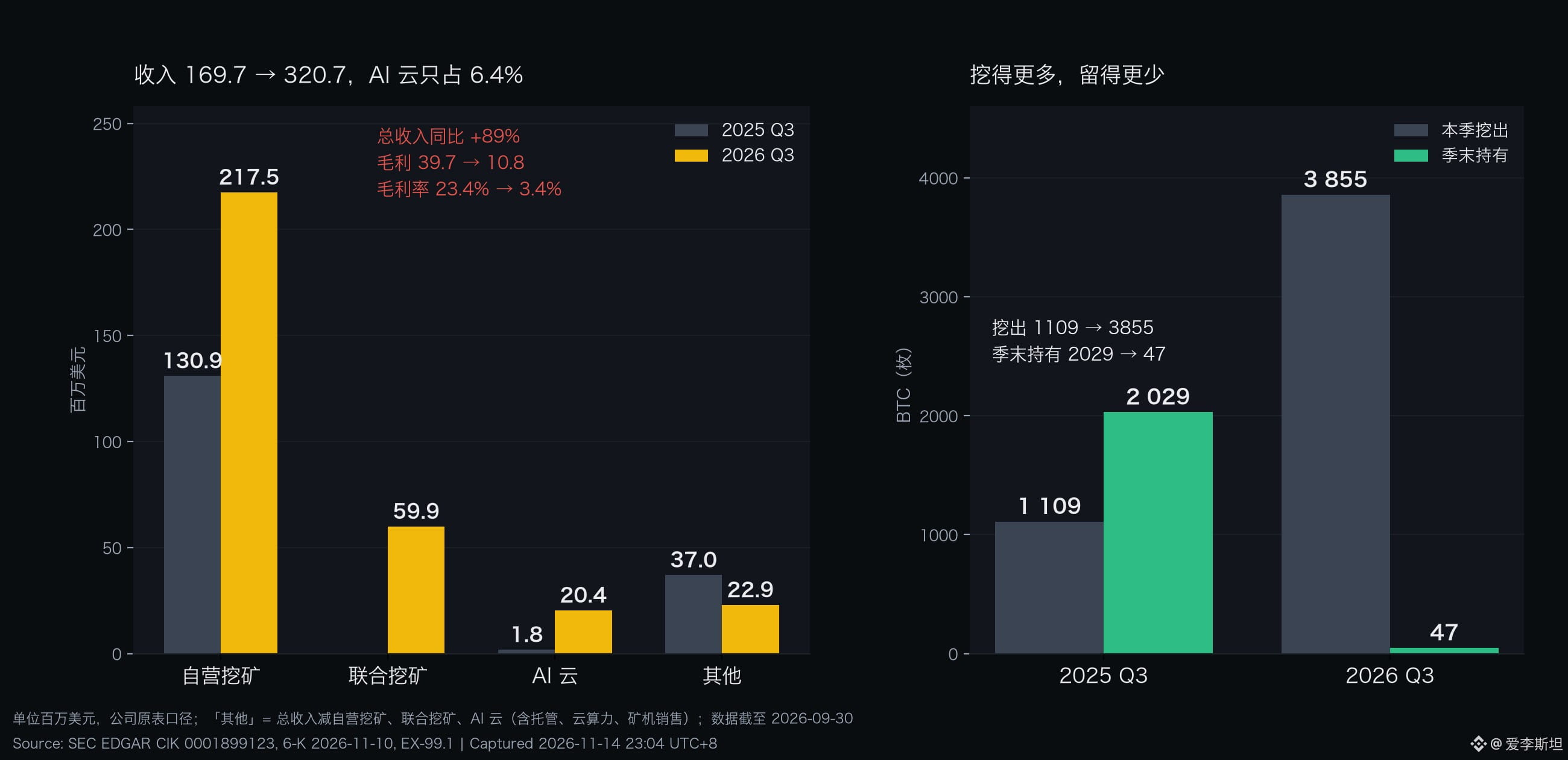
Bitdeer’s third-quarter revenue was $320.7 million, up 89% year over year, while its gross margin fell from 23.4% to 3.4%.
The money did come in, but once it arrived, computing power and electricity costs took nearly all of it right back out. On the books, only $10.8 million in gross profit remained.
The real engine behind that revenue was self-mining: $217.5 million, or 68% of total revenue.
Hashrate climbed from 35.0 EH/s to 86.4 EH/s, and the company mined 3,855 coins this quarter.
The problem is in another column.
At quarter-end, only 47 coins remained on the books, compared with 2,029 a year earlier.
Almost all the coins they mined were sold.
All converted into electricity costs.
Electricity use this quarter was 3,098 GWh, versus 1,656 GWh a year earlier. Power prices rose from $43 to $47 per megawatt-hour, pushing the cost per coin up substantially.
The results from a peer make the contrast even clearer.
$MARA mined 2,247 coins this quarter, sold 3,891, and still had 34,012 left at quarter-end.
Bitdeer mined more and kept less.
The roles were reversed.
The market sees AI cloud as the main story: $2.9 billion in revenue backlog, 332 IT MW secured, and Tydal’s $4.7 billion, 16-year lease is real too.
But so far this quarter, Bitdeer has recognized only $20.4 million from it, or 6.4% of revenue.
So right now, you’re buying next year’s story while paying this year’s power bill.
There’s another side to the story.
Adjusted EBITDA was $69.6 million, up 173% year over year, with depreciation and electricity costs recognized heavily up front.
The net loss was $125.5 million, of which $54.6 million came from fair-value changes on digital asset loans—a non-cash item.
That’s how the books are kept.
At quarter-end, cash stood at $213.7 million, and digital assets at $387 million.
One thing I can’t say for sure: the filing doesn’t break down the 47-coin figure, so it’s unclear how many were pledged or held on behalf of customers.
That number certainly jumps out.
But I wouldn’t dare read it as “selling everything.”
What’s really worth remembering is this structure: turning computing power into revenue is fast; turning revenue into gross profit is slow.
Any business selling capital-intensive expansion as a growth story eventually has to answer for its gross margin.
Because computing power can double in a year, but the electricity bill won’t wait for you.
As for the stock, $BTC 65740.70, down 4.54% in a day.
Would you look at the gross margin first, or the $2.9 billion backlog?
Source: SEC EDGAR, Bitdeer 6-K https://www.sec.gov/edgar/browse/?CIK=1899123
What really ate up the money was electricity and depreciation.
Bitdeer’s third-quarter revenue was $320.7 million, up 89% year over year, while its gross margin fell from 23.4% to 3.4%.
The money did come in, but once it arrived, computing power and electricity costs took nearly all of it right back out. On the books, only $10.8 million in gross profit remained.
The real engine behind that revenue was self-mining: $217.5 million, or 68% of total revenue.
Hashrate climbed from 35.0 EH/s to 86.4 EH/s, and the company mined 3,855 coins this quarter.
The problem is in another column.
At quarter-end, only 47 coins remained on the books, compared with 2,029 a year earlier.
Almost all the coins they mined were sold.
All converted into electricity costs.
Electricity use this quarter was 3,098 GWh, versus 1,656 GWh a year earlier. Power prices rose from $43 to $47 per megawatt-hour, pushing the cost per coin up substantially.
The results from a peer make the contrast even clearer.
$MARA mined 2,247 coins this quarter, sold 3,891, and still had 34,012 left at quarter-end.
Bitdeer mined more and kept less.
The roles were reversed.
The market sees AI cloud as the main story: $2.9 billion in revenue backlog, 332 IT MW secured, and Tydal’s $4.7 billion, 16-year lease is real too.
But so far this quarter, Bitdeer has recognized only $20.4 million from it, or 6.4% of revenue.
So right now, you’re buying next year’s story while paying this year’s power bill.
There’s another side to the story.
Adjusted EBITDA was $69.6 million, up 173% year over year, with depreciation and electricity costs recognized heavily up front.
The net loss was $125.5 million, of which $54.6 million came from fair-value changes on digital asset loans—a non-cash item.
That’s how the books are kept.
At quarter-end, cash stood at $213.7 million, and digital assets at $387 million.
One thing I can’t say for sure: the filing doesn’t break down the 47-coin figure, so it’s unclear how many were pledged or held on behalf of customers.
That number certainly jumps out.
But I wouldn’t dare read it as “selling everything.”
What’s really worth remembering is this structure: turning computing power into revenue is fast; turning revenue into gross profit is slow.
Any business selling capital-intensive expansion as a growth story eventually has to answer for its gross margin.
Because computing power can double in a year, but the electricity bill won’t wait for you.
As for the stock, $BTC 65740.70, down 4.54% in a day.
Would you look at the gross margin first, or the $2.9 billion backlog?
Source: SEC EDGAR, Bitdeer 6-K https://www.sec.gov/edgar/browse/?CIK=1899123