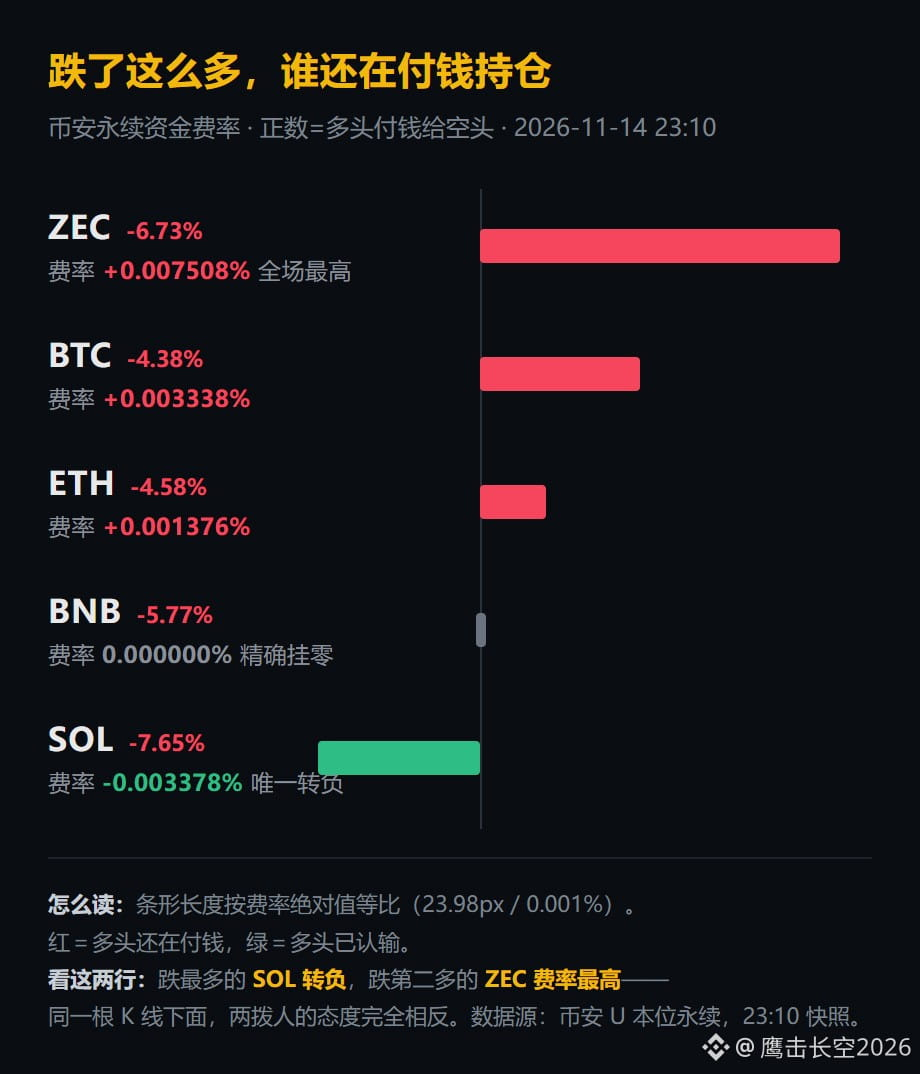
Down 4.4%, but funding rates are still positive: not a single long has given up
1
At 23:10, $BTC was quoted at 65,770, with an intraday low of 65,700, down 4.38% over 24 hours. That liquidation cluster worth over $200 million around 66,400—I circled it on the chart this morning, and just now the price broke through it.
By conventional wisdom, a drop like this should have flushed out the leverage.
I checked the funding rate. BTC is at +0.003338%—positive.
Down 4.4%, and longs are still paying shorts by the hour just to keep their positions open. This doesn’t look like a bottom.
2
The whole market has been talking about the same thing today: $1.31 billion in liquidations over 24 hours, including $1.093 billion in longs, or 83%; 159,000 traders liquidated (Coinglass via BlockBeats, 11-14 09:24); six straight weeks of declines; and consecutive net outflows from ETFs. All true—I used those figures myself earlier today.
But they don’t explain one thing: if the longs had really been beaten into submission, the funding rate should be negative.
Liquidations and funding rates are two completely different things. Liquidations are forced: you run out of margin, and the exchange closes your position for you. Funding is voluntary: you’re still willing to pay out of pocket to keep holding. The former tells you how many people were forced out; the latter tells you how many chose to stay. $1.3 billion in liquidations proves only the former.
3
At 18:44, I wrote: “Sellers have backed off, but buyers haven’t stepped in. That’s a vacuum, not a bottom.” My reasoning was the taker buy/sell ratio: BTC’s six-hour reading was 0.987, above the 24-hour reading of 0.906, suggesting aggressive buying was returning.
Five hours later, that number was 0.85. Selling pressure over six hours was heavier than over 24 hours. The direction reversed, and I’ll own that.
And it’s not just BTC. $ETH fell from 0.903 to 0.844, while BNB dropped from 0.840 to 0.802, the worst of the five coins. The only one that didn’t deteriorate was $SOL , rising from 0.921 to 0.944—but it fell 7.65%, the hardest of them all.
4
The funding rates show an even wider split than I expected:
ZEC fell 6.73%, with a funding rate of +0.007508%, the highest across the board.
SOL fell 7.65%, with a funding rate of -0.003378%, the only one to turn negative.
BNB fell 5.77%, with a funding rate of 0.000000%—not a single basis point either way.
ETH fell 4.58%, with a funding rate of +0.001376%.
Under the same candlestick, four groups of traders have completely different attitudes. The hardest-hit, SOL, has given up. For ZEC, the second-hardest hit, some traders are adding leveraged long positions. On BNB, neither longs nor shorts are willing to pay, leaving the market deadlocked.
Funding rates don’t tell you where the price is headed, but they do tell you how many people are still in the game. Today, traders in three of these coins are still paying to stay in.
5
There’s an even more powerful mechanism at work. Adam from Greeks.Live said today that both BTC and ETH have entered deep negative gamma territory. BTC is in negative gamma between 58,000 and 72,000, with no positive gamma cushion below the current price. As market makers maintain their hedges, they have to sell when prices fall and buy when they rise (Odaily Planet Daily, 11-14).
In plain English: within this range, a drop won’t automatically bring in buyers; it will actually create more selling. The saying “after a big enough drop, a rebound will naturally follow” doesn’t hold between 58,000 and 72,000.
6
Here’s what it would look like if I’m wrong: tomorrow, Monday, the weekly candle closes above 67,800 at 08:00, or the BTC funding rate turns negative while the price stops making new lows. If either of those happens, I should throw out today’s “the longs haven’t given up” thesis—no clinging to it for comfort.
7
My trade log: I’ll place a short at 66,800 on a BTC rebound, with a stop at 67,420 and a target of 65,300; if that breaks, I’ll look to 64,750 (the second-largest liquidation cluster according to CoinBoss at 21:01, worth $236 million). If price gets above 67,800 and holds there for an hour, I’ll exit without hesitation. I won’t go long on ETH above 1,900; if 1,845 breaks, I’ll look to 1,800. I won’t chase a short on SOL—the funding rate has already turned negative, and shorting here means taking the bag from someone else.
8
Wang Anshi wrote: “What seems ordinary is often extraordinary; what seems easy to achieve is hard-won.” Every bottom looks like a bottom. The hard part is telling which one is real. And the clue isn’t in the price, but in the funding rate: prices can deceive, but willingness to pay cannot.
Which side are you on? With funding rates still positive, is it “the longs aren’t dead yet; there’s another round of liquidations to come,” or “this is the final capitulation, and a weekly close above this level will turn things around”? While you’re at it, share your position, leverage, and stop-loss level, and I’ll take a look at each one.
For real-time levels and intraday alerts, find me in the comments—Eagle Soaring Through the Sky · Crypto Study Group
Crypto assets are highly volatile. The above is my trading log and does not constitute investment advice. Please make your own decisions and manage your risk.