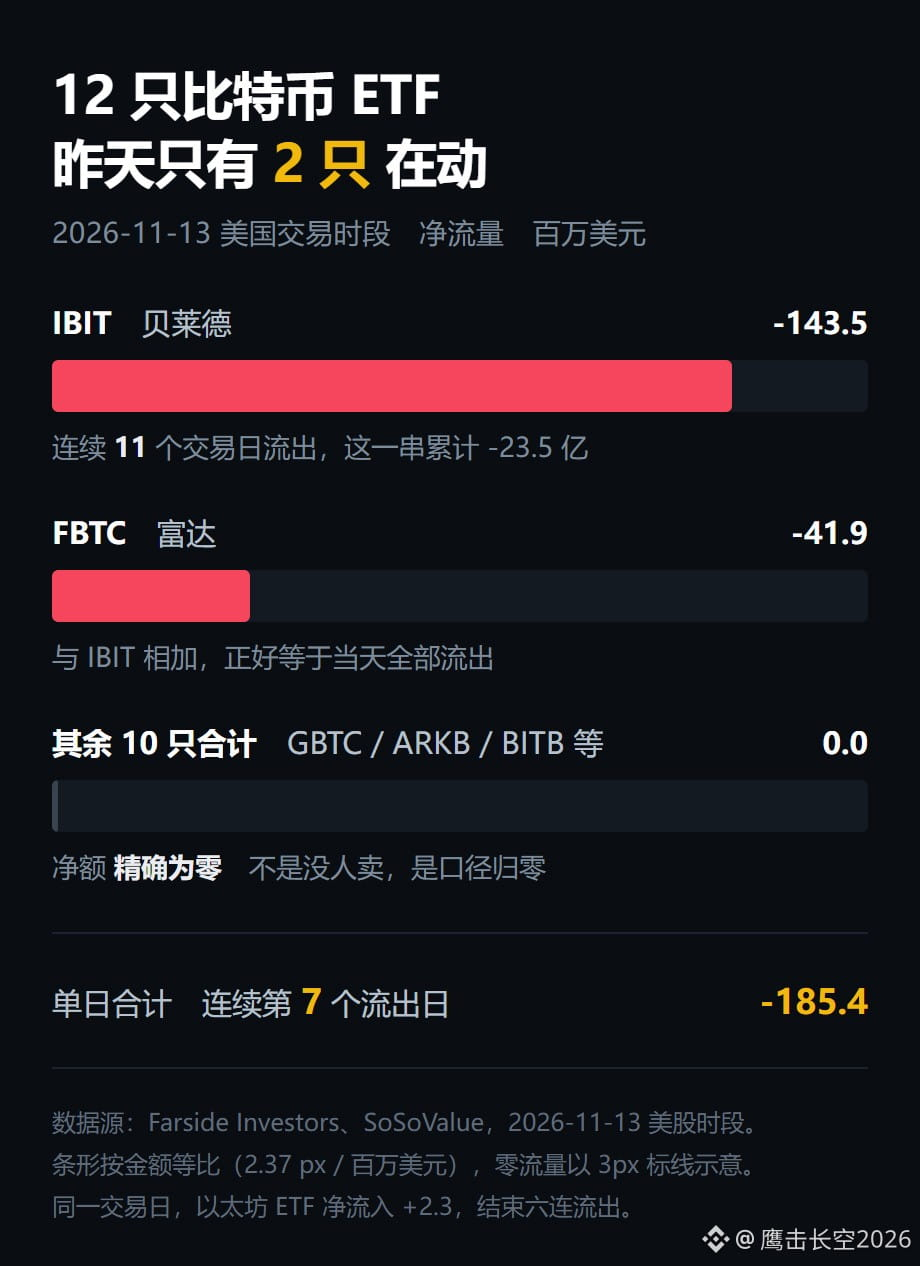
12 Bitcoin ETFs, 10 didn’t move a cent: It wasn’t the market running—it was two big clients
1. The bottom line first: There was no panic selling and no retail-investor stampede in this sell-off. On November 13, the 12 U.S. spot Bitcoin ETFs saw net outflows of $185.4 million, marking the seventh consecutive trading day. Every cent of that $185.4 million came from just two funds: BlackRock’s IBIT shed $143.5 million, and Fidelity’s FBTC shed $41.9 million. The other ten funds had exactly zero net flows.
2. I agree with the mainstream take—halfway: ETFs shed $2.35 billion over two weeks ($1.28 billion from November 2 to 6, and $1.07 billion from November 9 to 13). That’s two consecutive weeks with outflows topping $1 billion, the first time since late May this year. Institutions are pulling back—that part is true. The money really did leave.
3. But that doesn’t explain one detail: If investors are truly bearish, why did it happen only in the two biggest funds? Ten funds all landing at zero doesn’t mean “nobody sold”; it means “someone is trimming by the same proportion.” IBIT has $53.99 billion in net assets, accounting for 62.6% of the 12 funds’ combined $86.2 billion. When one channel accounts for 60%, even a slight reduction in risk exposure by allocators will inevitably show up there; the smaller funds are too small for even a 2% trim to produce a non-zero figure.
4. There was also a counterpoint on the same day: Ethereum ETFs saw $2.3 million in net inflows, ending a six-day outflow streak. If this were truly “an exodus from crypto,” Ethereum shouldn’t have turned positive. So what’s running isn’t sentiment toward the coins—it’s the arithmetic of positioning. That line is worth saving on its own.
5. Allocators’ sell orders stop once they’re done selling; they don’t keep chasing the price down. Leveraged traders’ sell orders are the ones that get more aggressive as prices fall. To judge whether this move is over, watching the size of the drop is useless—you need to look at the nature of the selling.
6. The data at this moment, 22:04, only supports being halfway optimistic. $BTC 66,464, down 4.40% in 24 hours; the intraday low of 66,268 is a new low for today; 4-hour RSI is 14.06. Aggressive buys ÷ aggressive sells, over a 6-hour window: BTC 0.926, ETH 0.861, BNB 0.805—the sellers haven’t clocked out, but they aren’t accelerating either.
7. BNB is the truly ugly one: funding rate exactly 0.000000%, meaning nobody is willing to pay to go long or short; 15-minute RSI is 6.0; the aggressive buy ratio has fallen from 0.844 over 24 hours to 0.805 over 6 hours. All three numbers point to the same thing—it isn’t being shorted; it’s being abandoned. ZEC is the opposite: its funding rate is +0.007409%, the highest of the five, yet its price is down 9.1%. Bulls are paying to stubbornly hold a coin that’s collapsing.
8. “When the path ends at the water’s source, sit and watch the clouds rise.” Wang Wei’s line feels apt tonight. But first I have to correct myself: an hour ago, I wrote here that it would “grind between 67,000 and 67,800 until Monday morning.” It’s now at 66,464; that range has already broken. It didn’t break with a crash, but with a slow leak—no high-volume long red candle, just a little selling every day. A stair-step decline is harder to trade than a sharp wick, because it doesn’t give you one chance to get out all at once.
9. No need to recalculate the levels: the 200-week moving average at 67,800 is now 2.0% overhead, having turned from support into a ceiling. The weekly candle closes at 8 a.m. Beijing time on Monday, with 34 hours to go. If it doesn’t reclaim that level, the six-week losing streak will be a fait accompli.
10. Three conditions that would prove me wrong; if any one happens, I’ll change my mind: First, if IBIT turns positive for the day at the U.S. market close on November 16, that would mean allocators have finished adjusting, and my “two firms rebalancing” explanation would carry less weight. Second, if a third of the 12 funds posts net outflows, that would mean a broad-based exodus—I’m wrong, and I’ll switch to defense. Third, if there’s a high-volume close back above 67,800 tonight, the grinding-market scenario is void on the spot.
11. These are my records, not recommendations. $BTC : I won’t chase shorts; I’ll place one short order at the 67,000 round-number level on a rebound, with a stop at 67,620 and a first target of 66,268; if that breaks, I’ll look at 65,300. If the weekly candle closes above 67,800 at 8 a.m. Monday, I’ll cancel this order unconditionally. $ETH 1,871: I won’t buy above 1,900; if it breaks below 1,860, I’ll look at 1,832. $SOL 75.00: down 8.0%, the second worst of the five; funding rate is -0.005687%, with shorts paying to hold on. Risk-reward for chasing a short here is the worst, so I’m staying away.
12. Pick a side: Is this “selling that stops once it’s done,” or “selling that’s just getting started”? One sentence on whether you’re taking this short on a rebound. While you’re at it, share your position, leverage, and stop-loss level—if you can’t state all three, don’t trade tonight.
For real-time levels and intraday alerts, find me in the comments—鹰击长空·币圈研习社
Crypto assets are highly volatile. The above is my trading record and does not constitute investment advice. Please make your own decisions and manage your risk.