AMD at $523—did it scare you off?
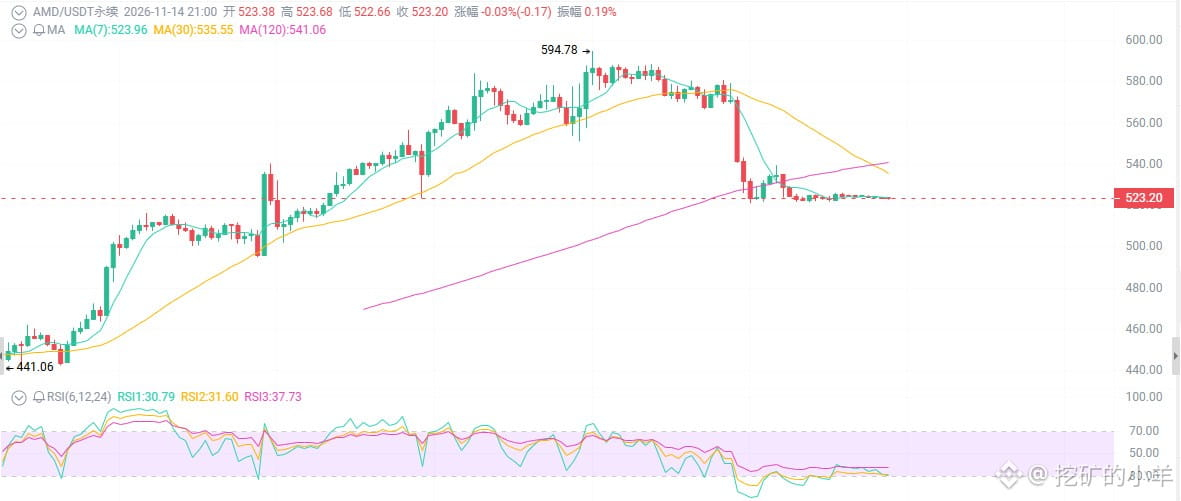
Rumors that Jensen Huang was resigning sent AMD soaring 30% in a week, but Friday’s sharp 8.75% drop brought you right back down to earth. From $585 to $523, trading volume surged, and the $520 level is now hanging by a thread. Will it break or hold? We’ll find out next week.
First, the surface story: one week in heaven, one day in hell.
From the start of the week through Thursday, money rotated furiously from NVDA into AMD. “Should’ve known—I should’ve bought on Thursday.” Then Friday’s opening bell brought a big red candle crashing down: an 8.75% drop, from $585 to $523, with an intraday low of $520.
“Figures—it was a fakeout. Is AI just hype?”
First: the rumors of Jensen Huang’s resignation were the real force behind this rally.
The most surreal thing this week wasn’t AMD’s 30% surge. It was the sudden rumor that former NVIDIA CEO Jensen Huang was resigning, along with talk of an export-control investigation.
Can’t touch NVDA—so who do you buy? AMD, of course.
So, from its November 5–6 lows, AMD was pushed higher by investors, reaching a weekly high of $585–$594. This wasn’t because AMD itself was suddenly that great; it was NVDA’s panicked money looking for shelter.
The essence of rotation trading is “borrowed time.” As soon as NVDA stabilizes, that borrowed money has to be paid back. Friday was payday. The entire chip sector came under pressure, and AMD became the ATM.
Second: AMD’s fundamentals are stronger than you might believe.
Q3 revenue of $13.4 billion, up 45% year over year—a record, and above guidance
Data center revenue of $8.5 billion, up 97% year over year, now accounting for 64% of the total
Non-GAAP EPS of $2.09, up 74% year over year
Q4 revenue guidance of $17 billion, up about 66% year over year and 27% quarter over quarter
Management says revenue will grow more than 80% in 2027, server CPU revenue will nearly double, and data center AI revenue will “significantly more than double”
Analysts’ average price target is $650–$660, with some calling for $700+.
Third: what really crushed the market on Friday wasn’t AMD—it was the macro hand.
October PPI came in hotter than expected, with the annual rate accelerating to a recent high. The 10-year Treasury yield rose significantly. Market expectations for the Fed shifted from “rate cuts” to “another hike” or “higher for longer.”
AI data centers are capital-intensive businesses. When financing costs rise, valuation multiples have to come down. Growth stocks fear high interest rates more than weak earnings. Earnings can wait; interest rates won’t wait for you.
And with NVDA set to report earnings on November 17, Friday’s selling was half profit-taking and half “better get out before NVDA reports.”