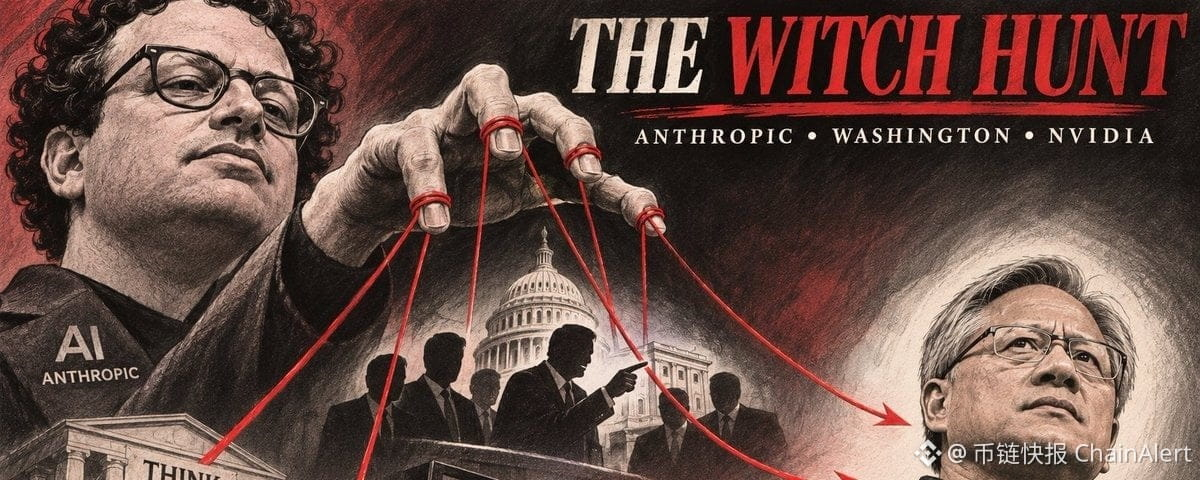
Unpacking the Jensen Huang Controversy: A Media Campaign and Collusion of Interests Targeting Anthropic
The media storm surrounding Nvidia CEO Jensen Huang may seem to have erupted out of nowhere. But tracing the connections reveals a clear chain of interests pointing to competitor Anthropic. From media framing and think-tank commentary to congressional pressure, several key players have significant overlap with Anthropic in terms of personnel, funding, and governance.
I. The Intertwining of Media Sources and PR Narratives
The New York Times’ reporting framework: Ana Swanson, the reporter who first ignited the controversy with allegations about chips and security, has long relied on Anthropic co-founder and head of policy Jack Clark as a key source. Clark, a former Bloomberg reporter and OpenAI policy director, is well versed in shaping public discourse. He has delivered a “software singularity” talk to key decision-makers at the Aspen Institute’s AI Policy Summit and is also a nonresident fellow at Georgetown University’s Center for Security and Emerging Technology (CSET).
The Financial Times’ shift in narrative: Demetri Sevastopulo, the reporter who later steered the discussion toward Huang’s private relationships, had previously reported exclusively in September 2025 that Anthropic had cut off access for companies with Chinese ties, pointing to deep information-sharing between him and the Anthropic team.
The social media flashpoint: On November 6, Chris McGuire, a member of the Council on Foreign Relations, published a highly inflammatory post that was shared within hours by several lawmakers and columnists, garnering more than 9 million views. McGuire previously served on the U.S. National Security Council, where his direct supervisor was Tarun Chhabra, now Anthropic’s head of national security policy. The two also attended a forum in Taipei together this June.
II. Political Donations, Behind-the-Scenes Lobbying, and Think-Tank Networks
Congressional attacks and political contributions:
After The New York Times report was published, Senator Chris Coons quickly announced that he would launch a congressional investigation. In July this year, he had accepted a $2,500 donation from AnthroPAC, Anthropic’s political action committee (Jack Clark personally contributed $5,000 to the PAC).
In February this year, Anthropic CEO Dario Amodei held a closed-door meeting with members of the Senate Banking Committee, pressing for tighter restrictions on chip exports to China. The Senate version of the AI WATCH Act was introduced afterward. The committee’s senior Republican, Kevin Cramer, also received a $1,000 donation from AnthroPAC in July and recently publicly called for Huang to resign.
In addition, during this political cycle Anthropic contributed $40 million to Public First Action and affiliated super PACs (with Amodei personally adding $1 million), continuing to fund lawmakers who support chip restrictions. These include House Foreign Affairs Committee Chair Brian Mast, who led a letter co-signed by other members on November 4 demanding accountability from Huang.
Think-tank incubation and accusations of a double standard:
Many of the most aggressive recent critics are affiliated with Georgetown University and its CSET, including law professor Mark Jia, former CSET analyst Ryan Fedasiuk (who has publicly called for Huang’s resignation), and former senior CIA official Dennis Wilder.
When CSET was founded, it received $55 million in seed funding from Open Philanthropy. Holden Karnofsky, co-founder of the funder, later joined Anthropic. Notably, when the Pentagon designated Anthropic a supply-chain risk, legal experts cited Mark Jia’s research to emphasize the high bar for national security designations. Yet this cautious standard went unmentioned when the target shifted to Huang.
At the governance level, Richard Fontaine, CEO of the Center for a New American Security (CNAS), has served as a member of Anthropic’s Long-Term Benefit Trust since June 2025. The think tank’s research framework on combating chip smuggling, meanwhile, forms the very blueprint for the current campaign to hold Nvidia accountable.
III. A High-Profile Political and Business Team, and a Critical Window for Capital
To advance its policy and market objectives, Anthropic has recruited key staff from both the Biden and Trump administrations:
Biden administration backgrounds: Tarun Chhabra (former NSC coordinator for technology and national security), Ben Buchanan (former White House AI adviser), Elizabeth Kelly (former director of the U.S. AI Safety Institute), Joel Meyer (former senior Department of Homeland Security official), among others.
Trump administration backgrounds: Chris Liddell (former White House deputy chief of staff, now an Anthropic board member), Sihao Huang (former senior AI adviser at the White House Office of Science and Technology Policy), Sarah Heck (former NSC member), among others.
In fact, Singapore’s Ministry of Home Affairs issued an official written statement as early as October 31, refuting the claims and saying it had never investigated the individuals concerned, yet mainstream media have largely remained silent. Behind the unsubstantiated “espionage allegations” and the shift in public scrutiny toward personal conduct, the timing of this series of concentrated attacks coincides closely with sharp fluctuations in Nvidia’s market capitalization and the sensitive period ahead of Anthropic’s planned IPO at an approximately $61 billion valuation.