

What are neuromorphic chips?
Neuromorphic chips are processors whose architecture imitates some of the principles of brain function. Their computing elements are organized by analogy with neurons and synapses and are closely connected to memory. Artificial neurons exchange information using short electrical pulses called spikes.
The idea and the term itself were proposed in the late 1980s by American scientist and microelectronics engineer Carver Mead, an emeritus professor at the California Institute of Technology. He created the first analog circuits that imitated the behavior of neurons.
The main goal of this technology is to save energy. The human brain consumes about 20 W while simultaneously recognizing patterns, controlling movement, and learning. In conventional processors, computing units operate continuously, and data is constantly transferred between memory and the processor.
A neuromorphic chip uses energy mainly when spikes are generated. Its advantage is therefore greatest for tasks involving sparse, time-varying data, such as processing sensor signals or recognizing gestures or sounds on-device. The amount of energy saved depends on the specific task and the hardware the chip is compared with.
How are they different from conventional processors?
The first difference is how they handle memory. In conventional CPUs and GPUs, memory and computing units are separate, so data constantly travels between them over a bus. These transfers can consume most of the time and energy. In computer engineering, this problem is known as the von Neumann bottleneck. In a neuromorphic chip, memory is located inside or right next to the computing units. Connection weights are stored directly in “synapses,” so data travels far less often and over shorter distances. Transfers do not disappear entirely: spike events still pass between cores over the chip’s internal network, while the chip receives input data and returns results through external interfaces.
The second difference is the computing model. At every step, a CPU or GPU recalculates huge arrays of data, even if the input image has barely changed. A neuromorphic chip operates on events: when a spike arrives, the system processes the corresponding input and updates the state of an artificial neuron. An output spike occurs when the conditions of its model are met—for example, when the membrane potential reaches a threshold. During periods of low activity, the chip is almost idle and consumes less energy. Not every such device has a clock signal, but not all of them do away with one either. For example, IBM TrueNorth cores operate asynchronously, while the cores in Intel Loihi synchronize in discrete time steps.
The third difference is massive parallelism. Many neural cores can process events simultaneously without having to synchronize all computations to a single global clock signal.
How does a neuromorphic chip work?
These chips run spiking neural networks (SNNs). In a conventional neural network, a neuron simply passes a number along. In a spiking neural network, a neuron accumulates incoming signals, causing an internal variable called the membrane potential to rise. When the potential exceeds a threshold, the neuron “fires” a spike—a brief pulse. The potential is then reset fully or partially, depending on the model.
Here, information is encoded not by the signal’s magnitude, but by the timing and frequency of the pulses. For example, a bright pixel may generate frequent spikes, while a dim one generates them rarely.
Hardware implementations vary:
digital chips model neurons using conventional logic circuits—as in Intel Loihi and SpiNNaker2;
analog chips use transistor physics to make electrical signals reproduce specific features of how biological neurons work;
memristor circuits rely on memristors—components whose resistance depends on past signals. A memristor acts like a synapse: it stores a connection weight and participates in the computation at the same time;
experimental approaches build neurons using superconductors, photons, or even sound waves.
Some chips can continue learning while performing tasks. Connections between neurons grow stronger or weaker depending on how often neighboring nodes activate together. A similar mechanism, known as synaptic plasticity, also operates in the living brain.
Which neuromorphic chips are already available?
The industry is developing in two directions at once: from gigantic supercomputers for scientific research to ultra-low-power chips for sensors.
Research platforms and supercomputers
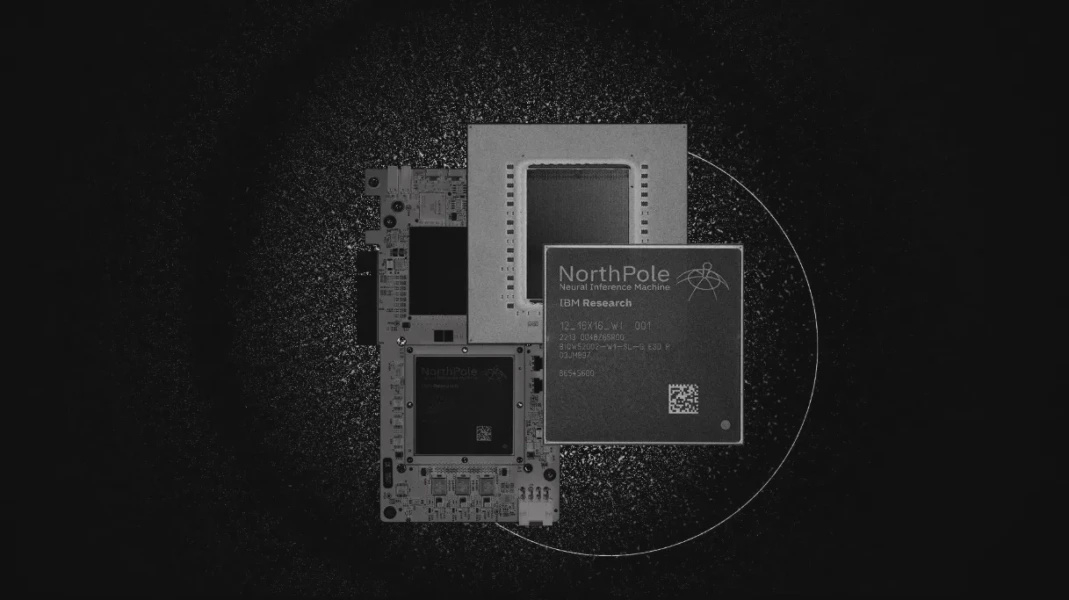
IBM TrueNorth and NorthPole. The TrueNorth neuromorphic chip (2014) packed 1 million neurons and 256 million synapses while consuming just 70 mW. The NorthPole processor, released in 2023, abandoned the spiking computing model but retained a key neuromorphic principle: tight integration of memory and computing units on a single chip.
Intel Loihi. Using Loihi 2 chips (2021), Intel built Hala Point, a neuromorphic system with 1,152 processors, for Sandia National Laboratories. It supports 1.15 billion neurons and achieves energy efficiency of over 15 TOPS/W.
SpiNNaker2. A neuromorphic chip with 152 ARM cores, developed by the universities of Dresden and Manchester and commercialized by the SpiNNcloud startup. In 2025, a system capable of modeling 175 million neurons went into operation at Sandia National Laboratories. In 2026, the Jülich Supercomputing Centre selected the platform for its ESAB hybrid AI project.
Commercial chips for edge AI
BrainChip Akida. Mass-produced neuromorphic accelerators from Australian developers for cameras, sensors, and IoT devices, capable of analyzing signals and learning locally.
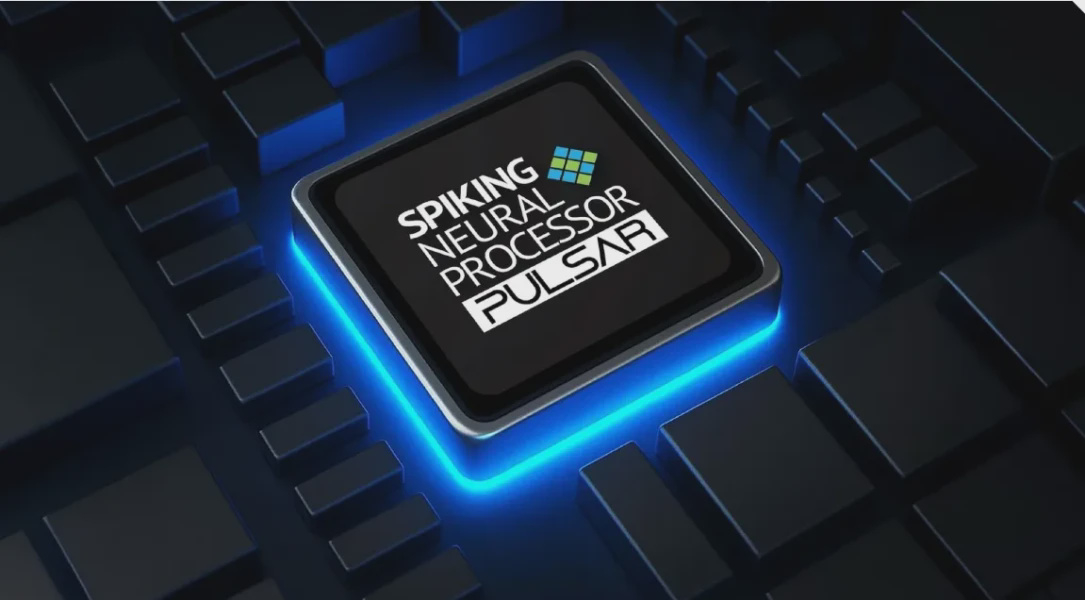
Innatera Pulsar. A neuromorphic microcontroller from the Netherlands. It combines an SNN engine, a CNN accelerator, and a RISC-V core, with power consumption below 1 mW in some use cases.
Experimental physics
Great Sky. A startup founded by former NIST researchers in Boulder, developing optoelectronic neuromorphic processors. Its chip architecture combines superconducting computing based on Josephson junctions with optical interconnects, through which neurons exchange single photons.
Where are neuromorphic chips used?
In commercial technology and science
Autonomous sensors and gadgets. Thanks to their ultra-low power consumption, neuromorphic microcontrollers such as Innatera Pulsar can operate in always-on mode. They can be used in wearable gadgets for gesture recognition, as well as in industrial equipment for continuous vibration monitoring and early warnings of component wear.
Supercomputer computing. Large neuromorphic systems, such as Intel’s Hala Point and clusters based on SpiNNaker2 chips, help scientists model how the brain’s neural networks work, solve complex optimization problems, and test new energy-efficient machine-learning algorithms.https://www.youtube.com/watch?v=CPuaud9xi3U
In 2026 experiments
Ultra-fast machine vision. In February 2026, scientists unveiled a new neuromorphic vision system that operates faster than human perception. A sensor based on synaptic transistors ignores a static background and instantly detects only moving objects. In the future, the technology could speed up visual data processing in drones, robots, and self-driving cars.
Nuclear fusion. In October 2026, U.S. national laboratories and Great Sky tested a superconducting AI chip for analyzing data from fusion facilities. The device analyzed real data from the U.S. DIII-D tokamak and models from Google DeepMind’s TORAX plasma simulator. The chip processed data collected at a rate of 1 million samples per second. The developers expect the technology to help create real-time plasma control systems in the future.
Cryogenic electronics for qubits. In March 2026, researchers at the University of Hong Kong unveiled experimental neuromorphic circuits based on silicon carbide, designed to operate at ultra-low temperatures. In the future, placing such microchips inside a cryostat could simplify quantum computer control and reduce the thermal load from connecting wires.
Can you buy a neuromorphic chip?
Yes, but mostly as developer kits. In October 2026, BrainChip released the AKD1500 Raspberry Pi 5 Dev Kit for $1,295. Inside the metal enclosure are a Raspberry Pi 5 with 8 GB of memory, an M.2 HAT+ expansion board, and a card with an Akida accelerator. According to CNX Software, a similar system can be assembled from components for about $350, excluding taxes, shipping, and setup time.
In early November, Innatera launched its own program for developers. Its Pulsar evaluation boards are already available through DigiKey in European Union countries, with the company promising to expand its shipping destinations by the end of 2026.
Intel Loihi chips are not available for general sale. Only members of Intel’s research community—research groups, commercial companies, and government organizations—have access to the hardware. However, anyone can write and test programs for neuromorphic systems on conventional processors using the open-source Lava framework.
What is holding back widespread adoption?
Despite progress in laboratories, the technology still has six hurdles to overcome:
Difficult training. A spike is a sharp jump in a signal, so the standard backpropagation method cannot be applied to it directly. Engineers have to use workarounds—for example, surrogate gradients or converting conventional neural networks into spiking ones—which often leads to a loss of accuracy.
A fragmented ecosystem. GPUs have a mature software ecosystem that includes CUDA, PyTorch, and many ready-made models. Many neuromorphic chip manufacturers use their own SDKs and compilers. There are few specialists in the field, and porting code between platforms requires manual adaptation.
A lack of common benchmarks. Researchers from universities and technology companies have already developed NeuroBench, an open set of tests for neuromorphic systems. However, there is still no industry standard on the level of MLPerf. Companies measure energy efficiency and speed differently, making it difficult to compare chips objectively.
Challenges running modern LLMs. Today’s large language models were built for GPUs. Neuromorphic chips excel with sparse data streams from sensors, where signals change infrequently. When performing the dense matrix computations typical of LLMs, their energy-efficiency advantage may shrink.
Instability of analog components. In analog and hybrid chips, memristors and transistors—even from the same batch—differ slightly from one another. Their characteristics also fluctuate with temperature changes and over time.
Poorly understood vulnerabilities. Compared with conventional processors, methods for protecting spiking systems in embedded devices from faults and attacks are still underdeveloped.
Will neuromorphic chips replace graphics cards?
Not in the coming years—they serve a different purpose. Compact neuromorphic chips are useful where milliseconds of response time and milliwatts of power matter: in sensors, smartwatches, drones, and robots.
Most likely, they will work alongside familiar CPUs and GPUs. Conventional processors will handle heavy matrix computations, while neuromorphic modules will rapidly process signals from sensors.
Some startups are already eyeing the data center market. According to Great Sky, its architecture could eventually reduce the total cost of generating 1 million output tokens to $0.01—about 300 times lower than the $3 benchmark selected by the company. These figures have not yet been verified through independent testing of a commercial system.
At this stage, Great Sky’s technology is being validated on specialized scientific tasks, including forecasting plasma instabilities in tokamaks. Tests of the next-generation chip—with a neural network scaled up by a factor of 10—are scheduled to take place at Brookhaven National Laboratory in early 2027.