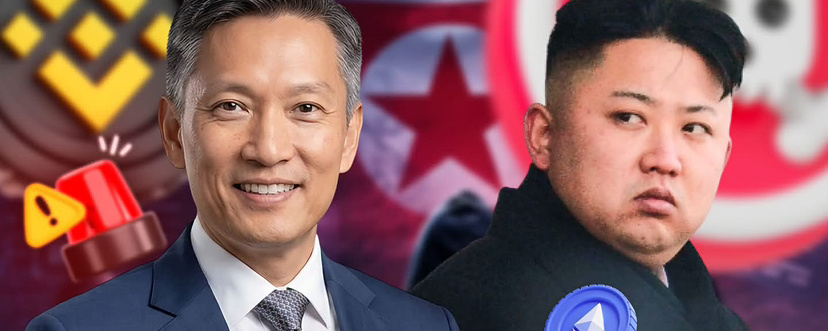
🚨🔐 #KimJongUn’s group of North Korean #Hackers hacked #Binance for $6.3 billion, and after that #
💰 Richard Teng explained the incident in detail during interviews with Fox and CNBC
This wasn’t just an ordinary cyberattack caused by a hacker sending a phishing link
🕵️♂️ Richard Teng said the attackers spent months gradually infiltrating Binance’s systems using fake job interviews, malware disguised as developer tools, and AI technologies.
🇰🇵 Richard Teng also said that the #FBI determined North Korean hackers were behind the attack.
⚠️ Even more interestingly, Binance says it proactively identified and prevented 57 cyberattacks suspected of being linked to North Korea in 2026.
Unfortunately, Binance was unable to prevent the attack on October 29.
🔐 So, how did Binance take responsibility for the losses?
Richard Teng said he had repeatedly apologized for the disruption users experienced as a result of the hack. He also said Binance would take responsibility for all the losses.
🛡️ According to his remarks in an interview on November 3,
💰 98% of the affected crypto assets have already been replenished.
🏦 Richard Teng also said the company had set aside funds in advance—an amount greater than the losses caused by the hack.
🔍 He said customers can also verify the company’s asset holdings themselves through Proof of Reserves.
He said the remaining 2% consists of tokens with low liquidity, so Binance is gradually buying them back over the counter (OTC) to avoid causing sudden price volatility.
💸 There were also many withdrawals when withdrawals resumed after the hack. However, Richard Teng added that hourly deposits and withdrawals have since returned to normal levels.
🚨 Another important point he mentioned was the effort to recover the stolen crypto.
❤️🔥 According to Binance’s statement, cooperation with law enforcement agencies, stablecoin issuers, and blockchain intelligence firms enabled them to freeze around $2.85 billion and prevent transfers.
⛓️ Crypto can move across borders on the blockchain, but the transparency that makes transactions traceable also helped recover control of the stolen assets.
🤖 Richard Teng also issued a more serious warning about AI cyberattacks.
He pointed out that cyberattacks, which used to happen once a month, began happening once a week. Now, there are cases where as many as four exchanges are attacked in a single day.
AI has become so powerful that hackers can use it to carry out social engineering, develop malware, and execute attacks much more quickly.
🛡️ Binance says it has closed the entry points used by the attackers and rebuilt the affected systems.
It also said it had strengthened device security, wallet risk controls, and AI-powered anomaly and fraud detection.
💡 So, to recap, we could say that experiencing this hack gave us many invaluable lessons. Here are some of them:
🏦 No matter how large a crypto exchange is, there is no guarantee it can protect itself from cyberattacks 100% of the time.
💸 We also learned not to keep all our money on a single exchange, and to keep there only the amount we need for trading.
Most importantly, if a security breach happens, we need to look closely at the exchanges we use: how quickly they can stop hackers, how well they can protect users’ assets, and how they take responsibility for resolving losses.
🚀 This also shows that as AI makes cyberattacks more advanced, it is becoming increasingly necessary to integrate AI more deeply into cybersecurity systems.
To put Richard Teng’s words another way, security systems need to operate at AI speed to defend against hackers who use AI to launch faster attacks. In other words, AI-powered attacks need to be countered with AI.
💬 How stressed and worried were you when Binance was hacked, bro? Did you think you had lost everything? Have those feelings eased now? How are you storing your crypto these days? Are you still keeping it on Binance? Be sure to share your thoughts in the comments below so others can hear about your experience too.