ZEC at $900: Are you buying the dip or running for the exits?
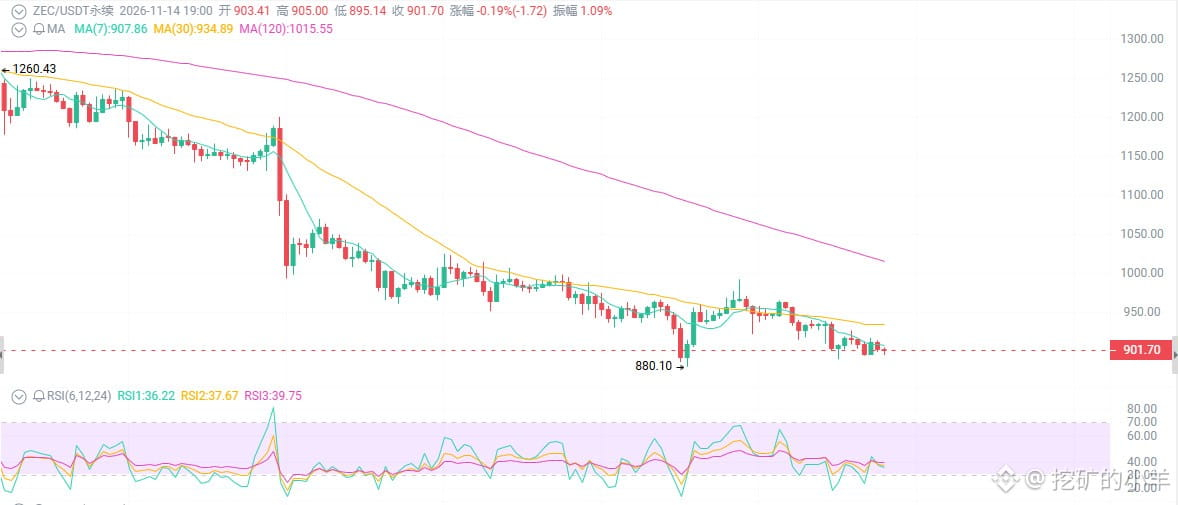
The NU7 upgrade is live. Block times have dropped from 75 seconds to 25 seconds, and fees are starting to flow into the reserve pool. Despite such major positive news, ZEC has fallen from $1,300 to $900—a brutal 30% plunge in a week. Is this the final leg down in a post-upgrade “sell the news” move, or the beginning of the end for the privacy narrative?
First, the headlines: the upgrade is live, but the price has crashed.
ZEC is down 27%–32% over the past seven days, breaking through support all the way down from highs above $1,300, with one big red daily candle after another. It’s down 4.5%–5.5% over 24 hours, with the price repeatedly grinding around the $890–$910 range. Trading volume picks up during sell-offs and dries up on bounces—suggesting sellers are serious, while buyers are still sitting on the sidelines.
First: the NU7 upgrade is genuinely impressive, but the market only cares about one question: “What’s next?”
Block times have been cut from 75 seconds to 25 seconds—three times faster. Sixty percent of fees go into the network sustainability mechanism reserve, while miners get 40%. The old Sprout privacy pool has been shut down, making the system cleaner.
This isn’t a minor upgrade. It’s a key step in ZEC’s transition from a “privacy experiment” to a “usable private payment tool.” Grayscale data shows developer activity has doubled, and Electric Capital is keeping an eye on it too.
Markets always trade “expectations,” not “reality.” Now that the upgrade is live, traders who bought the hype are taking profits, and new buyers can’t find a reason to enter.
Second: the community vote is a ticking time bomb set to go off on November 16.
From November 16–30, the ZEC community will vote on whether to move around 50,000 ZEC (worth $45 million) from the community grants treasury into the NSM reserve pool.
Sounds like a good thing? In the long run, it probably is—deflationary expectations and a network security budget could support the price.
But in the short term, it’s a bombshell.
Why? Because the market will wonder: Will those 50,000 ZEC be sold for cash? Even if they aren’t sold, where will the money for future ecosystem grants come from now that the treasury has lost such a big chunk? Could developers leave?
Third: the technicals are oversold, but oversold doesn’t mean the bottom is in.
The daily RSI is at 27, and the 4-hour chart is also in oversold territory. The $890–$900 area is a cluster of recent lows and a short-term support zone.
But note: there’s no bullish divergence and no high-volume signal that the decline has stalled.
An oversold bounce may happen, but its strength and staying power are uncertain. $940–$950 is the first hurdle for an intraday rebound, $1,000 is a psychological level, and $1,070–$1,130 is the Fibonacci resistance zone.