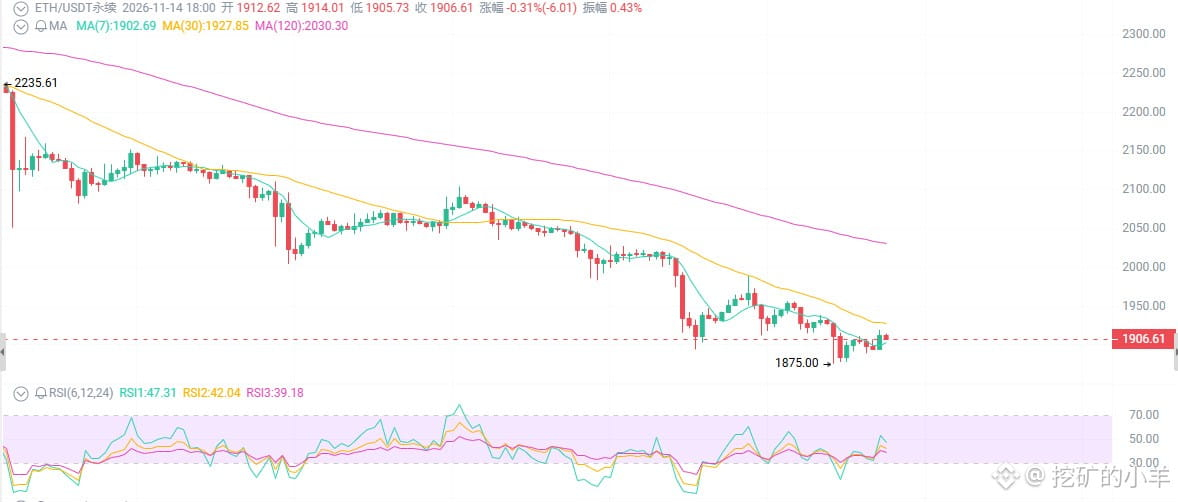
ETH at $1,906—are you panicking?
The RSI has plunged to 23, it's down more than 15% in 7 days, ETFs are seeing outflows, the Foundation is selling, and the upgrade has been delayed—but staked ETH has hit an all-time high, with 43.6 million ETH locked on-chain. Is this the final dip, or just the beginning of the abyss?
First, the surface picture: nothing but bad news.
The price has fallen below $2,000, the “ironclad floor” everyone believed in. It’s now at $1,906. Down 1.5%–4% in 24 hours, over 15% in 7 days, and more than 20% in 30 days. The daily moving averages are bearishly aligned, with the 200-day moving average overhead at above $2,100—a typical weak consolidation after a breakdown from a descending channel.
First thing: everyone is running, but one group isn’t budging.
ETFs are seeing outflows. On November 11, net outflows totaled $145 million in a single day, with cumulative outflows of hundreds of millions over the surrounding days. Wallets linked to the Ethereum Foundation sold around 4,000 ETH in November, 2,000 of which were converted directly into stablecoins.
But staked ETH has hit a record, with 43.6 million–44.5 million ETH locked on-chain, accounting for more than 36% of the total supply. The number of active validators is nearing 800,000.
Short-term money is fleeing in panic; long-term holders are sitting tight.
Second thing: Glamsterdam has been delayed, but this isn’t the first time ETH has been “late.”
Technical issues have cropped up on the upgrade testnet, and there’s no mainnet date yet. Sentiment has definitely taken a hit in the short term—people were counting on the upgrade to spark a rally, but now it’s been postponed.
How many times was ETH’s Merge delayed? How many times was the Shanghai upgrade delayed? Every time, people shouted, “ETH is finished,” and every time, the price had its answer after the upgrade went live.
ETH’s problem has never been that it’s “slow”; it’s “slow, but it won’t die.” L2s are still running, active addresses remain steady, and staking keeps setting records. A one-month delay doesn’t change the underlying fundamentals.
The real problem isn’t ETH itself—it’s the macro environment.
Third thing: macro conditions are draining liquidity, and ETH is hurting more than BTC.
PPI/CPI readings are running hot, expectations of a December Fed rate hike are rising, the dollar is strengthening, and real interest rates are climbing. U.S. AI stocks are wobbling, geopolitical tensions are flaring, and risk-off sentiment is in the driver’s seat.
What kind of asset is ETH? A growth stock, a tech stock, and a high-beta asset. When interest rates rise, it falls harder than BTC. It’s not ETH’s fault; it’s just in its “nature”—it surges harder than BTC on the way up, and suffers more than BTC on the way down.
In a bull market, ETH is your money printer. In a bear market, ETH is your meat grinder. Same coin, two very different lives.
The RSI has plunged to 23, it's down more than 15% in 7 days, ETFs are seeing outflows, the Foundation is selling, and the upgrade has been delayed—but staked ETH has hit an all-time high, with 43.6 million ETH locked on-chain. Is this the final dip, or just the beginning of the abyss?
First, the surface picture: nothing but bad news.
The price has fallen below $2,000, the “ironclad floor” everyone believed in. It’s now at $1,906. Down 1.5%–4% in 24 hours, over 15% in 7 days, and more than 20% in 30 days. The daily moving averages are bearishly aligned, with the 200-day moving average overhead at above $2,100—a typical weak consolidation after a breakdown from a descending channel.
First thing: everyone is running, but one group isn’t budging.
ETFs are seeing outflows. On November 11, net outflows totaled $145 million in a single day, with cumulative outflows of hundreds of millions over the surrounding days. Wallets linked to the Ethereum Foundation sold around 4,000 ETH in November, 2,000 of which were converted directly into stablecoins.
But staked ETH has hit a record, with 43.6 million–44.5 million ETH locked on-chain, accounting for more than 36% of the total supply. The number of active validators is nearing 800,000.
Short-term money is fleeing in panic; long-term holders are sitting tight.
Second thing: Glamsterdam has been delayed, but this isn’t the first time ETH has been “late.”
Technical issues have cropped up on the upgrade testnet, and there’s no mainnet date yet. Sentiment has definitely taken a hit in the short term—people were counting on the upgrade to spark a rally, but now it’s been postponed.
How many times was ETH’s Merge delayed? How many times was the Shanghai upgrade delayed? Every time, people shouted, “ETH is finished,” and every time, the price had its answer after the upgrade went live.
ETH’s problem has never been that it’s “slow”; it’s “slow, but it won’t die.” L2s are still running, active addresses remain steady, and staking keeps setting records. A one-month delay doesn’t change the underlying fundamentals.
The real problem isn’t ETH itself—it’s the macro environment.
Third thing: macro conditions are draining liquidity, and ETH is hurting more than BTC.
PPI/CPI readings are running hot, expectations of a December Fed rate hike are rising, the dollar is strengthening, and real interest rates are climbing. U.S. AI stocks are wobbling, geopolitical tensions are flaring, and risk-off sentiment is in the driver’s seat.
What kind of asset is ETH? A growth stock, a tech stock, and a high-beta asset. When interest rates rise, it falls harder than BTC. It’s not ETH’s fault; it’s just in its “nature”—it surges harder than BTC on the way up, and suffers more than BTC on the way down.
In a bull market, ETH is your money printer. In a bear market, ETH is your meat grinder. Same coin, two very different lives.