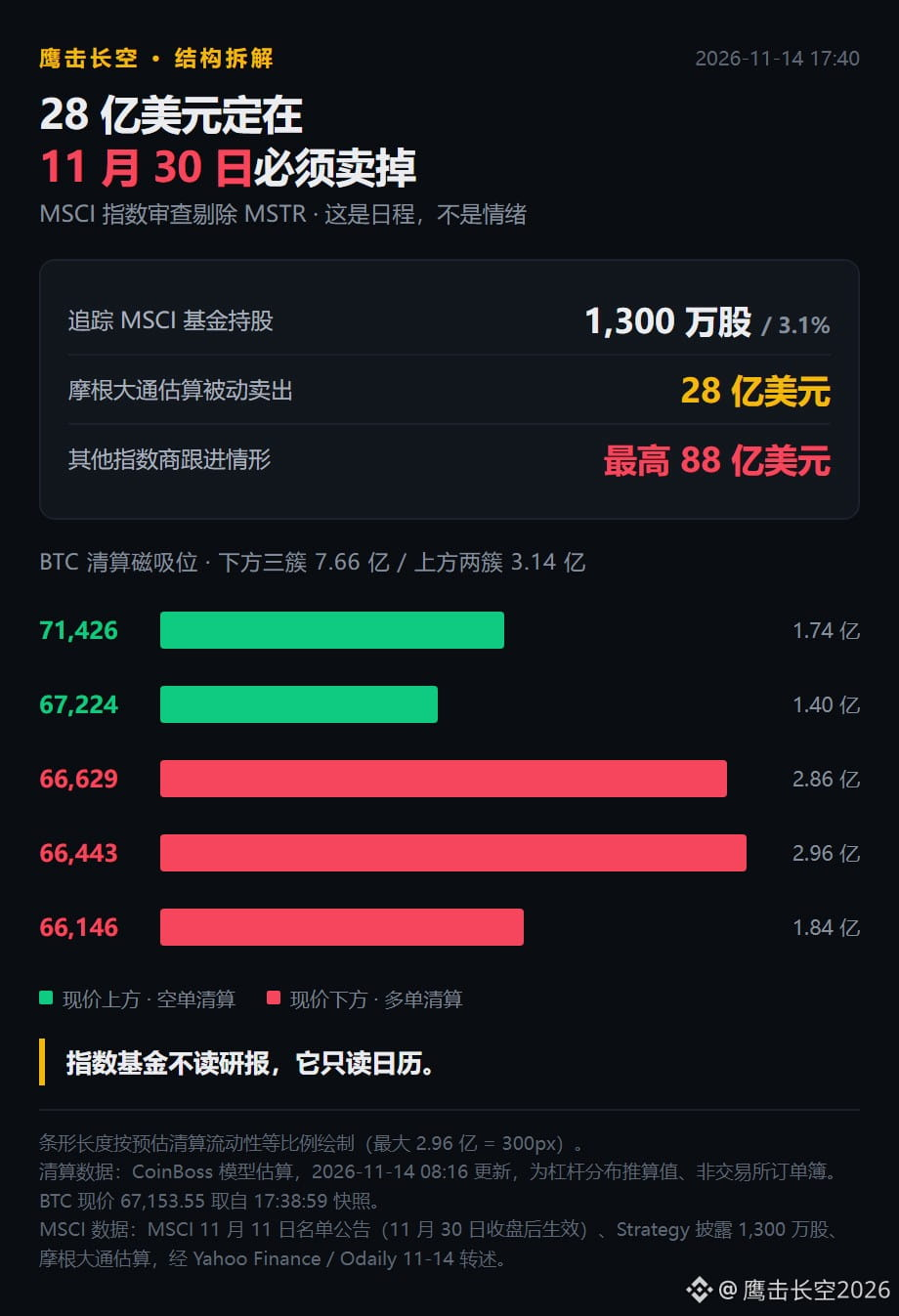
$2.8 billion. Must sell by November 30. Sellers don’t even look at the price.
1
After the close on November 30.
That sentence matters more than every macro analysis today. At the close that day, funds tracking the MSCI indexes have to sell the 13 million MSTR shares they hold—whether $BTC is at $67,000 or $70,000.
So Anthropic isn’t what’s driving the sell-off.
2
Everyone’s talking about Anthropic: $64.4 billion in fundraising, a simultaneous $26 billion private placement, six times oversubscribed, and a November 19 IPO. Then there’s the expectation of a 25-basis-point rate hike on December 9.
Both points are valid, and I wrote the same thing this afternoon. But they don’t explain one thing: over the past six hours, active sellers have already stopped selling.
I calculated active buying volume divided by active selling volume—BTC: 0.907 over 24 hours, 0.992 over the past six; $ETH climbed from 0.966 to 1.066; $SOL went from 0.929 to 1.060; ZEC rose from 0.989 to 1.005. Four of the five coins are back around 1 or above it.
The sellers are gone, but the price hasn’t moved. BTC has bounced just 1.05%, from today’s low of 66,456 to 67,153.
What’s missing isn’t buyers’ willingness—it’s the buyers themselves.
3
On November 11, MSCI announced its index review list. Strategy will be removed from MSCI USA, World, and ACWI, effective after the close on November 30. Japan’s Metaplanet and the UK’s Yellow Cake are also being dropped.
Strategy disclosed that funds tracking MSCI hold about 13 million of its shares, or 3.1% of its basic shares outstanding. JPMorgan estimates passive selling pressure at $2.8 billion; if other index providers follow suit, it could reach $8.8 billion.
Note what this means: it’s not “investors might want to sell”; it’s “funds are contractually required to sell.” Index funds don’t read research reports. They read calendars.
And where does Strategy get the money to buy crypto? By selling common and preferred stock. By October 25, it had raised $21.23 billion. Passive index demand is one of the things supporting its premium. If that premium narrows, its ability to raise money by issuing shares weakens, and its crypto purchases slow down.
The buyer who was always there to catch the falling knife is being crossed off the list.
4
The liquidation map tells the same story.
Below the current price of 67,153: an estimated $296 million in liquidation liquidity at 66,443, $286 million at 66,629, and $184 million at 66,146—three clusters totaling $766 million, all long positions. Above us, there’s only $140 million at 67,224, and another $174 million at 71,426—two clusters totaling $314 million.
$766 million below, $314 million above. To move higher, the market first has to withstand all the landmines below. Every bounce fizzles out at 67,200 because there’s almost nothing above it.
(Estimated by the CoinBoss model, 11-14 08:16; not exchange order-book data.)
5
What would show that I’ve read this wrong? Two things.
First, after November 30, MSTR’s premium to its net asset value doesn’t keep shrinking but instead stabilizes. That would mean other buyers absorbed the passive selling, and this whole thesis would be wrong.
Second, BTC spot’s six-hour taker ratio stays above 1.05 for three consecutive days, and the price closes above 68,290. That would show the buyers haven’t disappeared—they just weren’t around at the time.
If either of these happens, I’ll admit I was wrong and change my view.
6
Here’s my trading log for tonight.
$BTC : if it bounces to 67,682, I’ll open a short in one tranche, with a stop at 68,290. First target is 66,443; if that breaks, 66,187. I’m not catching the $296 million pit at 66,443. Let those who dare try.
$ETH hit a low of 1,878, right on the line I drew this morning. Its six-hour taker ratio of 1.066 is the best of the five, but the funding rate hasn’t budged from +0.004631%. I won’t chase this move. I’ll take another look below 1,855.
$SOL is the worst performer, down 5.39%, with the most negative funding rate at -0.007412%. Shorts are very crowded. But unless it reclaims 76.9, I’m not talking about going long.
I won’t call a direction for BNB. I’ll just give you one number: its six-hour taker ratio is 0.886, and its 24-hour ratio is also 0.886. Completely unchanged. The only coin in the market that hasn’t been bought back.
“Eight hundred li away, we share roasted meat beneath the general’s command; fifty strings play a frontier tune as soldiers are reviewed on the autumn battlefield.” — Xin Qiji’s troops were on the roster, and so are these 13 million shares MSCI has marked for removal.
7
Pick a side: before November 30, does BTC hit the $296 million cluster at 66,443 first, or return to 68,290?
Whether to take this bounce short is up to you. Drop your position size, leverage, and stop-loss in the comments. I’ll pick a few and respond thoughtfully.
For real-time levels and intraday alerts, find me in the comments—Eagle Soars Through the Sky · Crypto Study Group.
Crypto assets are highly volatile. The above is my trading log and does not constitute investment advice. Please make your own decisions and manage your risk.