
🇺🇸THE $39M SHORT SQUEEZE IS NOT A BITCOIN BULL MARKET REVERSAL ₿
📊 US Inflation | Federal Reserve | Bitcoin Liquidity | Institutional Positioning
Date: 14 November 2026
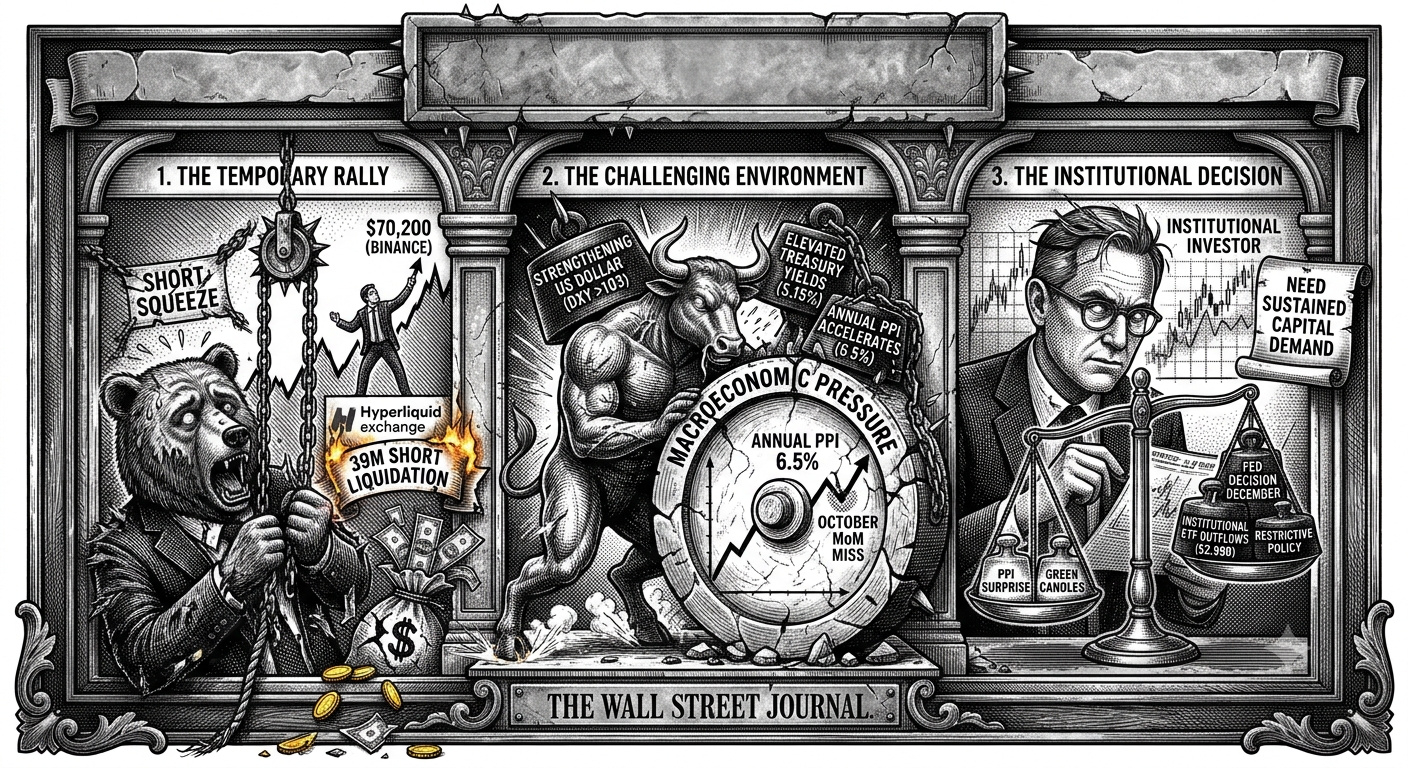
A 0.1 percentage-point inflation miss triggered a Bitcoin rebound, liquidated millions in bearish positions and briefly pushed BTC above $70,200. But the bigger market question remains: HAS THE MACROECONOMIC PRESSURE ACTUALLY CHANGED?
The October US Producer Price Index (PPI) delivered a modest downside surprise. Bitcoin reacted immediately, catching leveraged bears offside and producing a sharp short-covering rally.
However, beneath the green candles, the financial environment remains challenging.
The US dollar is strengthening, Treasury yields are elevated, institutional Bitcoin ETF flows remain negative, and annual producer inflation has reached its highest level since November 2022.
This is where traders need to distinguish between a temporary derivatives-driven rally and a genuine improvement in market fundamentals.
🇺🇸 1. THE PPI NUMBERS — A MISS, BUT NOT AN INFLATION VICTORY
The US Bureau of Labor Statistics released October 2026 PPI data on November 13.
📊 Headline PPI (YoY): 6.5% versus 6.6% expected.
📊 Previous Annual PPI: 6.3%.
📊 Headline PPI (MoM): 0.3% versus 0.4% expected.
📊 Previous Monthly PPI: 1.4% in September, revised.
📊 PPI excluding foods, energy and trade services: 0.5% monthly and 4.9% annually.
The most important detail is that annual producer inflation accelerated to 6.5%, its highest level since November 2022.
The monthly headline reading improved, but underlying producer-price pressure remained persistent.
⚠️ Why this matters:
A softer monthly reading can improve market expectations, but businesses are still facing substantial input-cost pressures.
Furthermore, the report followed hotter-than-expected consumer inflation, making it difficult for investors to conclude that the Federal Reserve has won its inflation battle.
The message is simple:
Inflation momentum improved on a monthly basis, but the broader inflation problem remains unresolved.
₿ 2. BITCOIN'S $70,200 REBOUND — HOW BEARS GOT CAUGHT
The PPI release triggered an immediate reaction in Bitcoin derivatives markets.
Before the release, BTC had traded below $67,600 earlier in the session before recovering toward approximately $69,246.
Following the inflation announcement:
🚀 Bitcoin moved rapidly toward $70,000 within minutes.
🚀 BTC briefly crossed $70,200 on Binance.
💥 Approximately $39.06 million in short positions were liquidated within one hour.
📊 Total crypto liquidations during that hour reached approximately $41.14 million.
This is a classic short squeeze.
When traders borrow assets or use leveraged positions to bet on falling prices, an unexpected upward move can force exchanges to close their positions.
Closing a short requires buying back the asset, potentially creating additional buying pressure.
That means the Bitcoin rebound was supported not only by the inflation headline but also by forced buying from bearish traders.
Important distinction: Liquidations are the notional value of positions forcibly closed, not necessarily the amount of cash traders lost.
🐋 The $52 Million Bitcoin Short — A Warning About Leverage
One particularly interesting position appeared on Hyperliquid.
According to Hyperbot tracking
A trader opened a short position of approximately 750 BTC.
Average entry price was around $69,008.
Notional exposure was approximately $52 million.
Reported liquidation price was around $70,986.
The trader's posted margin was approximately $1.94 million, with leverage reportedly reaching up to 40x.
At Bitcoin's temporary peak above $70,200, the position came within approximately 1.1% of its reported liquidation level.
This illustrates how quickly leveraged positions can approach forced closure during economic announcements.
There is no verified evidence that the trader had advance knowledge of the PPI release.👀
For other traders, the lesson is clear:
A position can be fundamentally correct and still be liquidated because its leverage and liquidation distance are poorly managed.
🏦 3. THE FEDERAL RESERVE — THE BIGGER RISK HAS NOT DISAPPEARED
The PPI surprise may have provided temporary relief, but the broader interest-rate outlook remains restrictive.
The Federal Reserve's current target range is 3.75%–4.00%.
Markets were pricing in at least a 25-basis-point increase for December, with some risk of a larger move.
However, the exact historical CME FedWatch probability split of 84.7% versus 15.3% has not been independently established here. It should not be treated as a verified statistic.
Why does this matter for Bitcoin?
📉 Higher interest rates increase the opportunity cost of holding non-yielding assets.
💵 Tighter financial conditions can reduce speculative capital allocation.
🏦 Institutional investors may prefer yield-bearing instruments over volatile digital assets.
⚠️ A stronger dollar can create additional pressure on dollar-denominated cryptocurrencies.
The PPI report alone cannot determine the Federal Reserve's next decision.
The next CPI, PCE inflation readings and Fed communications will be critical.
💵 4. THE MACROECONOMIC HEADWINDS — WHY THE RELIEF RALLY STRUGGLED
The strongest argument against declaring a Bitcoin recovery is the behaviour of other financial indicators.
💲 US Dollar Index (DXY)
The dollar strengthened above 103.
Available historical data indicates approximately 103.17 on November 12 and 103.41 on November 13.
A stronger dollar can make risk-sensitive assets less attractive and increase pressure on cryptocurrencies.
📈 US 10-Year Treasury Yield
The 10-year Treasury yield reached approximately 5.15% on November 13, up from 5.10% on November 12.
This matters because higher yields can increase the relative attractiveness of traditional fixed-income investments.
For Bitcoin, which does not generate a contractual yield, this creates an additional hurdle for institutional allocation.
🏦 Bitcoin Spot ETF Outflows
Institutional demand is another major concern.
US spot Bitcoin ETFs recorded approximately $2.81 billion in cumulative net outflows from October 30 through November 12.
Including the November 13 outflow of approximately $185.4 million takes the cumulative figure to approximately $2.99 billion.
This is an important warning.
A temporary derivatives-driven rally cannot independently establish that institutional investors are returning.
Price recovery without improving capital flows deserves caution.
🧠 5. MARKET PSYCHOLOGY — THREE DIFFERENT STORIES
🐂 Bullish Traders: Looking for a Liquidity Reversal
Bullish traders believe softer monthly producer inflation could reduce monetary tightening concerns.
They are watching for:
Dollar weakness.
Falling Treasury yields.
Renewed Bitcoin ETF inflows.
Sustainable BTC buying above $70,000.
Their argument is that macroeconomic pressure could gradually ease.
🐻 Bearish Traders: Looking Beyond the PPI Headline
Bearish traders are focusing on:
Annual PPI accelerating to 6.5%.
Elevated Treasury yields.
Stronger dollar conditions.
Persistent institutional ETF outflows.
Their argument is that the relief rally could become another selling opportunity if the macroeconomic environment remains restrictive.
⚖️ Institutional Investors: Waiting for Confirmation
Institutional investors need more than a short squeeze.
They need evidence of sustained capital demand, improving liquidity conditions and a more favourable interest-rate outlook.
My interpretation:
The market has received a temporary sentiment boost, but institutional conviction remains unproven.
🔍 6. WHAT TRADERS SHOULD WATCH NEXT
₿ Bitcoin's $70,000 Level: A sustained reclaim could improve short-term market structure. Repeated rejection would indicate that sellers remain active.
💵 DXY: A sustained decline could provide additional relief to crypto assets.
📈 Treasury Yields: A meaningful decline would strengthen the argument for improving financial conditions.
🏦 ETF Flows: A return to consistent net inflows would provide stronger evidence of institutional demand.
📊 Open Interest: Monitor whether price recovery is accompanied by healthy positioning rather than excessive leverage.
💥 Liquidation Clusters: Watch for crowded positions on both sides of the market. A heavily leveraged market can produce sharp moves in either direction.
🎯 7. STRATEGY FOR CRYPTO EXCHANGE TRADERS AND INVESTORS
For Short-Term Traders
Do not chase every green candle following an economic release.
Watch whether BTC can sustain a recovery above $70,000.
Monitor funding rates and liquidation clusters.
Keep leverage conservative during major economic announcements.
Avoid interpreting forced short covering as organic spot demand.
For Swing Traders
Look for higher highs and higher lows before declaring a trend reversal.
Monitor whether Bitcoin can establish support above reclaimed resistance.
Compare ETH and large-cap altcoin strength against BTC.
Follow ETF flows and dollar movements for confirmation.
For Long-Term Investors
Focus on broader liquidity conditions rather than one-day price movements.
Monitor institutional demand and Federal Reserve policy.
Avoid making portfolio decisions solely on inflation headlines.
Use disciplined position sizing and avoid attempting to identify the exact market bottom.
🏁 FINAL VERDICT — THE PPI MISS EXPLAINED THE SHORT SQUEEZE, NOT A NEW BULL MARKET
US PPI Miss May EAse BTC Pressure is an important macroeconomic development, but its impact needs to be interpreted correctly.
The softer monthly PPI reading gave Bitcoin an opportunity to recover, while bearish traders using excessive leverage were forced to buy back positions.
The resulting $39 million short liquidation event demonstrates how quickly sentiment and positioning can change around economic announcements.
But the underlying risks have not disappeared.
Annual producer inflation remains elevated, the US dollar has strengthened above 103, the 10-year Treasury yield is around 5.15%, and Bitcoin ETF outflows continue to signal institutional caution.
My conclusion as an independent market analyst:
The PPI miss created a trading opportunity for Bitcoin bulls, but it did not establish a fundamental trend reversal.
The next sustainable bullish move will require three important developments:
📉 Improving inflation and a less restrictive Federal Reserve outlook.
💵 Lower dollar strength and easing Treasury yields.
🏦 Renewed institutional demand through sustained spot ETF inflows.
Until these conditions improve, traders should treat sharp Bitcoin rebounds with caution.
A short squeeze can move the market. Institutional capital is what can help sustain the move.
The smartest traders do not simply buy the headline. They understand the liquidity, positioning and macroeconomic forces behind the price.
Manage leverage. Respect the macro. Follow the capital. Trade the liquidity — not the hashtag.