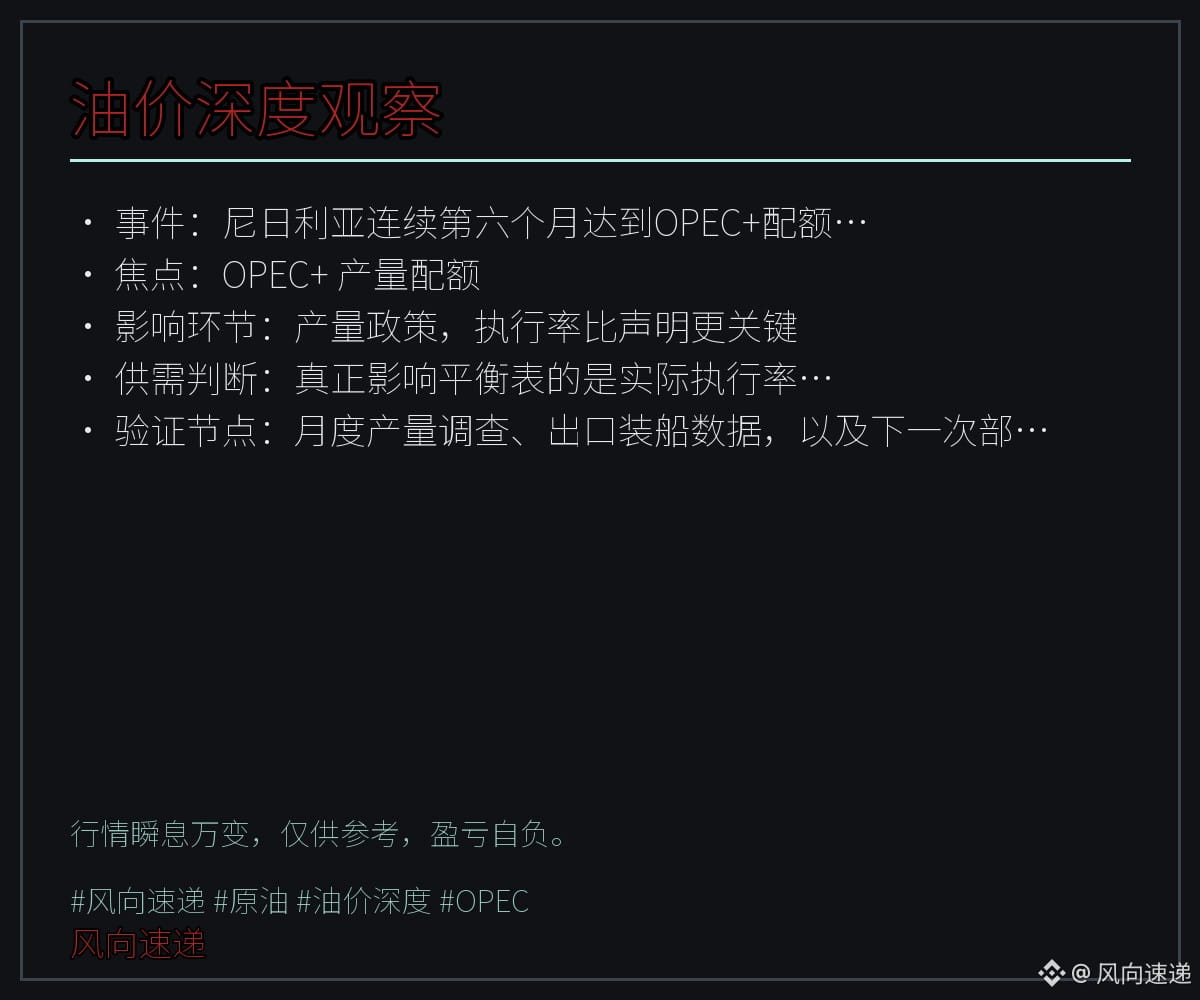
Oil Price Deep Dive
【Key Event】
Nigeria meets its OPEC+ quota for the sixth consecutive month, with average crude oil production of 1.51 million barrels per day - News and Statistics (2 hours ago)
【Who Is Influencing Oil Prices】
OPEC+ signals its production policy. The focus is on OPEC+ production quotas. OPEC+ accounts for about 40% of global output, and its quotas determine the medium-term supply curve. Spare capacity is the main buffer for smoothing sudden supply shortfalls.
【Transmission Mechanism】
Production cuts or extensions of voluntary cuts directly reduce exportable volumes, while production increases lower near-month premiums through expectations of greater future supply.
Policy signals can also alter trade flows: landed price spreads between Asia and Europe move first, with changes feeding back into benchmark oil prices afterward.
【Supply, Demand, and Pricing】
What truly affects the balance sheet is the actual compliance rate; overproduction by member countries can significantly weaken the impact of cut announcements.
WTI is currently trading around $88.56, with a 24-hour change of +0.35%. Price movements are limited, and the market's response has been moderate for now. Further data will be needed to confirm how much of this news has been priced in. Expectations ahead of a meeting are often partially reflected in prices already; the reaction afterward depends on the difference between the decision and expectations.
【What to Watch Next】
Watch monthly production surveys, export loading data, and the timing and messaging of the next ministerial meeting.
【What Would Invalidate This Outlook】
If demand weakens at the same time, the price support from production cuts will be offset by falling demand.
Markets can change rapidly. For reference only; you are responsible for any gains or losses.
#风向速递 #原油 #油价深度 #OPEC