

This is something I’ve been thinking about for a long time. As AI has developed, I believe it has improved cognitive efficiency, not intelligence.
And improving cognitive efficiency requires users to have a certain level of domain knowledge. People with expertise in a particular field can use AI to improve their cognitive and work efficiency. But that doesn’t mean non-experts can use AI to improve their ability to think independently in that field.
If someone relies too heavily on conclusions provided by AI, without actively reasoning, imagining, verifying, reflecting, and questioning for themselves, their judgment may actually deteriorate!
Secondly, although AI improves efficiency and increases our analytical efficiency within a given period, over the long term, it can also increase the total number of underlying errors #英伟达正物色新CEO,谁会接替黄仁勋?
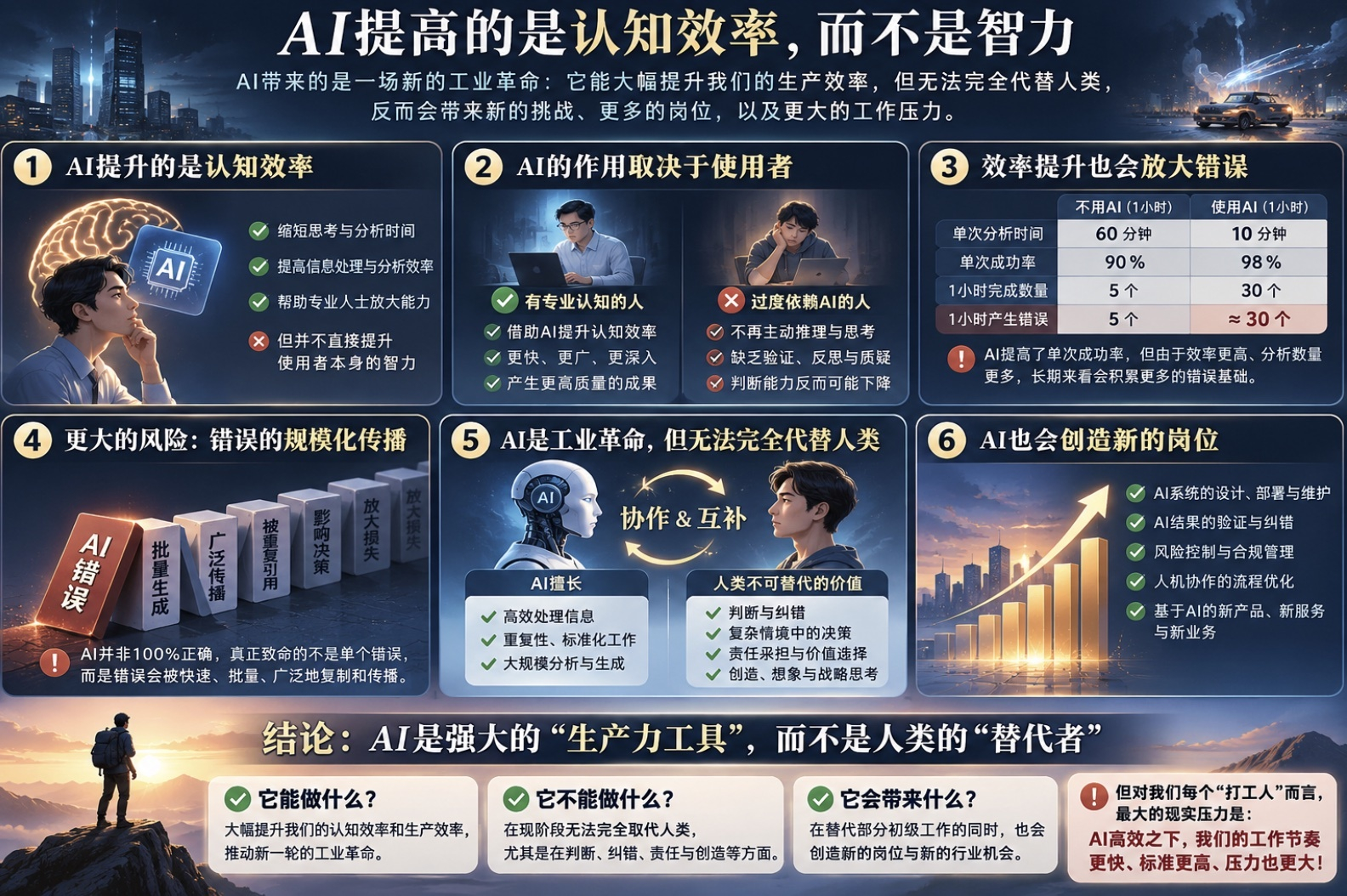
Simply put, I use AI to calculate a problem, reducing the analysis time from one hour to ten minutes and increasing the success rate from 90% to 98%. It does solve the problem.
But if this kind of problem is calculated over a long period, AI's high efficiency means that while five errors might occur in an hour originally, using AI could produce 30 errors in an hour. Over time, these accumulate, leaving more errors at the foundation.
AI is not 100% accurate—that's a misconception many people have. More importantly, AI's errors can spread widely at scale. That's what makes them deadly!
AI is seen as a new industrial revolution for humanity, but it has also made many people anxious about its impact on their industries!
AI replacing humans has become a career nightmare for many “ordinary people.” This is especially true in the early stages of the AI era, when AI replaces a large number of entry-level jobs. In fact, this is also due to people's excessive trust and confidence in AI.
But as time passes, people will realize that AI provides assistance rather than replacement—at least for now. And assistance presupposes that there is a “person” who needs help.
And as AI becomes more widespread and the number of underlying errors grows, how do we identify AI errors? How do we correct them? How do we make adjustments? These questions still need to be answered by “people.”
So, from today's perspective, AI boosts our productivity. It is an industrial revolution, but it cannot completely replace humans. In fact, the increase in AI efficiency may even create more jobs.
Of course, for people like you and me who work for a living, the biggest concern is that our workloads will increase under AI's efficiency!