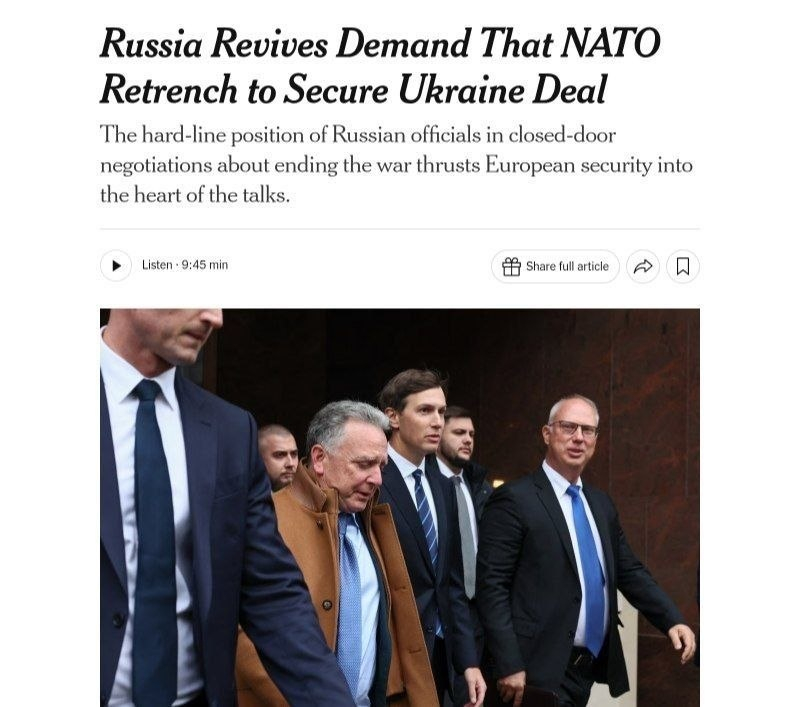
Russia has revived the ultimatum-like demands it made of NATO in late 2021, shortly before its full-scale invasion of Ukraine.
According to The New York Times on November 13, during closed-door talks in Abu Dhabi, Russian representatives circulated a document dated November 10 outlining the Kremlin’s terms for the future structure of European security. Its authenticity was confirmed by two sources familiar with the negotiations.
Among the main demands of the Russian Federation:
▪️ NATO must stop further expansion.
▪️ Withdrawal of the alliance’s troops and military infrastructure to their 1997 positions.
▪️ An end to NATO military activity in Ukraine, Eastern Europe, the South Caucasus and Central Asia.
▪️ A complete halt to the supply of Western weapons and military equipment to Ukraine.
▪️ Restrictions on nuclear deterrence mechanisms: Moscow wants France and the United Kingdom to give up the option of extending nuclear guarantees to other European states.
▪️ The Russian Federation links Ukraine’s potential EU membership to Kyiv giving up participation in the bloc’s common defense policy.
Why 1997?
In 1997, NATO and the Russian Federation signed the Founding Act on Mutual Relations, Cooperation and Security. NATO’s first post-Cold War enlargement took place in 1999, when Poland, the Czech Republic and Hungary joined the alliance.
In the following years, the Baltic states, Bulgaria, Romania and other Central and Eastern European countries joined NATO.
Meeting Moscow’s demand would mean a substantial reduction in NATO’s military presence on its eastern flank, particularly in Poland, Latvia, Lithuania and Estonia.
What is happening in the negotiations?
On November 10–11, the first trilateral talks since February took place in Abu Dhabi, involving Ukraine, the United States and the Russian Federation.
The outcomes were:
• An agreement in principle was reached on a large-scale exchange of prisoners of war — 1,500 people from each side.
• Ukraine’s security guarantees were discussed.
• No breakthrough was made on territorial issues or the postwar security system.
• The parties agreed to continue negotiations with the participation of European representatives.
U.S. representatives Steve Witkoff and Jared Kushner urged Moscow to present new proposals that would include concrete steps by the Russian Federation itself to reduce military tensions.
Polish Prime Minister Donald Tusk has already said that accepting Russia’s terms would pose a direct threat to Poland’s security.
Moscow is trying to turn negotiations on ending its war against Ukraine into a sweeping bargain over the entire European security system.
In effect, this is a return to the Cold War logic of spheres of influence, when major powers set security rules for other countries.
But there is a fundamental difference: Poland, the Baltic states and Ukraine are not objects of geopolitical bargaining, but independent states with the right to determine their own security policies.
The question is not only what concessions Ukraine is willing to make, but also whether the West is prepared to allow the European security system to be revised under pressure from the Kremlin.
#ukraine #NATO #EuropeanSecurity #Geopolitics #russia