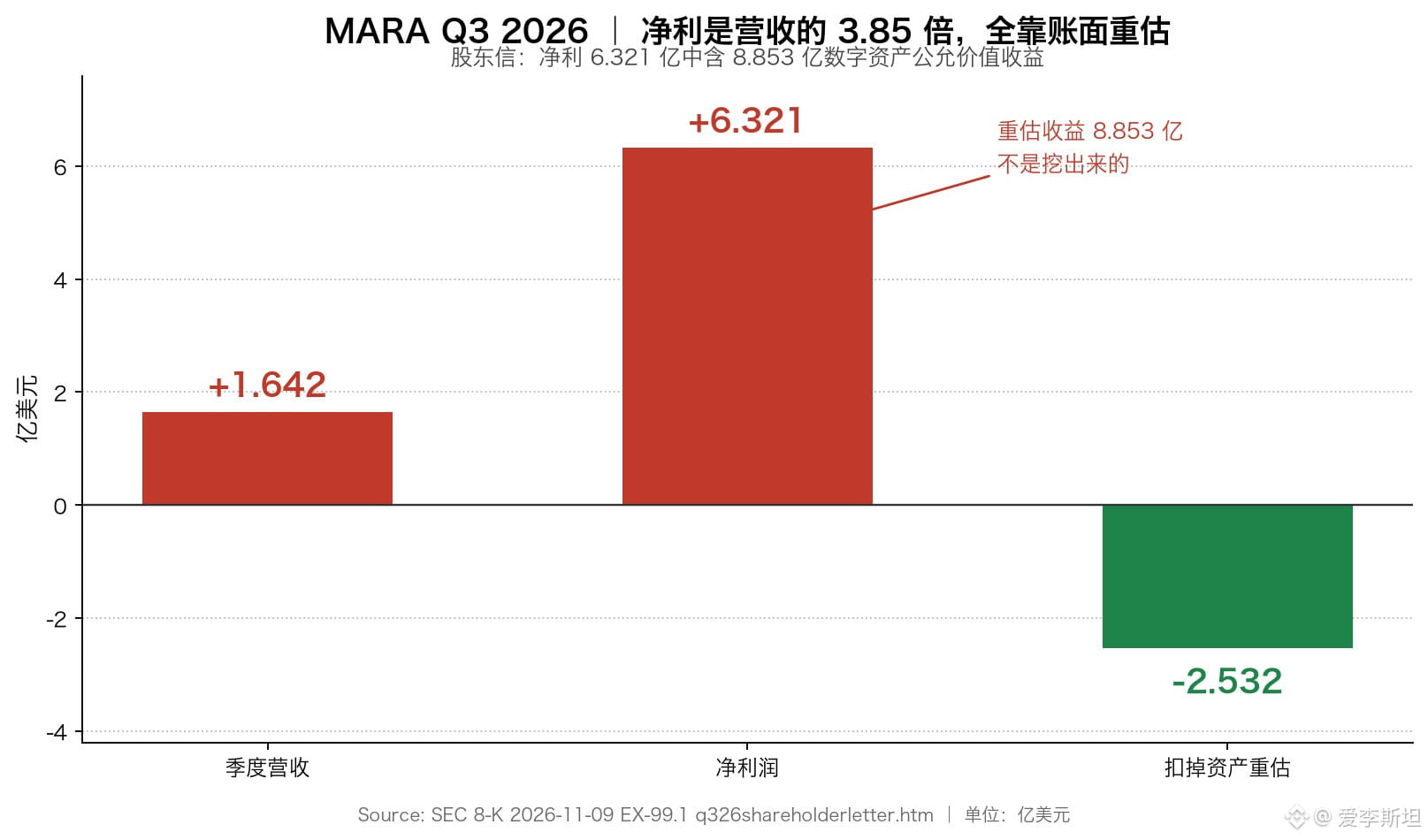
$MARA Third-quarter revenue was $164.2 million, down 35%. Net income was $632.1 million, five times the same period last year.
That fivefold increase didn’t come from mining at all.
It was all on paper.
$885.3 million of net income came from changes in the fair value of digital assets. Excluding that, the company actually lost $253.2 million this quarter.
Mining capacity held up. It rose from 60.4 to 71.2 EH/s, up 18%; the company mined 644 blocks, compared with 633 last year, up 2%. With 18% more machines, why were there only 2% more blocks? The network’s total hashrate is rising too, diluting the company’s share of the blocks it mines. As a result, revenue per terahash is shrinking.
Its share is shrinking.
Costs were fairly steady. Electricity at its self-built sites costs $0.04 per kWh. The power cost per coin was $39,674, only 1.1% more than last year’s $39,235. The average selling price was $75,300, leaving a profit of $35,626 per coin.
But production couldn’t keep up with sales. The company mined 2,247 coins this quarter and sold 3,891, with 34,012 coins still in its holdings. It mined far fewer coins than it sold; the shortfall came out of inventory.
The moves after the quarter were even more drastic. It sold 13,597 coins in one go at $81,039 each, bringing in about $1.1 billion. That money didn’t stay on the balance sheet or go toward expanding production—it went straight into creditors’ pockets.
Not a single coin was kept.
Of that amount, $750 million paid off Bitcoin-backed loans, redeeming 17,477 pledged coins. Since the start of the year, the company has reduced its debt by $1.4 billion, or 37% of total debt.
Holdings and production figures don’t tell us why. Selling coins to pay down debt could be voluntary deleveraging, or it could be a forced margin call. The filing doesn’t say. Another 1,408 coins were put into digital asset management, earning $2.5 million in interest this quarter.
Adjusted EBITDA was $857.7 million, compared with $395.6 million in the same period last year. This measure excludes revaluation gains, so it looks much better—but it still doesn’t reach the net income figure. The difference is depreciation and taxes.
Next, watch two things: approval to connect Matagorda’s 2 GW capacity to the grid, and how much of the $500 million buyback is actually carried out. The former determines whether it remains a mining company; the latter determines what price it pays for its own shares.
The real takeaway is this structure: hashrate is rising, revenue is falling, and profits depend on revaluation.
Any company whose profits are built on asset revaluations will look better on its income statement than in its cash flow.
Because what rises on paper is the price; what rises in your pocket is the money.
$BTC Current price: 66,960, down 2.37% in 24 hours.
Source: https://www.sec.gov/Archives/edgar/data/1507605/000150760526000026/q326shareholderletter.htm
That fivefold increase didn’t come from mining at all.
It was all on paper.
$885.3 million of net income came from changes in the fair value of digital assets. Excluding that, the company actually lost $253.2 million this quarter.
Mining capacity held up. It rose from 60.4 to 71.2 EH/s, up 18%; the company mined 644 blocks, compared with 633 last year, up 2%. With 18% more machines, why were there only 2% more blocks? The network’s total hashrate is rising too, diluting the company’s share of the blocks it mines. As a result, revenue per terahash is shrinking.
Its share is shrinking.
Costs were fairly steady. Electricity at its self-built sites costs $0.04 per kWh. The power cost per coin was $39,674, only 1.1% more than last year’s $39,235. The average selling price was $75,300, leaving a profit of $35,626 per coin.
But production couldn’t keep up with sales. The company mined 2,247 coins this quarter and sold 3,891, with 34,012 coins still in its holdings. It mined far fewer coins than it sold; the shortfall came out of inventory.
The moves after the quarter were even more drastic. It sold 13,597 coins in one go at $81,039 each, bringing in about $1.1 billion. That money didn’t stay on the balance sheet or go toward expanding production—it went straight into creditors’ pockets.
Not a single coin was kept.
Of that amount, $750 million paid off Bitcoin-backed loans, redeeming 17,477 pledged coins. Since the start of the year, the company has reduced its debt by $1.4 billion, or 37% of total debt.
Holdings and production figures don’t tell us why. Selling coins to pay down debt could be voluntary deleveraging, or it could be a forced margin call. The filing doesn’t say. Another 1,408 coins were put into digital asset management, earning $2.5 million in interest this quarter.
Adjusted EBITDA was $857.7 million, compared with $395.6 million in the same period last year. This measure excludes revaluation gains, so it looks much better—but it still doesn’t reach the net income figure. The difference is depreciation and taxes.
Next, watch two things: approval to connect Matagorda’s 2 GW capacity to the grid, and how much of the $500 million buyback is actually carried out. The former determines whether it remains a mining company; the latter determines what price it pays for its own shares.
The real takeaway is this structure: hashrate is rising, revenue is falling, and profits depend on revaluation.
Any company whose profits are built on asset revaluations will look better on its income statement than in its cash flow.
Because what rises on paper is the price; what rises in your pocket is the money.
$BTC Current price: 66,960, down 2.37% in 24 hours.
Source: https://www.sec.gov/Archives/edgar/data/1507605/000150760526000026/q326shareholderletter.htm