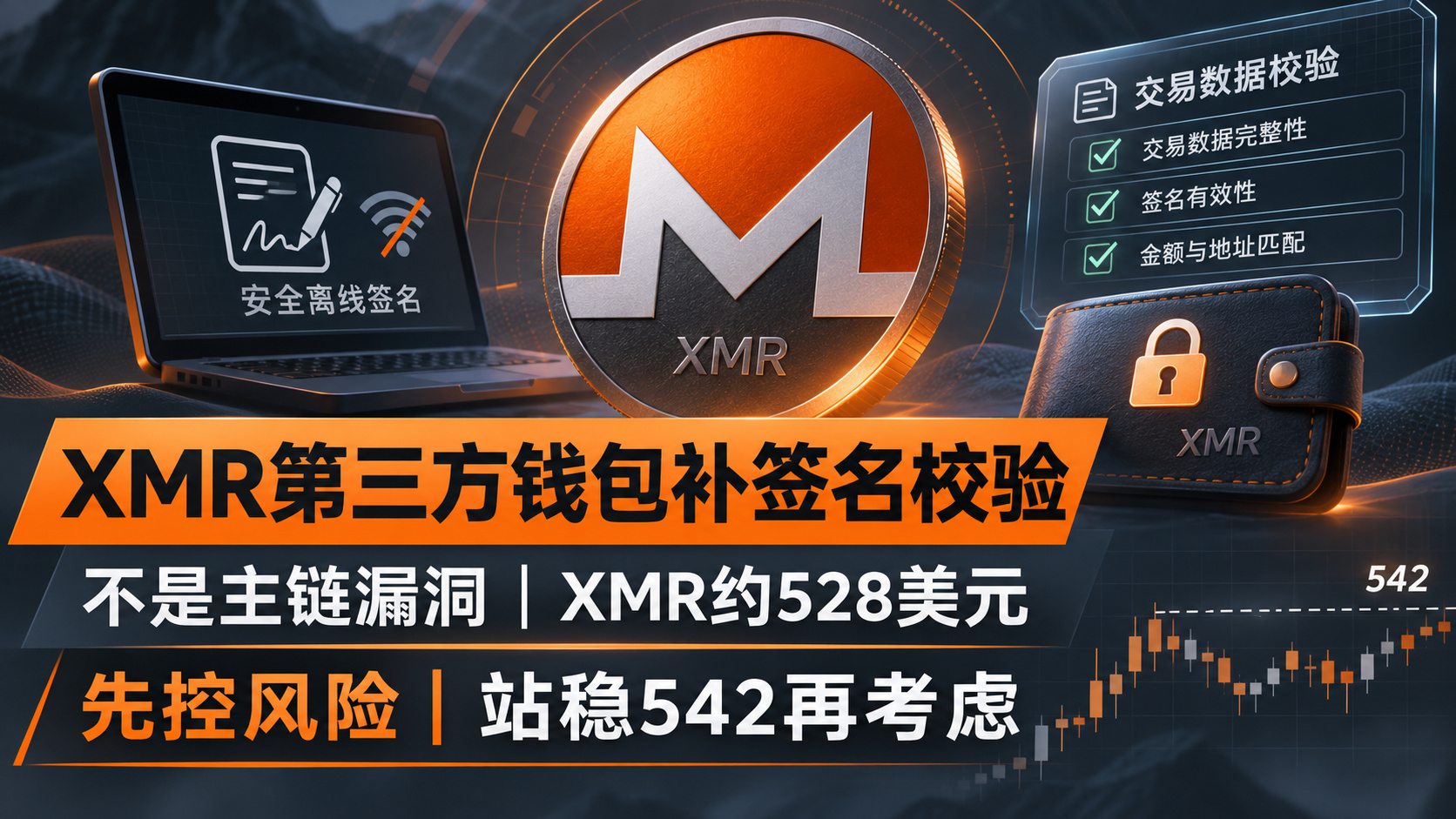
XMR third-party wallet adds signature verification|Does not mean the main chain was compromised|I’m prioritizing risk control
My position is to put asset security ahead of trading opportunities. On November 9, the MMGen Wallet project released v17.0.0. According to the official notes, this version adds transaction data integrity checks to XMR’s offline signing process: verifying that the change address belongs to your own wallet and that the amount and destination shown for the transaction are correct. This is intended to prevent attackers from stealing assets by tampering with transaction data if the online environment has been compromised. The project advised Monero users to upgrade both their online and offline installations, and to manually check the recipient address, amount, and transaction type before signing offline. PyPI’s release history also confirms that version 17.0.0 was released on November 9. The scope matters: this is a fix for the third-party MMGen wallet, not a Monero main-chain consensus vulnerability, and it does not mean every XMR wallet is affected by the same issue. “Could be exploited” also does not mean that large-scale theft has been confirmed.
The direct market impact is not a change in token supply, but rather the cost of use and trust. On-chain transactions in privacy coins are difficult to trace after the fact in the way transactions on transparent ledgers can be, so the information displayed and checked before signing is especially important. If users mistakenly attribute a software-level risk to the main chain, sentiment could worsen; if the wallet is promptly fixed and users adopt the update, the risk could subside. For MMGen users, the first step is to check the version and signature on the project’s official release page, then back up and update. Don’t click on unknown installation packages forwarded in group chats. Those who don’t use this wallet can still treat offline verification of recipient addresses and amounts as a basic precaution.
When I checked Kraken’s XMR/USD market, the price was about $527.74, with a 24-hour range of approximately $500 to $541.38 and a reference opening price of about $528.95. The price remains near the middle of the range and shows no one-way rally; this price action at a single point in time cannot be attributed to a wallet announcement from five days earlier. This round of trending topics on the platform focused on PPI, Bitcoin security, and regulation, with XMR not among the relevant main topics, so I won’t force a connection. More important for trading: after MEXC’s earlier announcement that it would remove XMR-related trading pairs, tradable depth across platforms may change, and quoted prices may differ from execution prices. For now, watch whether the intraday low of $500 holds and whether the $541–$542 upper boundary can be decisively broken.
If I were trading myself, I wouldn’t chase the price right now. I would only consider a small spot long position, with an initial position no larger than 2% of my account funds and no leverage. The entry trigger would be a four-hour close holding above $542, followed by a retest of the $540–$542 range that holds, with normal bid-ask spreads. If there’s no trigger, I stay out. The first target is $560; at that level, I’d sell half and move the stop-loss on the remaining position to breakeven. The second target is $580; at that level, I’d close the entire position. If, after entry, a four-hour candle closes below $520, I’d stop out. If the price first falls below $500, I’d cancel the long plan. If another security incident confirmed by official sources expands in scope, or exchange liquidity suddenly deteriorates, I’d close the position early and reassess. These are all conditions, not realized profits.
Sources: MMGen Wallet’s official v17.0.0 release notes, PyPI release history, and Kraken XMR/USD market data. #XMR
The above is solely my personal market observation and does not constitute investment advice.