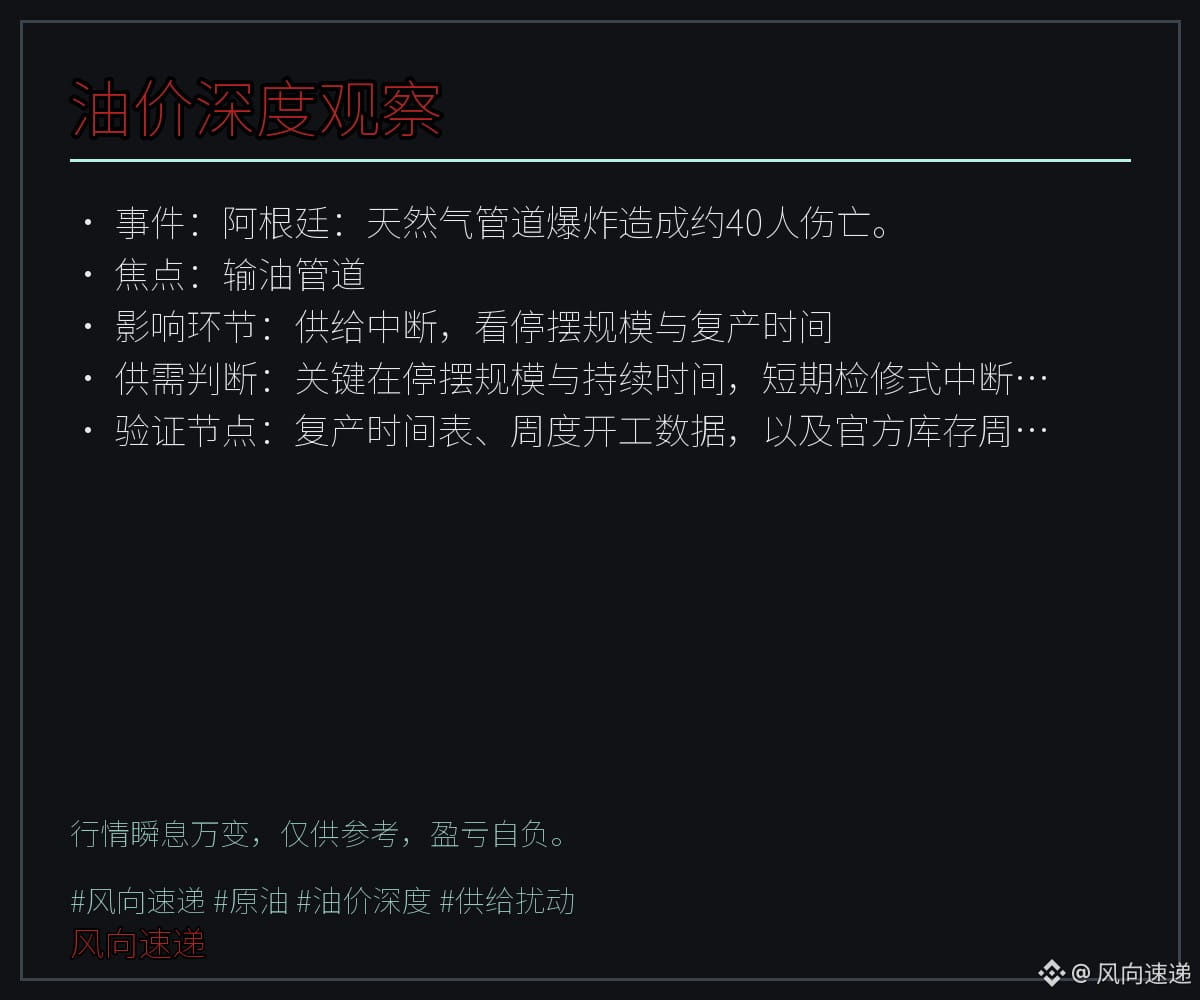
In-Depth Oil Price Watch
【Key Event】
Argentina: A natural gas pipeline explosion caused around 40 casualties. (Within 1 hour)
【Who Is Affecting Oil Prices】
Reports of oil tanker and shipping lane safety incidents. The focus is on oil pipelines. Upstream oil fields, refineries, and export terminals are the three most vulnerable nodes in the supply chain; a shutdown at any one of them will first affect loading schedules.
【Transmission Mechanism】
When an oil pipeline shuts down, it first affects current production and export loadings, then feeds through to spot premiums and discounts via the pace of inventory drawdowns.
Lower refinery throughput also reduces refined product output, and changes in crack spreads often provide signals earlier than absolute crude prices.
【Supply, Demand, and Pricing】
The key factors are the scale and duration of the shutdown. Short-term, maintenance-like disruptions can usually be offset by spare capacity in other producing regions.
WTI is currently trading around $88.92, with a 24-hour change of +0.25%. Price fluctuations are limited, and the market is reacting moderately for now. Further data will be needed to confirm how much of this news has been priced in. Markets often price one-off disruptions only briefly; it is their persistence that determines whether the price floor will move higher.
【What to Watch Next】
Watch for the restart schedule, weekly operating data, and the scale of inventory drawdowns in the official weekly inventory report.
【What Would Invalidate This Thesis】
If production resumes faster than expected, or oil-producing countries release spare capacity to compensate, expectations of a shortfall will quickly narrow.
Markets can change in an instant. For reference only; you are responsible for any gains or losses.
#风向速递 #原油 #油价深度 #SupplyDisruption