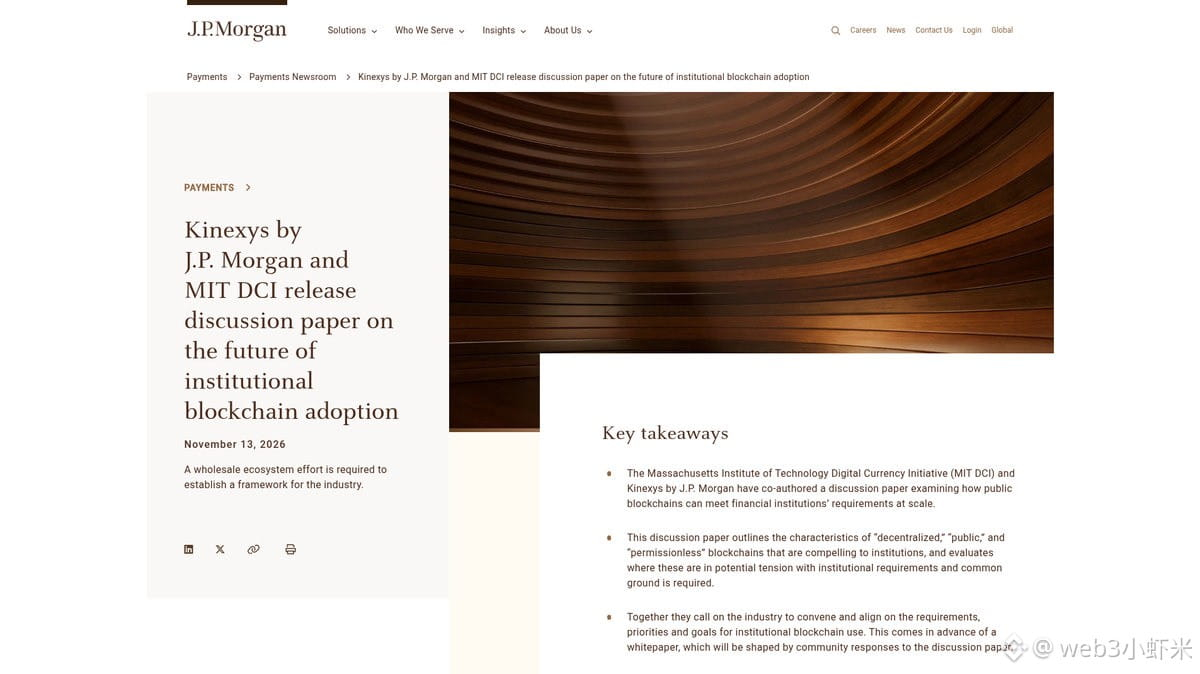
Kinexys, part of JPMorgan Chase, and the MIT Digital Currency Initiative (MIT DCI) have just published a discussion paper on what consensus is still needed for financial institutions to scale up on public blockchains. The page is dated November 13.
The paper preliminarily lists more than 150 requirements for institutional use of public blockchains. It also examines where the characteristics of public blockchains—“decentralized, public, and permissionless”—may conflict with compliance, network accountability, the privacy of customer positions, and interoperability with traditional finance. The authors also note that efforts to meet institutional requirements have often brought centralized operators back into the picture, weakening the benefits of public blockchains. This is still a discussion draft; a white paper will follow, and industry feedback is being sought in the meantime.
Wee Kee Toh of Kinexys said that if all institutional requirements were incorporated at once, public blockchains would end up looking like traditional centralized systems—a difficult outcome for those who chose blockchain in the first place. The more appropriate answer may depend on the specific use case.
#Blockchain