
#sxt $SXT @SpaceandTime From Building a Position in the Live Market to the Official Tech Demo: A Deep Dive into SXT’s Real Strengths and Risks
Taking advantage of this community event, I recently opened a small starter position around 0.00946 to keep an eye on things (as shown). Today, rather than guessing at short-term price moves, I want to talk about why I’m willing to take a chance on SXT at this level, based on its technology and real-world implementation.
In today’s crypto market, any project can slap an “AI + Web3” label on itself. But I’ve always had one question: why would large enterprises trust AI with their core data? Without tamper-proof verification for the underlying data, the results are not only worthless—they could even be disastrous.
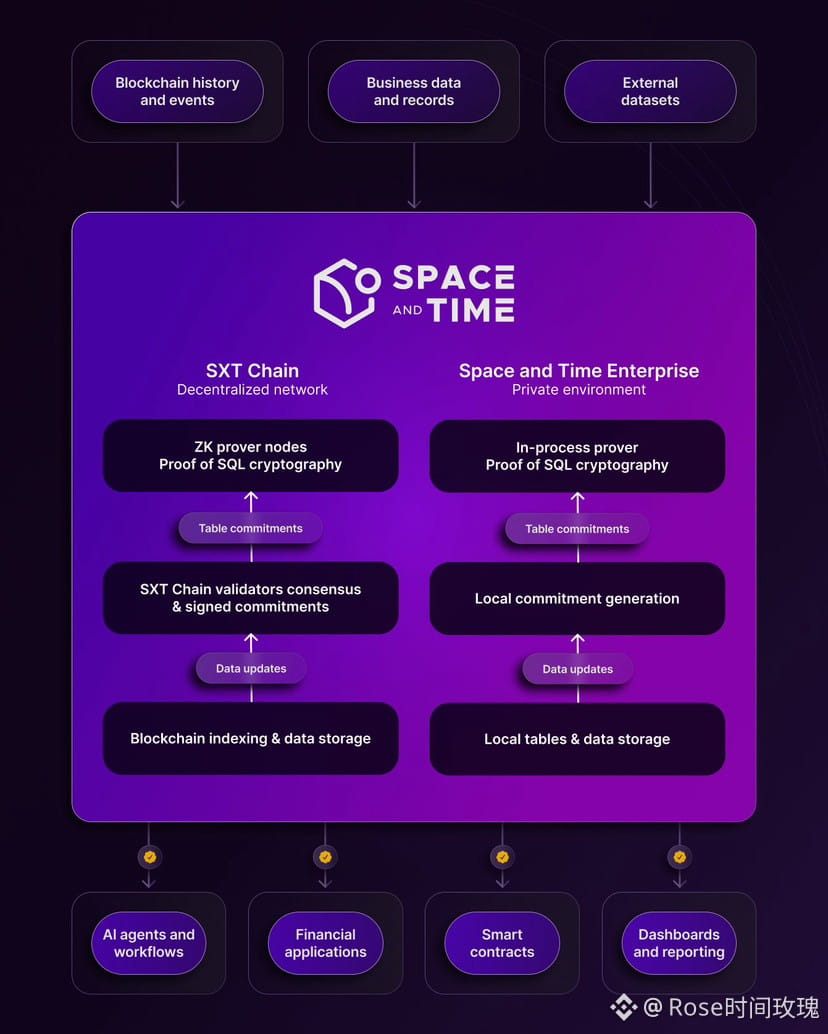
That’s where SXT’s core technology comes in. Its flagship offering, Proof of SQL, can be thought of as stamping every on-chain data query with a “cryptographic seal.” You can see the computation results and use mathematical proofs to verify that they haven’t been tampered with.
What really caught my eye was the technical demo the team recently released. They published a step-by-step tutorial showing developers how to use AI models like Claude to run this technology directly on a private local server.
This is a very smart move. Traditional Wall Street financial giants want to use AI to improve efficiency, but they would never send trade secrets to the public internet. SXT’s model—“process the data locally and only share the verification proof”—perfectly addresses the essential need of large traditional institutions for both efficiency and privacy.
That said, to be objective, even great technology has to face the test of tokenomics.
SXT has a total supply of 5 billion, and the selling pressure from future unlocks shouldn’t be underestimated. Without genuine commercial demand in the ecosystem to absorb the supply, even the strongest technology narrative won’t prevent the price from falling further.
So my strategy is simple: start with a small position as a ticket in and a way to test the waters. If SXT really lands enterprise clients and achieves a viable business model, I’ll add significantly to my position; if the business doesn’t take off, I’ll treat this small position as an experiment. I’m not focused on short-term stories—only the long term.
#SXT $SXT @SpaceandTime