Everyone can see that stablecoins are shrinking, but where they’re shrinking matters much more than how much.
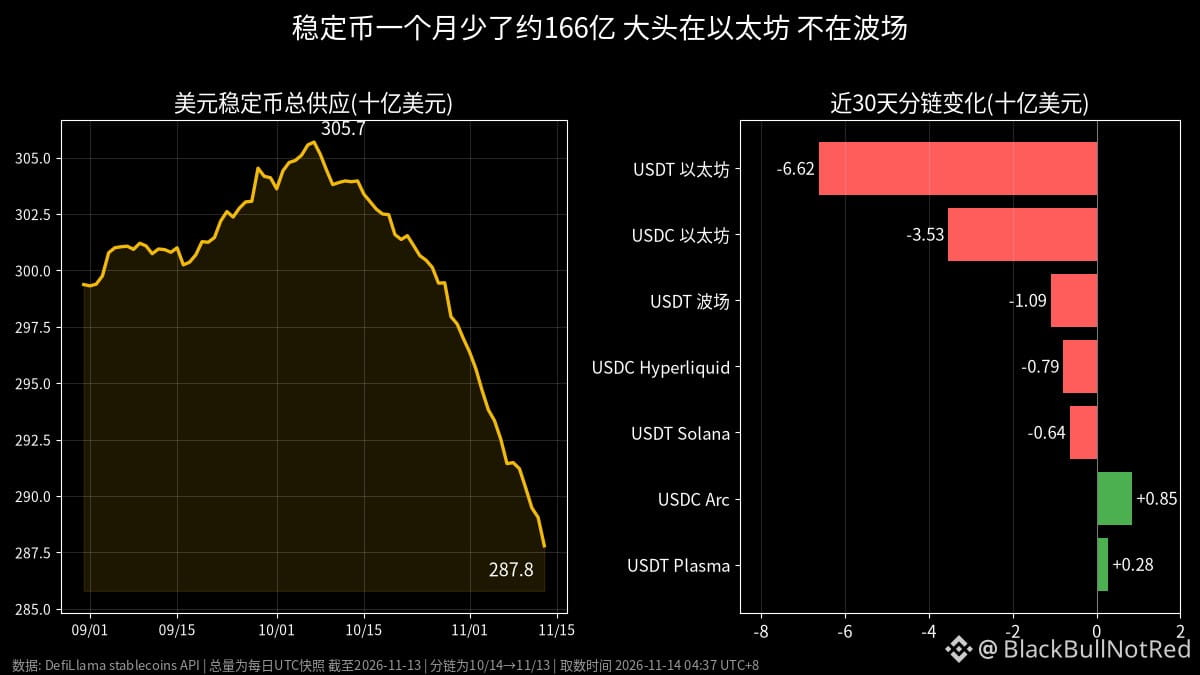
According to DefiLlama, the total supply of dollar stablecoins fell from $305.7 billion on October 7 to $287.8 billion on November 13—a drop of nearly $18 billion in just over a month. By token, the total decrease over the past 30 days was around $16.6 billion. USDT accounted for more than half of that, down over $8.6 billion, while USDC fell by more than $3.8 billion.
The on-chain breakdown gets interesting. Over the past 30 days, USDT on Ethereum fell by $6.6 billion, while on Tron it fell by just $1.1 billion. And there’s $92 billion worth of USDT on Tron, more than the $66.7 billion on Ethereum. It’s a similar story with USDC: down $3.5 billion on Ethereum and nearly $800 million on Hyperliquid.
My read: this doesn’t mean retail users have stopped using U. Tron is mainly used for transfers, cross-border payments, and OTC currency exchange, and activity there is basically holding steady. What’s really seeing outflows is Ethereum—the main institutional and DeFi highway—along with perpetuals margin pools like Hyperliquid. Put simply, leveraged money and big players are redeeming dollars off-chain. That’s exactly what you’d expect in a bear market deleveraging cycle.
Two things not to overinterpret. First, redemptions don’t necessarily mean selling. The money may have been idle U already; redeeming just means withdrawing it, not selling coins. Second, some of the funds are simply moving elsewhere: USDC on Circle’s own Arc chain increased by $850 million, and USDT on Plasma grew by just under $300 million. That’s relocation, not outflows.
The signal worth waiting for is USDT on Ethereum stabilizing and turning upward. That would show that big money is coming back. Whether Tron holds steady is much less significant as a market signal.
#稳定币 #USDT