
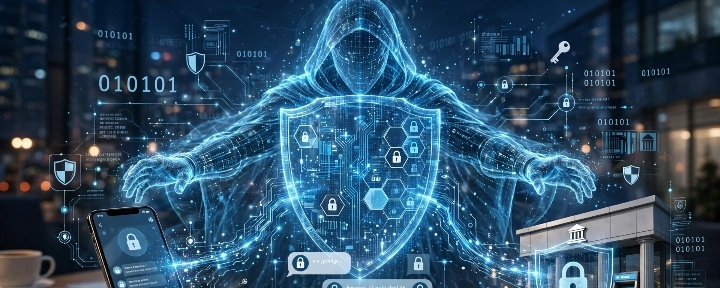
Encryption... the invisible guardian that protects you 100 times a day without you even noticing
Did you know that right now, as you read this article, you're protected by 4 layers of encryption without even realizing it?
And today, since you woke up, you've used encryption more than 100 times without pressing a single button that says "Turn on encryption"?
And your entire life—your money, photos, messages, location, even your heartbeat—is all in one place, protected by one thing you can't see, hear, or touch, called: *encryption*
This isn't a boring technical article. It's an article that will make you look at your phone in a completely different way once you learn that there's an invisible guard standing beside you 24 hours a day, protecting you from thieves, spies, and intruders—even from yourself.
Chapter One: What Is Encryption? The Story of the Box and the Lock
Imagine you want to send your friend a message with a dangerous secret: "I love so-and-so."
But the message will pass through 10 people before it reaches them. Every one of them can read it.
So what do you do?
You put the message in a box, lock it, and give the key only to your friend. The others can see the box and hear something inside, but they can't open it.
That's encryption, simply put: *turning your understandable words into unintelligible words that only someone with the key can understand.*
In the computer world, encryption turns the word "I love you" into something like: `x7$9kL#mP2!vQ8z`
Anyone who sees it thinks it's random, meaningless text. But whoever has the key can turn it back into "I love you."
And that's the secret protecting the whole world today.
Chapter Two: Your Day with Encryption... From Morning to Night
Let's go through your day together and see how many times encryption saves you without you even realizing it:
*6:00 AM: You wake up and unlock your phone with your fingerprint*
Your fingerprint isn't stored as an image on your phone. It's stored in encrypted form in a special chip called the Secure Enclave, which no app can access. Even if someone steals your phone, they can't steal your fingerprint because it's encrypted.
*6:05: You open WhatsApp and send "Good morning" to your mother*
Did you know your WhatsApp message is protected by End-to-End Encryption? That means even WhatsApp itself can't read your message. Only you and your mother can read it. If a hacker intercepts it along the way, they'll see strange, meaningless symbols.
*7:00: You order coffee through an app and pay with your card*
Your card number isn't sent as it is. It's encrypted and turned into a fake number that's used only once. Even if a hacker steals the number, they won't be able to use it again. This is called tokenization, and it's a type of encryption.
*8:00: You go to work and check your email*
When you see `https` at the beginning of a website address, the S means Secure—in other words, encrypted. Everything you type, including every password you enter, is encrypted. No one at the café where you're sitting can steal it, even if they're connected to the same Wi-Fi.
*12:00: You send 500 riyals to your brother in Egypt*
The transfer doesn't go directly. It travels encrypted through five banks. Each bank decrypts part of it and encrypts it again until it reaches your brother. That's why no intermediary bank can see the full amount or know who you are.
*15:00: You watch a movie on Netflix*
The movie is encrypted. You can't copy or download it because Netflix encrypts it and gives a temporary key only to your device, which expires after you watch the movie. That's why no one can easily steal Netflix movies.
*20:00: You go to the hospital, and the doctor measures your blood pressure and pulse*
Your medical report is encrypted and stored in an encrypted cloud. No employee can read it except the doctor treating you, using a special key. If the hospital's database were stolen, the thief would get encrypted files they couldn't read.
*23:00: You go to sleep, and your phone is backing up*
Your photos, messages, and contacts are all uploaded to iCloud or Google Drive, encrypted. Even Apple itself can't see your photos because the key is only on your phone.
In one day, you've used encryption more than 100 times without even realizing it. Encryption is the air you breathe in the digital world. You can't see it, but without it, you'd die.
Chapter Three: The Encryption That Saved the World in Wartime
Encryption is nothing new. It's 2,000 years old.
During World War II, the Germans used a machine called *Enigma* to encrypt their military messages. It was an amazing machine, with 159 million million million possible combinations, and the Germans thought it was impossible for anyone to crack it.
But in England, at a secret place called Bletchley Park, there was a brilliant young man named *Alan Turing*, the father of the computer. He built the first computer in history to crack Enigma's code.
And he succeeded. He cracked the code. The Allies found out where the German submarines would go and where the planes would strike. They saved millions of lives and shortened the war by a full two years.
But after the war, no one honored Turing himself. Instead, they imprisoned him because he was different. He died by suicide at the age of 41, after biting into a poisoned apple. It's said that Apple adopted the bitten-apple logo to honor him.
Encryption saved the world, and killed the man who saved it.
Chapter Four: Encryption in Our Lives Today... 5 Things You Don't Know
*1. Encryption protects your money in the bank*
When you enter your password at an ATM, it doesn't send your password as it is. It sends an encrypted fingerprint of it, called a hash. The bank doesn't know your password; it only knows its fingerprint. So even if a hacker stole the bank's database, they wouldn't know your password.
*2. Encryption protects your location*
When you request a car from Uber or order food, your location is encrypted, and the driver sees your approximate location, not your exact one. They can't know exactly where you live until they get close to you. This protects you from stalkers.
*3. Encryption protects your voice*
When you talk to Siri or Alexa, your voice is encrypted before it's sent to the cloud, decrypted there, and the reply is encrypted again and sent back to you. That's why your neighbor can't hear what you say to Siri, even if they're listening to the Wi-Fi.
*4. Encryption protects your car*
Your new car has more than 100 small computers that communicate with one another using encryption. When you press the unlock button on your remote, it sends an encrypted code that changes each time. That's why a thief can't copy the remote's signal and unlock your car—the code will change the next time.
*5. Encryption even protects the dead*
When someone dies and leaves behind a locked phone, the police can't unlock it, even with a court order, if it's strongly encrypted. In 2016, the FBI asked Apple to unlock a terrorist's phone, and Apple refused, saying: "If we create a back door into encryption, every thief will be able to get in." Apple won the case. Encryption is stronger than the government itself.
Chapter Five: The Coming Threat... The Quantum Computer
But there's a coming threat that frightens every cryptography expert in the world.
It's called: *the Quantum Computer*
A regular computer thinks in terms of 0 or 1. A quantum computer thinks in terms of 0 and 1 at the same time. That means it can try millions of possibilities in the same instant.
The encryption that protects you today relies on the fact that a regular computer needs 100 years to crack it.
A quantum computer can crack it in 10 minutes.
That's why America and China say: "Whoever builds the first powerful quantum computer will be able to crack the encryption of every bank, every military, and every government in the world."
That's why the world is now developing *Post-Quantum Cryptography*—a new kind of encryption that even a quantum computer can't crack.
We're in a race: who will build the strongest lock before the strongest key is made?
Chapter Six: What Does Encryption Mean for You, Here in Riyadh?
It means three things you should understand and put into practice today, before tomorrow:
*First: Your password is your life*
Don't use the same password for every website. If a hacker steals your password from a weak site, they'll use it to access all your accounts. Use a password manager, like 1Password or iCloud Keychain, and have it generate a different, long, secure password for every site.
*Second: Two-factor authentication is your second guard*
Even if a hacker steals your password, they won't be able to log in if you have two-factor authentication (2FA). That means they'll need your phone, too. Turn it on for every account: WhatsApp, email, bank, Binance—everything.
*Third: Don't send your secrets over public Wi-Fi*
When you sit in a café, connect to the free Wi-Fi, and log in to your bank account, you're sending your money out into the street without any protection. Use a VPN or your phone's mobile data, and don't log in to important accounts over public Wi-Fi.
Encryption protects you, but you also have to protect yourself.
Conclusion: The Guard That Never Sleeps
In the end, encryption is like a guard standing in front of your house 24 hours a day. It doesn't sleep, eat, ask for a salary, or complain.
It's what protects your messages to your mother, your money in the bank, photos of your children, the location of your home, and your secret that no one knows.
Without encryption, there would be no internet, no online banking, no WhatsApp, no Bitcoin, and none of the things you use today.
So next time you send a message and see the little lock icon 🔒, remember: that lock is what stands between you and the whole world—between your privacy and chaos.
Respect it. Don't give its key to anyone. Don't send your password to anyone. Don't click on suspicious links.
Because encryption is strong, but humans are the weakest link in encryption.
And here's the final question for you: If you could encrypt one thing in your life so no one could ever see it, even if they stole your phone, what would it be?
---