
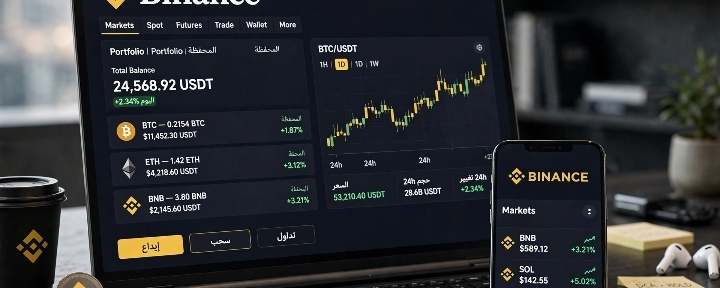

Binance... How did a poor young man who couldn't afford coffee become an empire of digital money?
In 2017, a young Chinese-Canadian man named *Changpeng Zhao*, known as *CZ*, was selling his apartment and everything he owned, betting it all on a crazy idea. All his friends told him: "You'll fail. There's no way you'll succeed."
He had no office, not many employees, and not even a well-known name.
And just 6 months later, his company, *Binance*, had become the biggest cryptocurrency trading platform in the entire world—bigger than Coinbase and bigger than all the digital banks combined.
Seven years later, CZ became the richest man in crypto, with a fortune that peaked at more than $60 billion. Binance was processing more transactions every day than the New York Stock Exchange and Nasdaq combined.
How did this happen? Who is CZ? And why did Binance nearly die 100 times, yet survive?
This isn't the story of a company. It's a story of war, betrayal, prison, and coming back from the dead.
Chapter One: From Burger Flipper to King of Crypto
CZ was born in China into a very poor family. His father was a university professor who was fired for criticizing the government, so the family immigrated to Canada. CZ worked at McDonald's and a gas station, and studied programming at night.
In 2005, he moved to Shanghai and founded a high-speed trading software company, selling its systems to major banks. He was successful, wealthy, and comfortable.
In 2013, while playing poker, he heard about Bitcoin for the first time. His friend told him, "Put 10% of your money into Bitcoin."
So what did CZ do?
He didn't put in 10%. He sold his apartment and spent all the proceeds on Bitcoin, which was priced at $600 at the time. A few months later, Bitcoin crashed to $200. He lost two-thirds of his wealth in one night.
Any ordinary person would have taken their own life or said, "It's over. I'll go back to working at a company."
But CZ said a line that would become his life philosophy: *"If you believe in something, don't be afraid to lose everything for it."*
And he stayed.
In 2017, he decided to build his own platform. At the time, existing platforms were slow and complicated, crashed every day, and took people's money through high fees.
So he said, "I'll build a platform that works like Google: fast, cheap, and never crashes."
He named it *Binance*, combining two words: *Binary + Finance*—meaning "binary money," or digital money.
Chapter Two: Just 6 Months... How Did Binance Take Over the World?
In July 2017, Binance launched its own coin, *BNB*, and raised just $15 million from people. It was a very small amount compared to its competitors.
But CZ did 3 things no one had done before, changing the rules of the game forever:
*1. Insane speed:*
While Coinbase processed 7 transactions per second, Binance processed 1.4 million transactions per second. The difference was like the difference between a horse and a rocket.
*2. Small coins:*
Coinbase listed only 5 coins. Binance listed 100 coins, then 200, then 500. CZ said, "People don't just want Bitcoin; they want to discover the next coin before it becomes famous." So Binance became the place where new coins were born.
*3. No headquarters, no country, no one can shut it down:*
Binance had no headquarters. Its employees worked from 50 countries, from their homes. There was no office a government could raid, and no bank whose accounts it could freeze. It was a ghost company, everywhere and nowhere.
And in January 2018, just 6 months after launching, Binance became *the world's No. 1* by trading volume, with $10 billion in trades per day and 6 million users.
And the company was 6 months old. Just 6 months!
Chapter Three: The Coin That Went from a "Discount Coupon" to a Monster
At first, BNB was just a little coin worth $0.10 that gave you a 50% discount on trading fees on Binance. Nobody cared about it.
But CZ was very clever. He started burning BNB every 3 months. That meant buying a quantity from the market and sending it to an address from which it could never be recovered, reducing the supply and pushing up the price.
Then he launched *BNB Chain*, a blockchain belonging to Binance that was 100 times cheaper and faster than Ethereum. Thousands of apps, games, and coins began running on it.
Then he made BNB the coin for everything: you could use it to pay fees, buy travel tickets, book hotels, and buy coffee.
The result? A coin that started at $0.10 reached $690 in 2021, a 6,900-fold increase. Someone who put in 1,000 riyals at the beginning would have had 6,900,000 riyals.
And in 2025 and 2026, BNB became one of the world's top 5 coins, with a market capitalization exceeding $100 billion. It came to be used for payments and decentralized finance, and even for tokenizing real-world assets.
CZ didn't create a coin. He created an entire economy.
Chapter Four: The Fall... When All of America United Against One Man
But the happy story didn't last.
In 2023, all of America came together against Binance: the Department of Justice, the Securities and Exchange Commission (SEC), the Commodity Futures Trading Commission (CFTC), and the Internal Revenue Service (IRS).
The accusation: Binance had allowed Americans to trade without a license and had not adequately enforced anti-money-laundering laws.
CZ had two choices: flee, as FTX founder Sam Bankman-Fried did—he fled and was then sentenced to 25 years in prison—or face the charges.
So what did CZ do?
In November 2023, he boarded a plane to Seattle, went to court in person, and said, "I am guilty." He pleaded guilty and paid a personal fine of $50 million. Binance paid a $4.3 billion fine, the largest fine in cryptocurrency history.
He resigned as CEO, handed the company over to his friend Richard Teng, and spent 4 months in prison in 2024.
Four months in a California prison, for a man who had been the richest person in crypto.
Many people said, "Binance is finished. CZ is finished. This is the end."
But what happened next was stranger than fiction.
Chapter Five: The Comeback from Prison... Why Didn't Binance Die?
In prison, CZ read, wrote, and thought. When he got out in September 2024, he didn't return to Binance as its CEO, because he was barred from managing it for 3 years. But he returned as an owner, an adviser, and a symbol.
While he was in prison, something happened that no one expected: *Binance didn't collapse—it got stronger.*
Why? Because Binance wasn't just CZ. It was a system. It had 5,000 employees, 250 million users in 180 countries, and more than $100 billion in user funds, backed 1:1 and verified each month in a "Proof of Reserves" report.
When CZ got out, the first thing he did was announce his new project: *Giggle Academy*, a free educational platform for poor children around the world, teaching them math, blockchain, and artificial intelligence at no cost.
In 2025, Binance became the first platform to obtain licenses in Dubai, Abu Dhabi, France, and Bahrain. It also signed a $2 billion investment deal with UAE-based MGX, the largest institutional investment in crypto history.
In 2026, Binance became the platform processing more than 50% of all cryptocurrency trades worldwide. It had more than 280 million users and was launching new products: a Web3 wallet, stablecoin payments, a Binance Card, and an asset-tokenization service.
Who would have thought that a company fined $4.3 billion, whose founder went to prison, would come back stronger?
That is the lesson of Binance.
Chapter Six: What Makes Binance Different from All the Other Platforms?
There are 600 trading platforms in the world. Why is Binance the only one to have succeeded like this?
The answer lies in 5 secrets, known only to those who have tried it:
*1. Liquidity:* If you want to sell $10 million worth of Bitcoin on a small platform, the price will crash. On Binance, you can sell it in a second without moving the price, because millions of buyers and sellers are there at the same time.
*2. Fees:* Binance charges 0.1%, among the lowest fees in the world. If you pay with BNB, it drops to 0.075%. Banks charge you 3% for a transfer; Binance charges you 0.1%.
*3. Security:* Binance has a fund called *SAFU*. It's an emergency fund with more than $1 billion of the company's own money, used to reimburse users if there's a hack. In 2019, when a hacker stole $40 million from Binance, Binance reimbursed all affected users from the SAFU fund, and no one lost a single riyal.
*4. Education:* Binance Academy is the world's largest free school for crypto, available in 30 languages, including Arabic. It teaches you everything from scratch, for free.
*5. Constant innovation:* Binance never sleeps. Every month it launches a new product: futures, copy trading, loans, a card, a wallet, NFTs, stablecoins, tokenization.
Binance isn't a platform. Binance is an entire city.
Conclusion: Is Binance the future, or will it die like the others?
In the world of crypto, giant companies have died: Mt. Gox, FTX, Celsius, and Luna. They all said, "We're the strongest," then died overnight.
So why did Binance survive?
The answer CZ always gives: *"Companies don't die because of competitors. They die because they forget their users."*
Binance survived because in every crisis, it put users first. When the market crashed, it didn't suspend withdrawals. When a hacker stole money, it reimbursed people. When America fined it, it paid up and didn't run away.
Will Binance last another 10 years? No one knows. But what we know today is this: Binance changed the shape of money, changed the way people trade, and changed the lives of 280 million people.
And it all started with a young man who sold his apartment, bought Bitcoin, lost two-thirds of his money, and didn't give up.
So if you're thinking about starting something today and are afraid of failing, remember CZ.
Remember that the greatest financial empire of the 21st century began in a small room, with an idea everyone called "impossible."
---