


Have you ever wondered why you don’t get a fee discount when swapping tokens on an on-chain DEX? After all, you use the same old address every time.
The reason is pretty down-to-earth: smart contracts only handle the state of your “current” transaction. They can’t see your previous interactions or look back at your transaction history from months ago. What if, instead, the project team used off-chain servers to pull the data, calculate everything, and then send the list back on-chain? People wouldn’t trust that either—who knows if someone behind the scenes might secretly alter the data or slip in their own picks?
@SpaceandTime This is exactly the knot that needed to be tackled head-on.
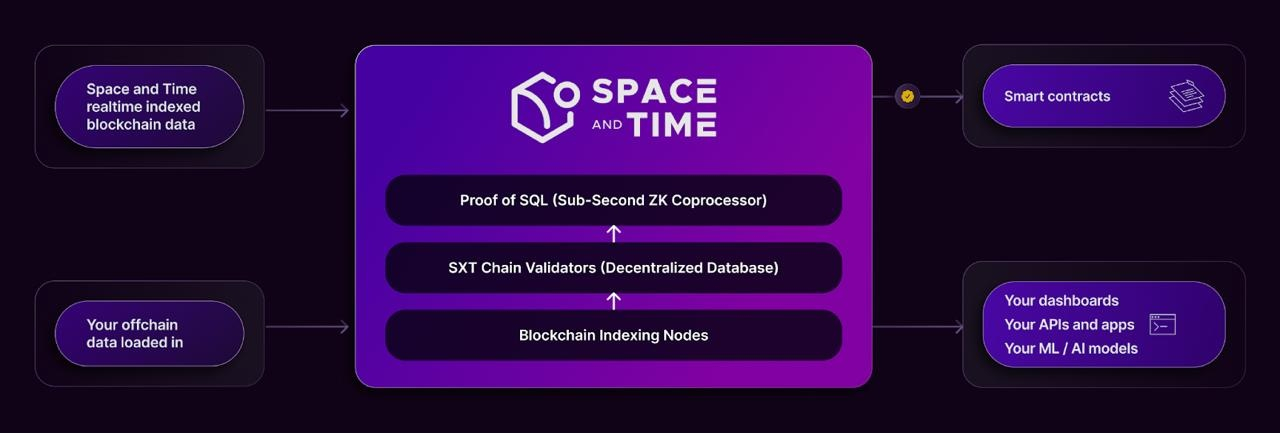
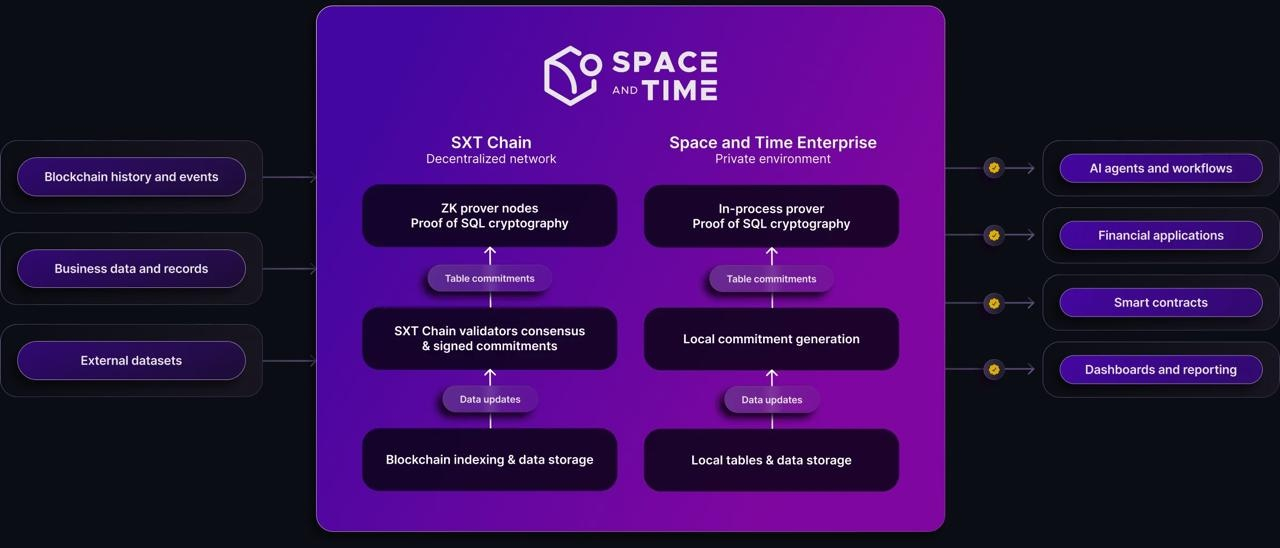
The process is straightforward: first, historical transaction data from various public blockchains and custom off-chain data tables are synchronized to the network. At the validator level, cryptographic commitments are attached to the underlying tables, effectively sealing the original ledgers with a tamper-proof foundation. Then, when you swap tokens in a pool with discount rules, such as Uniswap Hooks, the app queries the network directly for your address's past transaction records. As the prover nodes execute the query, they also generate a zero-knowledge proof and return it alongside the results to the smart contract. The contract doesn't need to dig through months of old blocks itself; it only needs to verify the proof to confirm that the underlying tables haven't been tampered with and the calculations are correct, then automatically apply your fee discount on the spot.
At this point, many people may be wondering: haven't tools for querying on-chain data, such as Dune and The Graph, and price-feeding oracles been around for a long time? What exactly sets Space and Time apart?
Breaking down why Microsoft's venture capital arm, M12, backed it, its core strength is really bringing together three things that others can't easily combine:
First: queried data comes with a “tamper-proof receipt” that smart contracts can confidently use to move funds.
When we use Dune to query historical data, the results are just charts and dashboards for people to look at. Smart contracts can't safely trust them—if a centralized indexing node changes a number, the contract has no way to detect it. Space and Time, however, uses its proprietary Proof of SQL technology to attach a zero-knowledge proof to every database query result. Put simply, after querying the data, others can only ask you to “trust me, I didn't cheat.” Space and Time puts a cryptographic receipt right in front of the contract, so the contract can verify it for itself.
Second: unlike traditional oracles, which only feed “one-off price quotes,” it can crunch complex datasets in a second.
Traditional oracles are good at relaying existing public price quotes (such as the current price of ETH). But ask one to aggregate thousands of interactions from an address across several chains over the past three months, or combine historical records from multiple pools, and it can't handle the computation. Space and Time is essentially a data warehouse with a zero-knowledge proof coprocessor, built specifically for heavy-duty data queries and aggregation—and it has brought proof generation for millions of rows of data down to sub-second speeds.
Third: it can combine “public on-chain records” with “confidential off-chain institutional ledgers” without exposing the underlying business data.
Traditional financial institutions have a concern when putting assets on-chain: they don't want to expose their underlying holdings and business transactions for everyone to see, but they still need to prove to the outside world that their books aren't fabricated. Space and Time Mainnet v2 supports custom off-chain data tables, allowing institutions to prove on-chain that “this calculation was indeed run on data backed by real commitments” without exposing the original private data underneath.
Once you understand these three features, it's much easier to see how its role in providing verifiable data for AI, tokenization, and DeFi translates into practical applications:
- In DeFi: Beyond the previously mentioned use cases—DEX pools automatically checking historical records to offer fee discounts to returning addresses, and protocols distributing rewards transparently—on-chain merchants could also automatically verify the transaction volumes of past customers, and we could directly retrieve historical contract information with proof attached.
- In tokenized assets (RWA): Whether verifying the holdings and cash flow calculations behind a fund's net asset value (NAV) report, or combining activity for a tokenized stock spread across multiple liquidity pools to calculate a unified trading volume, the accounting can be done off-chain and verified on-chain.
- In AI agents: The industry is now giving AI agents wallets so they can trade automatically. But before an agent rebalances its portfolio or enters a protocol, it needs to know how much the protocol actually collected in fees over a given period and what its historical activity looked like. With query results backed by proofs, agents won't be misled by fake data returned by black-box APIs.
As for how the whole network operates, $SXT

also has a clear role: it is used to pay for data queries and computational workloads on the network, while validator nodes stake $SXT to secure the entire data network, completing the cycle between the supply and demand for data verification.
On-chain infrastructure has long been focused on making transfers faster. But going forward, whether it's institutions putting assets on-chain or AI managing money on people's behalf, the real bottleneck will come down to the same question: **How can we accurately account for historical on-chain and off-chain records without blindly trusting anyone?** Taking on this difficult work and doing it thoroughly is what makes Space and Time truly stand out. #SXT
Disclaimer: Purchasing SXT involves risk. We recommend doing your own research and seeking professional advice before purchasing SXT or any other cryptocurrency.